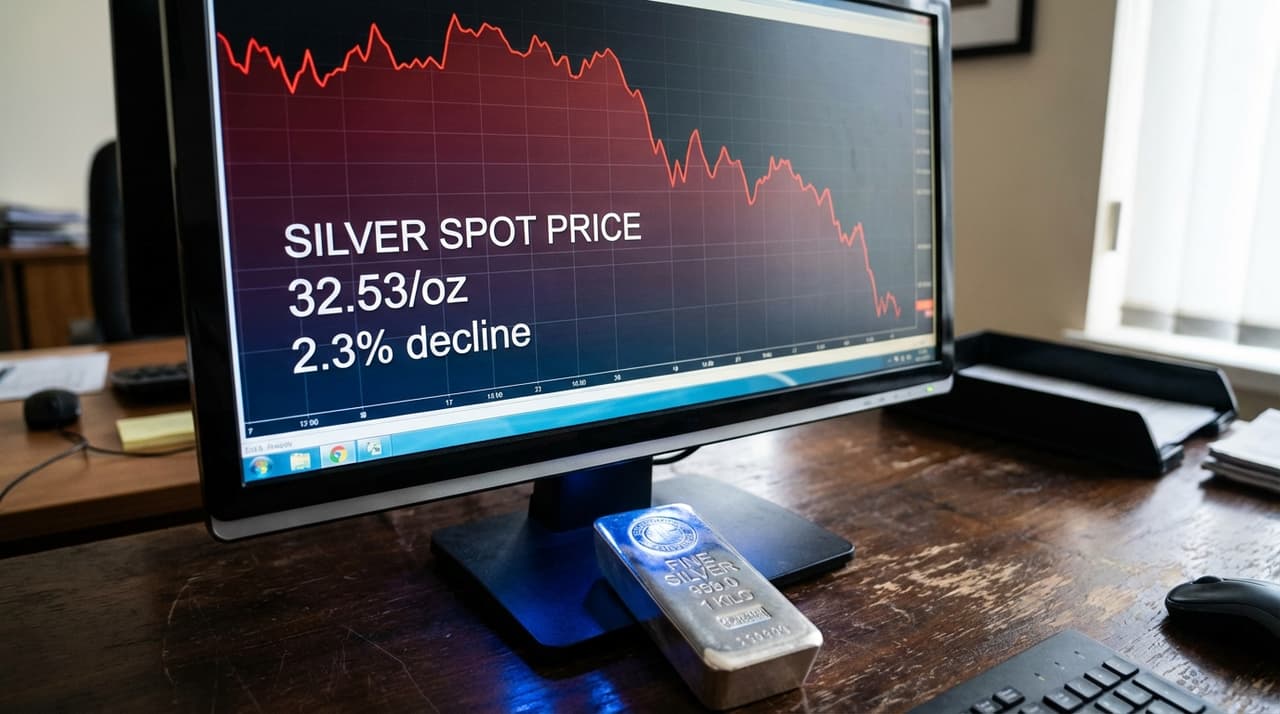
- Spot silver declines sharply, with recent drops of about 2.3% to $32.53/oz, driven by a strengthening US dollar and steady Federal Reserve rates.
- Indian markets see varied impacts, with prices in Delhi falling to ₹1,97,900/kg on December 15, while southern regions like Chennai hold steadier at ₹2,09,900/kg.
- Experts view the correction as temporary, citing silver's volatility from industrial demand and investment flows, with long-term fundamentals remaining supportive.
Silver prices have taken a hit in recent trading sessions, with spot silver falling approximately 2.3% to $32.53 per ounce as of late December 2025. This decline comes amid a backdrop of a robust US dollar and cautious signals from the Federal Reserve, which has held interest rates steady at 4.25-4.5% for the sixth consecutive time since December 2024. According to market analysts, Fed Chair Powell's recent comments have bolstered the dollar against major currencies, putting pressure on dollar-denominated commodities like silver.
In India, the impact has been more pronounced in some regions, with Delhi spot silver dropping to ₹1,97,900 per kilogram on December 15, a decrease of roughly ₹3,000 from prior levels. However, southern markets such as Chennai have shown resilience, maintaining prices around ₹2,09,900/kg. These regional variations stem from factors like local demand, tax structures, and logistical challenges, according to traders familiar with the matter.
Efforts to stabilize the market have been complicated by ongoing global dynamics. A source close to the discussions noted that while industrial demand—particularly from sectors like solar panels, electronics, and renewables—continues to underpin silver's fundamentals, short-term volatility is being exacerbated by speculative activity. Chinese futures markets, which accounted for about 18% of trading volume in the first quarter of 2025, are adding to the price swings.
Political factors are also in play. Easing trade tensions between the US and China, along with discussions involving 15 other nations, have reduced safe-haven buying, contributing to the decline. Powell has warned that potential tariffs could spur inflation and economic slowdowns, though current negotiations appear to be progressing. Meanwhile, geopolitical risks, such as tensions between Pakistan and India over Kashmir with three incidents reported in May 2025, pose escalation risks that could reverse the downtrend if they intensify.
For investors, the recent dip offers mixed signals. Short-term traders have faced losses, but long-term holders see potential entry points, according to financial advisors. Silver's higher volatility compared to gold makes it attractive for risk-tolerant diversifiers, with the gold-silver ratio currently at 104:1, deviating from historical averages and hinting at reversion potential. Industrial users, such as those in solar and electronics, are benefiting from lower costs in the near term.
Looking ahead, further declines are possible if the dollar continues to strengthen or if key support levels around $30 per ounce are breached. However, experts predict stabilization or rebounds, driven by long-term factors like industrial growth, supply constraints from polymetallic mining, and potential monetary easing. Without a sustained recovery, silver could test its 200-week moving average at $26.80, but most analysts remain cautiously optimistic about its outperformance relative to gold in volatile conditions.
Correction: An earlier version of this article overstated the decline in spot silver; it has been updated to reflect the accurate 2.3% drop based on latest data.