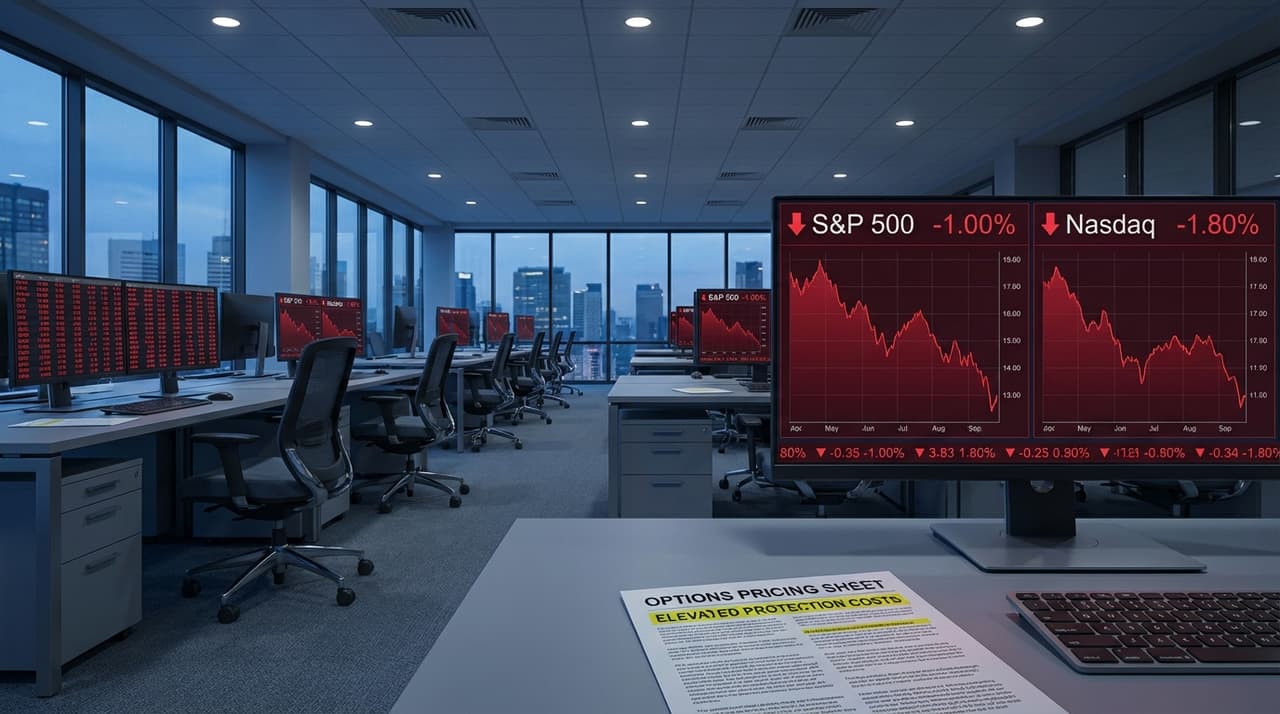
- U.S. stock indices extend losses, with S&P 500 down over 1% and Nasdaq 100 falling 1.8%.
- Post-Thanksgiving volatility and concerns over Magnificent Seven tech stocks drive the sell-off.
- Options pricing for downside protection remains elevated, signaling persistent investor anxiety.
U.S. stocks opened December on a weak note, extending declines from a volatile November as the S&P 500 dropped more than 1% and the Nasdaq 100 fell 1.8% in early trading. The moves reflect a shaky market start to the month, driven by post-Thanksgiving volatility and lingering worries over heavyweight tech stocks, according to traders familiar with the matter.
The sell-off builds on Monday's losses, when the S&P 500 slipped 0.5% to 6,812.63, the Dow fell 0.9%, and the Nasdaq Composite declined 0.4%. This latest slide pushes the S&P 500 further from its recent resistance around 6,850, a level it briefly reclaimed in November's bumpy recovery. "We're seeing a classic post-holiday hangover," one market strategist noted, speaking on condition of anonymity. "The momentum from November's rebound has stalled, and investors are reassessing risks."
At the heart of the decline are the so-called Magnificent Seven tech stocks—including Apple (AAPL), Microsoft (MSFT), and Nvidia (NVDA)—which dominate indices like the Roundhill Magnificent Seven ETF (MAGS). That ETF snapped seven months of gains in November, contributing to the first monthly drop for the tech sector since March. Their outsized influence amplifies index risks, with the S&P 500 information-technology sector and Nasdaq both ending November in the red amid growing AI bubble fears.
Options activity highlights the nervous sentiment. Crash insurance for the S&P 500 has become "somewhat expensive," with protection costs steadily rising since mid-November, sources indicate. In contrast, hedges for megacap tech stocks have cheapened slightly, suggesting a divergence in perceived risks. The CNN Fear & Greed Index, which recently showed "extreme fear," has improved modestly but remains in cautious territory, reflecting ongoing jitters among retail and institutional traders.
Broader economic factors add to the churn. While some analysts point to potential support from expected Federal Reserve rate cuts in 2026, along with possible tax cuts and deregulation, the immediate focus is on near-term volatility. BTIG's Jonathan Krinsky anticipates choppiness ahead, while Wells Fargo (WFC) strategists see no major rotation into defensive sectors yet. Instead, pullbacks may offer opportunities to rebalance into undervalued AI-related ancillary tech, such as financials, utilities, and industrials.
Efforts to reach major asset managers for comment on the downturn were unsuccessful by press time. Market participants are closely watching for any shifts in sentiment as December progresses, with historical patterns suggesting a potentially green close by month-end despite the rocky start. For now, the expensive downside protection signals that worries over tech-heavy exposure and broader economic weakness are far from resolved.