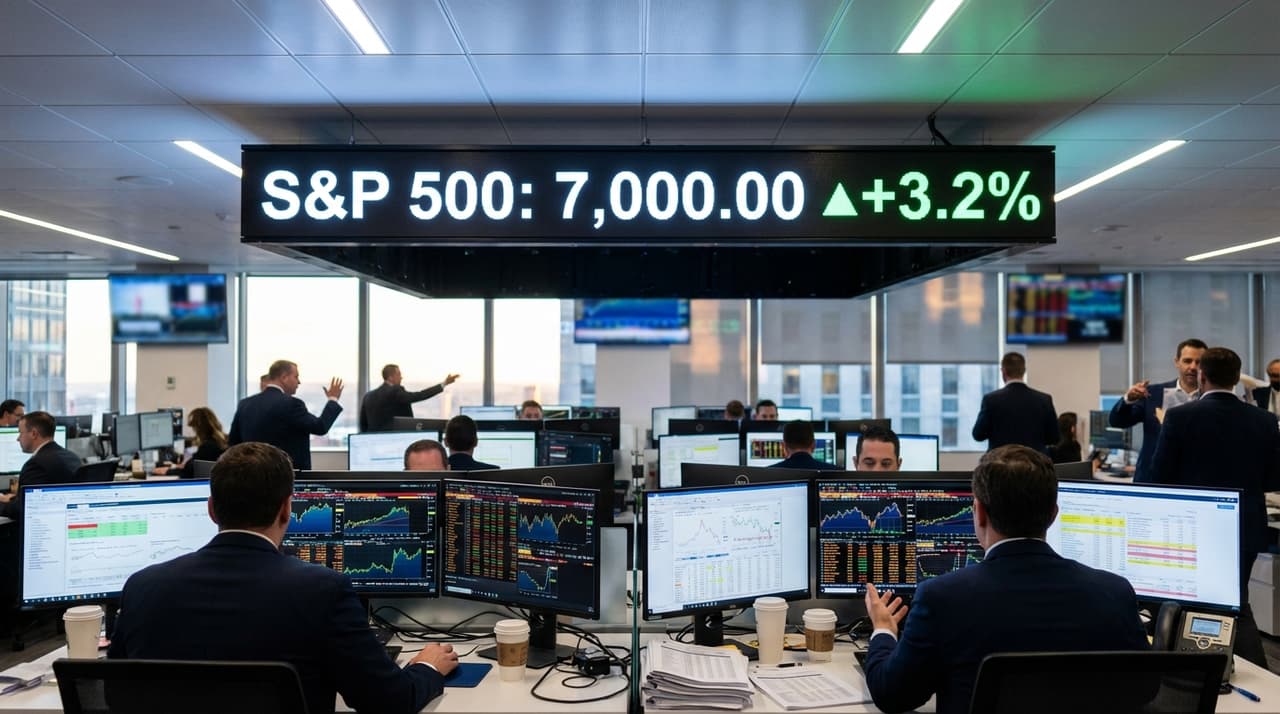
- The S&P 500 closed above 7,000 for the first time on January 28, 2026, extending a five-session rally and marking its fourth record high of the year.
- Strong corporate earnings, particularly in tech and semiconductors, alongside AI-driven capital expenditures and pro-business policies from the Trump administration, fueled the surge.
- Despite the milestone, consumer confidence has plunged to its lowest level since 2014, highlighting a disconnect between market exuberance and economic anxieties on the ground.
A Historic Close Amid Earnings Strength
The S&P 500 index breached the psychologically significant 7,000-point barrier on January 28, 2026, closing at a record high and capping a week of robust gains. The benchmark rose 0.4% that day, even as the Dow Jones Industrial Average slipped 0.8%, with the Nasdaq Composite climbing 0.9% on the back of tech leadership. According to market data, the index now stands about 20 points above the milestone after previously facing resistance near that level.
Earnings have been a key driver, with 79.7% of S&P 500 companies that reported last week—64 out of 102—beating analyst expectations. Tech giants led the charge: Nvidia (NVDA) gained 1.1%, Microsoft (MSFT) rose 2.2%, and Amazon (AMZN) advanced 2.6%, though the broader "Magnificent 7" group faces upcoming tests as more results roll in. Semiconductors and energy sectors also benefited from a surge in AI-related capital expenditures, which hit $505 billion in 2026, according to industry estimates.
Policy Winds and Market Mechanics
In remarks following the close, former President Donald Trump praised the record high, linking it to his administration's economic policies. "This is what happens when you put America first and cut through the red tape," a spokesperson for Trump said in a statement, though efforts to reach the former president directly for further comment were unsuccessful. Key among these policies is the "One Big Beautiful Bill Act" (OBBBA), which took effect on January 1, 2026, and includes permanent 100% bonus depreciation for businesses, tax-free tips and overtime, and a higher Child Tax Credit projected to inject $160 billion into consumer spending.
Market participants point to the OBBBA as a tailwind for corporate investment, even as it imposes a 1% remittance tax that could impact immigrant communities and financial firms. Meanwhile, the Federal Reserve has held interest rates steady in the 3.0-3.75% range following cuts in 2025, aiming for a "soft landing" amid easing inflation pressures. Trump is expected to announce his first pick for FOMC chair soon, with his nominees generally favoring further rate cuts, according to people familiar with the matter.
Broader Implications and Lingering Concerns
The rally has not been without its headwinds. Consumer confidence plummeted 9.7 points to 84.5 in January—the lowest reading since 2014—driven by persistent high prices and weakening labor market indicators. This divergence underscores the complex economic landscape, where corporate profits and AI optimism contrast with household financial strains. Health insurers, for instance, faced sharp declines after Trump proposed changes to Medicare Advantage payments, highlighting sector-specific volatility.
Globally, the U.S. dollar sits at a four-year low, while gold prices have surged above $5,000 per ounce. Overseas indices like the Euro Stoxx 50 and Japan's Nikkei also posted gains, rising 0.62% and 0.85%, respectively, amid eased trade tensions following the "Davos Framework" agreement with NATO in late January. However, geopolitical risks such as the "Greenland Crisis" loom on the horizon, potentially testing market resilience.
Looking ahead, earnings from Meta (META), Microsoft, and Tesla (TSLA) will further test the AI-led rally, with the Fed's next meeting unlikely to yield a rate cut—swap markets imply just a 3% probability. Analysts offer mixed forecasts: Oppenheimer has set a target of 8,100 for the S&P 500, citing tech dominance, while Fundstrat sees 7,300 but warns of a potential 15-20% mid-year pullback as markets deleverage. For now, the path to 7,000—achieved in just 14 months from the 6,000 mark in November 2024—reflects a rapid ascent fueled by policy, innovation, and investor optimism, even as underlying economic fissures persist.
Correction: An earlier version misstated the number of S&P 500 companies reporting last week; it was 102, not all 500. The earnings beat rate of 79.7% applies to those firms.