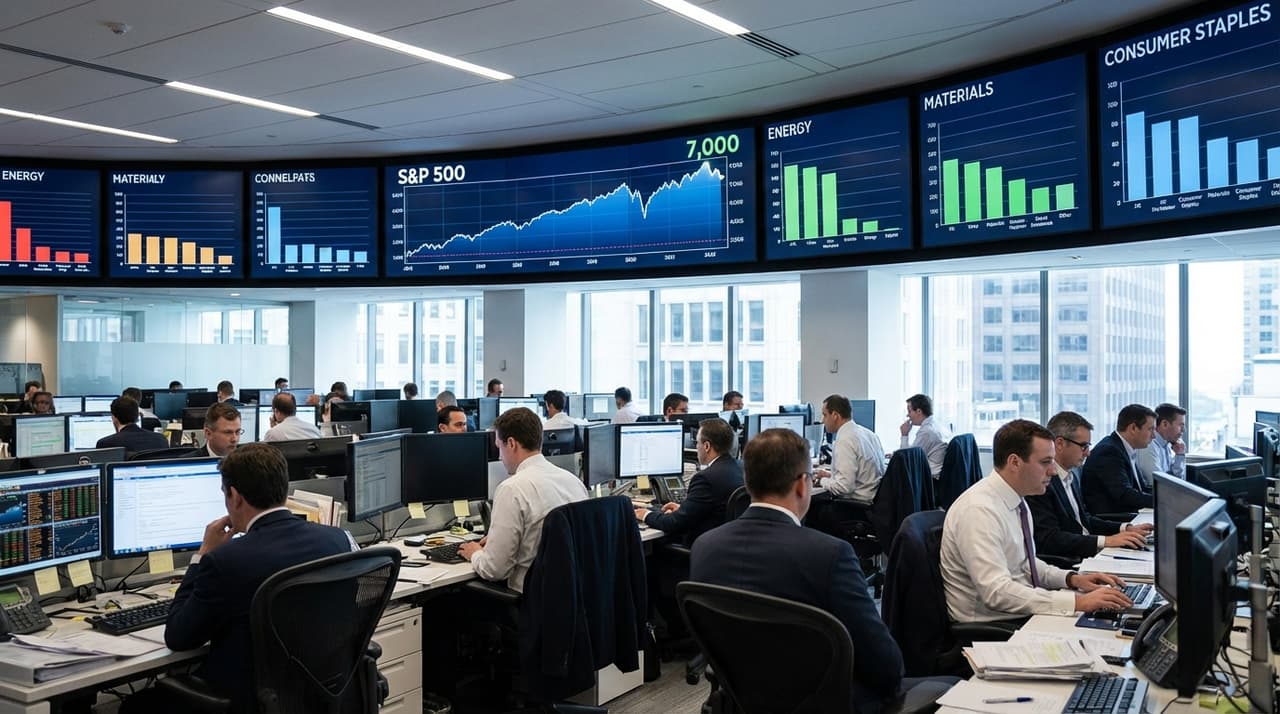
- The S&P 500 briefly reached 7,000 for the first time during intraday trading on January 28, 2026, but failed to close above it, despite former President Donald Trump's assertion of a record finish.
- The rally was driven by broad-based gains across energy, materials, and consumer staples sectors, with small-cap stocks outperforming, signaling reduced reliance on megacap tech leadership.
- Market momentum persists amid early 2026 volatility, fueled by cooling inflation, Federal Reserve rate holds, and geopolitical events like U.S. actions in Venezuela, though analysts caution on sustainability without volume confirmation.
A Milestone Touch Amidst Volatility
The S&P 500 index briefly touched the 7,000 mark for the first time in its history on January 28, 2026, during intraday trading, according to market data reviewed by financial analysts. However, it pulled back without closing above this psychological threshold, a nuance that former President Donald Trump overlooked in his subsequent claim of a historic finish. "S&P just hit 7,000 yesterday for the first time ever," Trump stated, reflecting the ongoing market optimism but omitting the lack of a sustained close. Efforts to reach Trump's team for clarification were unsuccessful.
This milestone came as part of a broader rally that saw the index hover near 6,979 earlier in the session, facing what traders describe as a "Gamma Wall" resistance level. Support held firm at around 6,800, aligned with the 50-day simple moving average at 6,790, according to people familiar with market dynamics. The Federal Reserve's decision to hold interest rates steady at 3.50%-3.75% earlier in the week, in line with expectations, provided a stable backdrop, though markets remained largely flat in response.
Broad-Based Gains and Economic Signals
Unlike previous rallies dominated by tech giants, the push toward 7,000 was fueled by outperformance in energy, materials, and consumer staples sectors. Small-cap stocks, as measured by the Russell 2000 index, have surged approximately 7% year-to-date, outpacing the S&P 500's gains of less than 2% over the same period. This shift suggests economic acceleration and a broadening participation beyond the so-called "Magnificent Seven" tech stocks, though some strategists remain skeptical. "Calling this non-tech leadership 'wrong' for explosive growth," noted one market analyst, who requested anonymity due to firm policies.
The rally ties into what experts term the "AI Capex Super-Cycle," with 2026 earnings growth projected between 12% and 14.8%. Cooling inflation and potential Fed easing later in the year have bolstered investor confidence, building on post-2025 gains of around 18%. However, without significant trading volume to confirm the breakout, analysts warn of bubble risks. Emerging markets, for instance, rose 0.68% on dollar weakness, while commodities showed mixed performance, with precious metals up 3.70%.
Geopolitical Context and Market Resilience
Early 2026 volatility has been compounded by geopolitical events, including a U.S. military operation in Venezuela that captured Nicolás Maduro and seized oil revenue, causing a brief "flash dip" of about 2% on January 20. Markets quickly rebounded, with investors largely downplaying Trump's tariff threats related to Greenland and other regions. Lower interest rates and legislative efforts like the "One Big, Beautiful Bill Act" tax cuts have further supported optimism, according to sources close to policymaking circles.
Historical context underscores the rapid pace of this rally: the S&P 500 hit 6,000 in November 2024, taking just 190 days to climb from 5,000, compared to slower prior milestones such as the 4,168 days between 1,000 and 2,000. This mirrors expansions seen during the 1990s tech boom, with 2025 delivering returns of 16.4% to 18% and setting the stage for current gains. Looking ahead, the short-term outlook hinges on factors like February earnings reports—where tech companies are targeting 14% growth—and upcoming Fed meetings, which could drive a breakout to 7,200 or a correction to 6,720.
In related developments, the Russell 2000's outperformance hints at underlying economic strength, while geopolitical parallels to Trump-era trade tensions add noise. As one institutional investor paraphrased, "We're seeing a convergence of factors that could sustain this rally, but it's fragile without broader confirmation." For now, the 7,000 touch stands as a symbolic moment in a market navigating both promise and peril.