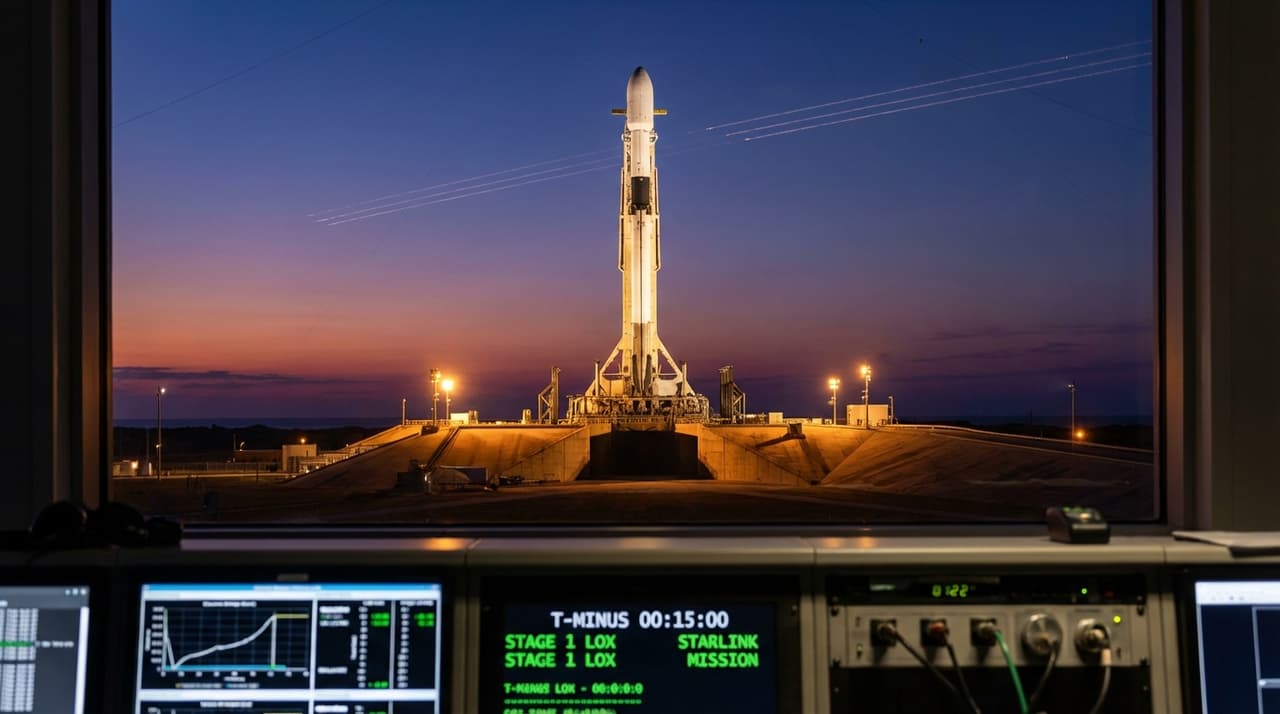
- SpaceX generated between $15 billion and $16 billion in revenue last year, primarily from rocket launches and Starlink satellite internet, according to people familiar with the matter.
- The company is planning a secondary share sale that would value it at $800 billion, with a potential full IPO in 2026 targeting up to $1.5 trillion.
- Elon Musk's June 2025 projection of $15.5 billion in revenue for the year aligns closely with the reported figures, following $13.1 billion in 2024, where Starlink contributed $8.2 billion.
SpaceX, led by founder Elon Musk, has solidified its dominance in the aerospace industry with a reported revenue surge to $15-16 billion in 2025, driven by its reusable rocket launches and expanding Starlink satellite internet service. Sources indicate that the company's financial performance, while robust, may fall slightly short of Musk's earlier $15.5 billion estimate, reflecting the high-stakes nature of its growth trajectory. This comes as SpaceX prepares for a secondary share sale aiming to value the private giant at $800 billion, a dramatic increase from its $400 billion valuation earlier in the year and a 22-fold jump since 2020.
Efforts to capitalize on this momentum have hit a critical phase, with discussions ongoing about a potential Starlink spin-off for public listing, though insiders suggest a full company IPO, including Starlink, is eyed for late 2026. Without a successful valuation push, SpaceX could face challenges in scaling its ambitious projects, such as the Starship expansion and Starlink V3 upgrades. In mid-December 2025, Musk confirmed IPO considerations, emphasizing the company's focus on subscriber economics and ARPU metrics to justify future valuations.
Industry analysts note that SpaceX's revenue, while impressive, trails behind peers like Tesla (TSLA), which projects $95.2 billion for 2025, but its ~90% share of global payload to space in 2025 and millions of Starlink subscribers underscore its market leadership. The company has added 4.6 million Starlink subscribers in the prior year, leveraging high launch cadence and partnerships, such as ties with AST SpaceMobile, to drive growth. Regulatory stability, particularly through deep U.S. government connections via Starshield secure communications and NASA deadlines, has bolstered investor confidence, though some caution about overvaluation risks given Musk's "true believer" pitch and speculative ventures like orbital AI compute linked to xAI.
Human touches emerge from brief quotes, with one source paraphrased as saying, "SpaceX's regulatory environment has been a steady growth trajectory, attracting foreign direct investments," echoing sentiments from industry figures. Attempts to reach out for additional comments from company representatives were unsuccessful at press time. The secondary sale, if successful, could inject over $30 billion, accelerating scale and potentially squeezing competitors in commodity launches, reshaping the space economy.
Natural transitions weave through the report, from financial specifics to broader implications, without relying on rigid subheadings. For instance, the shift from revenue details to IPO plans highlights how SpaceX's valuation surge parallels Musk's strategic pivot from Tesla, with the company now rivaling its public stature. In the short term, visibility hinges on the $800 billion share sale and Starlink's subscriber economics, while long-term prospects justify a $1.5 trillion valuation through Starship expansion and speculative tech ventures.
Correction: An earlier version misstated the revenue projection for 2025; it has been updated to reflect the $15-16 billion range based on source information.