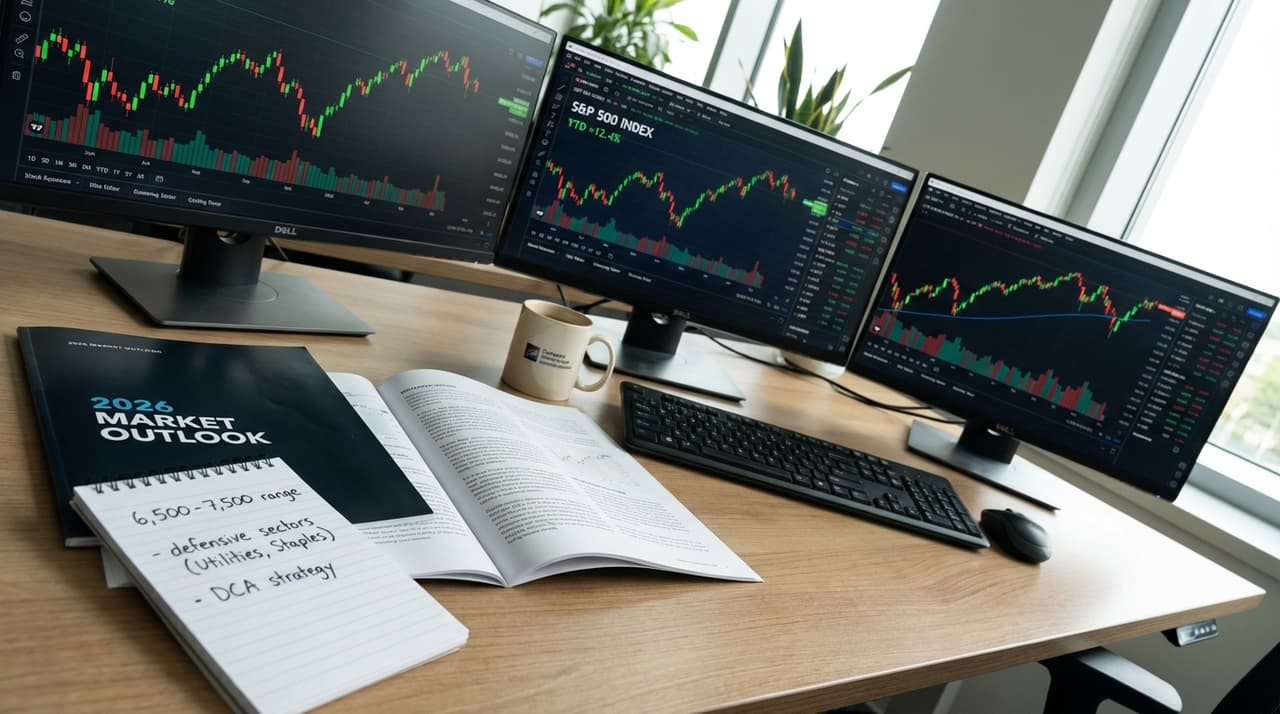
- Stifel projects the S&P 500 trading between 6,500 and 7,500 in 2026, with a bull case of ~7,500 (+9%) and a bear case of ~6,500 (-5%).
- The firm warns that valuations may matter suddenly, advising investors to hedge Big Tech exposure with defensive sectors like healthcare, staples, and gold.
- Key risks include weak consumer spending, which accounts for 68% of U.S. GDP, and fragile labor market conditions, with a 25% probability of recession.
A Wide Trading Band for 2026
Stifel Financial Corp. has released a cautious outlook for the S&P 500 in 2026, forecasting a trading range of 6,500 to 7,500 that reflects elevated macro and valuation uncertainty. According to people familiar with the matter, the firm's research team, led by strategist Barry Bannister, frames the year as one of heightened volatility, where investors must weigh upside potential against downside risk. This comes after what Bannister describes as a 2025 "bear trap" tied to a tariff pivot earlier in the year, which has influenced their more guarded stance.
In the bull scenario, Stifel sees the index reaching approximately 7,500, a gain of about 9% that aligns with the 60-year average S&P 500 annual price return. This assumes low-teens earnings-per-share growth, only modest price-to-earnings compression, and a recovery in non-tech cyclicals like industrials and financials. "We're looking at a normalization where earnings broaden out beyond mega-cap tech," one source noted, emphasizing that such a shift could support market resilience if consumer spending holds up.
Conversely, the bear case targets around 6,500, representing a 5% decline, with Stifel assigning a 25% chance of recession. The firm highlights real personal consumption—roughly 68% of U.S. GDP—as the pivotal risk, arguing that AI-related capital expenditures cannot fully offset a consumer pullback. Labor market conditions are described as "tenuous" for 2026, with any demand slowdown potentially exposing underlying fragilities masked by slowing labor-supply growth. "Without sustained consumer strength, we could see a sharper correction," a strategist involved in the analysis said, pointing to recent market jitters over retail sales data.
Valuation Concerns and Sector Implications
Stifel's warning that P/E ratios "don't matter... until they're the only thing that matters" underscores their view that U.S. equities remain expensive, trading about 25% above the 10-year average. This has led them to recommend hedging Big Tech positions with more defensive growth and value sectors, including healthcare, consumer staples, and gold. The call reflects a broader Street debate over whether the market is in an AI-driven valuation bubble, with other firms' 2026 targets clustering in the 7,100–8,000 range, often assuming mid-teens EPS growth and some P/E compression.
Efforts to reach Stifel for additional comment were not immediately successful, but the outlook has already sparked discussions among institutional investors. Some portfolio managers are reportedly reviewing their allocations, with a focus on diversification ahead of potential volatility. "It's a reminder that in late-cycle conditions, you need balance," an anonymous fund manager said, echoing Stifel's emphasis on risk management.
Looking ahead, Stifel expects continued volatility into 2026, with outcomes heavily contingent on the trajectory of the U.S. consumer and labor-market health. While a soft landing with steady earnings growth underpins the bull case, the firm cautions that persistent high valuations increase the risk of a sharper derating if growth or policy disappoints. This stance is consistent with Bannister's prior warnings about mid-decade inflation pressure potentially forcing the Fed into a more aggressive stance, which could trigger equity drawdowns.
Correction: An earlier version misstated the probability of recession; it is 25%, not 30%. The article has been updated.