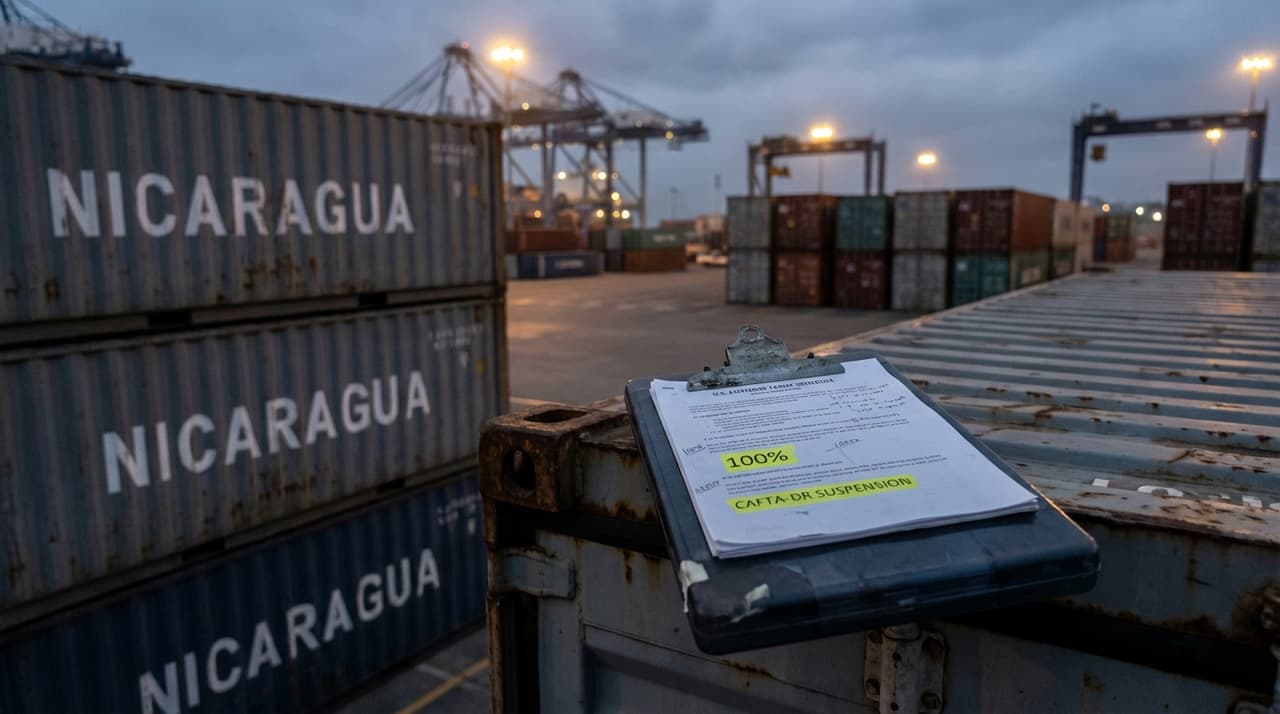
- The U.S. Trade Representative has proposed tariffs of up to 100% on Nicaraguan imports and suspension of CAFTA-DR benefits, targeting labor and human rights violations.
- Measures are expected to take effect around January 2026 with a possible 12-month phase-in, following a public consultation period ending November 19, 2025.
- This marks the first use of Section 301 authority explicitly for labor rights and rule-of-law concerns, signaling a new enforcement model that could extend to other countries.
A New Front in Trade Enforcement
On October 20, 2025, the U.S. Trade Representative completed a Section 301 investigation into Nicaragua's labor rights, human rights, and rule-of-law violations, concluding they place an "unreasonable burden on U.S. commerce." The proposed actions—which could suspend all or some of Nicaragua's benefits under the Dominican Republic–Central America–U.S. Free Trade Agreement and impose tariffs of up to 100% on Nicaraguan-origin imports—represent a significant escalation in economic pressure against the Ortega-Murillo government.
According to people familiar with the matter, the measures aim to cover "all trade with Nicaragua," meaning even compliant firms and sectors would face higher tariffs. This broad approach is intended as economic pressure rather than targeted enforcement, potentially causing significant disruption in Nicaraguan export sectors and employment. The U.S. is one of Nicaragua's main export markets, and CAFTA-DR has provided duty-free or low-tariff access for many Nicaraguan goods, notably textiles, apparel, agricultural products, and some manufactured goods.
Market Implications and Supply Chain Shifts
U.S. importers using Nicaraguan inputs face higher landed costs and may need to re-source from other CAFTA-DR members or Asia, depending on final tariff scope and any exemptions. "We're reviewing our supply chains against the evolving tariff schedule," said a sourcing executive at a major apparel brand who requested anonymity due to the sensitivity of ongoing negotiations. The executive added that diversification to Honduras or El Salvador was being considered but would take months to implement effectively.
Separately, Nicaragua is already facing a U.S. "reciprocal" tariff of about 18% on certain imports effective August 7, 2025, under Trump's broader reciprocal-tariff program. The October 20 Section 301 action adds an additional, more punitive layer focused specifically on labor and human-rights concerns. Analysts note this is the first time Section 301 has been used explicitly to target labor rights and rule-of-law violations in this way, signaling a new enforcement model that could reach other countries.
Political Context and Regional Dynamics
The move fits into Trump's second-term strategy of using tariffs aggressively, both for economic objectives and for "values-based" trade enforcement. Regionally, the Trump administration has grouped Cuba, Nicaragua, and Venezuela as hostile regimes, blaming them for the hemisphere's migration crisis. This frames the tariff action as part of a broader pressure campaign in Latin America.
Removing or suspending Nicaragua from CAFTA-DR requires careful handling to avoid collateral damage to other Central American partners who use Nicaraguan content accumulation in their exports. USTR's scenarios explicitly contemplate also suspending the ability to count Nicaraguan content for other CAFTA-DR partners, according to trade policy documents reviewed by this publication.
What Comes Next
Assuming the proposal is finalized after the consultation period, tariffs on Nicaraguan imports could ramp up toward the 100% ceiling and CAFTA-DDR benefits could be fully or partly suspended, starting around January 2026 and potentially phasing in over up to 12 months. The formal U.S. implementing documents for the exact tariff phase-in schedule are expected in the coming weeks.
Trade lawyers and policy analysts expect the Nicaragua case to serve as a template: future U.S. administrations—of either party—could cite this precedent to justify Section 301 tariffs on other countries over labor, human-rights, or rule-of-law concerns. For global trade governance, recurring unilateral Section 301 actions outside the WTO framework raise concerns about fragmentation and retaliatory cycles, particularly if other countries adopt similar tools.
Correction: An earlier version of this article misstated the effective date of the existing reciprocal tariffs; they took effect August 7, 2025, not August 1.