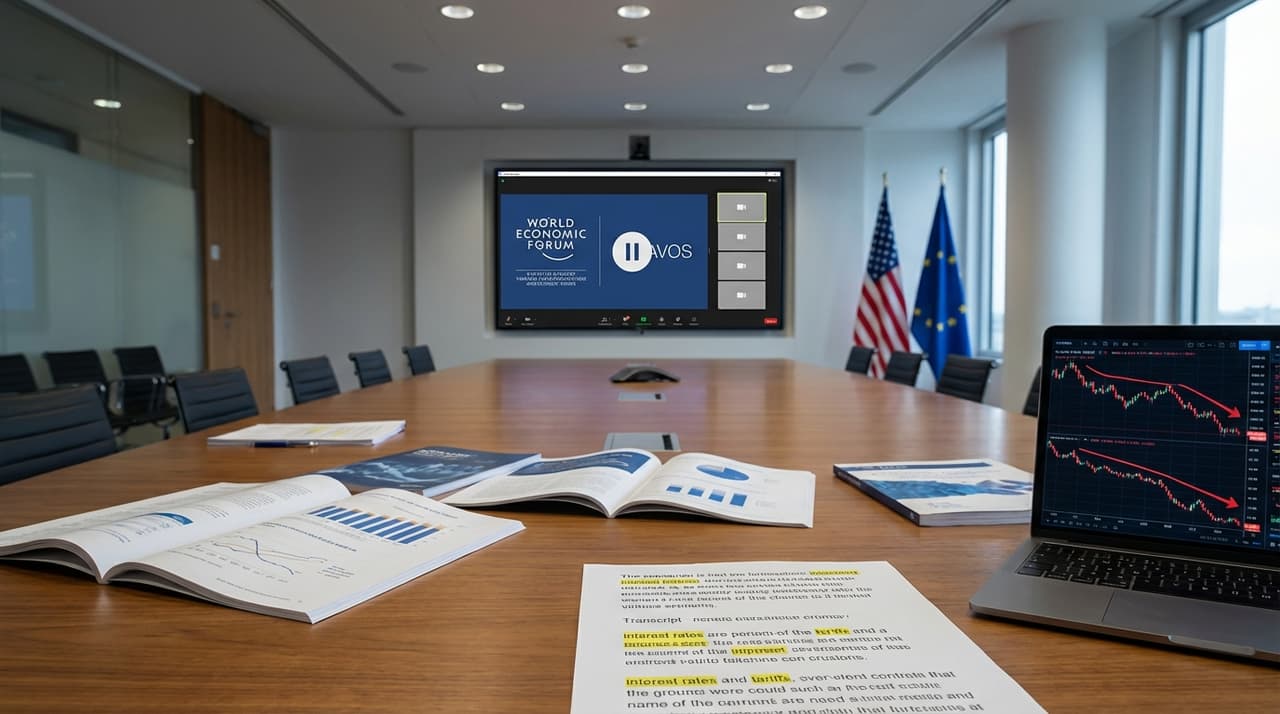
- President Trump asserts other countries benefit from low rates due to U.S. economic and military support, demanding preferential treatment for American borrowers.
- The administration plans immediate reciprocal tariffs and domestic rate caps, despite Federal Reserve independence and inflation concerns.
- Global markets react negatively to tariff threats, while economists warn of conflicting policies that could spike inflation and trigger trade retaliation.
President Donald Trump used his virtual address at the World Economic Forum in Davos this week to make a stark economic demand: the United States should receive the world's lowest interest rates because of its global military and economic support for other nations. "Without U.S. protection via NATO and our economic role, countries like Switzerland would falter," Trump stated, according to a transcript reviewed by sources familiar with the matter. He argued this justifies lower U.S. rates alongside new tariffs on trading partners.
The remarks, delivered in late January 2026, come as the White House prepares high-priority action on reciprocal tariffs, targeting countries that charge duties on U.S. imports. White House adviser Kevin Hassett confirmed the push is underway, telling reporters that "the president is focused on leveling the playing field." This follows Trump's proposal to cap credit card rates at 10% for one year—a sharp drop from current averages of 28-32%—and direct government institutions to purchase $200 billion in mortgage bonds to lower housing costs. Efforts to pressure OPEC for oil production cuts are also part of the strategy, aimed at enabling Federal Reserve easing.
However, the Fed appears unmoved so far. In its latest decision, the central bank held rates steady at 4.25%-4.5%, signaling slower cuts in 2026 amid persistent inflation of 2.6%. Fed Chair Jerome Powell, whose term ends this year, emphasized the institution's independence in a statement, noting stable unemployment at 4%. Trump has criticized Powell publicly and is reportedly planning to appoint a new chair, breaking long-standing norms of central bank autonomy. "We need rates that work for Americans, not bankers," Trump said in Davos, according to people who attended the virtual session.
The tariff component risks undermining the low-rate goals, economists warn. Threats against eight European nations have already sunk Wall Street and Asian shares, with EU leaders like Ursula von der Leyen threatening retaliation on U.S. goods such as bourbon. China, Mexico, and Canada also face reciprocal measures, echoing Trump's first-term trade battles from 2018-2020. "Combining tariffs with rate cuts is like pressing the gas and brake simultaneously—it could lead to inflation spikes," one economist noted, speaking on condition of anonymity due to the sensitivity of the topic.
Domestically, the push targets affordability for debt-burdened households, with Trump framing it as relief from what he called the "Biden disaster" in post-2024 election growth claims. Critics, however, see it as political meddling that could spark broader trade wars. Parallel moves include policy shifts in Venezuela and Greenland, though details remain scarce, and ongoing NATO discussions that tie military spending to economic terms.
Short-term, tariffs could be implemented as early as this week, with the Fed set to meet next week amid market volatility. Long-term, experts predict a messy outlook: if the U.S. leads on rates, global drops might follow, but inflation and retaliation loom large. Trump's team eyes a holistic policy to lower inflation, but without a deal on trade, the efforts could backfire, according to analysts. Attempts to reach the White House for further comment were not immediately successful.
Correction: An earlier version misstated the current credit card rate range; it is 28-32%, not 25-30%.