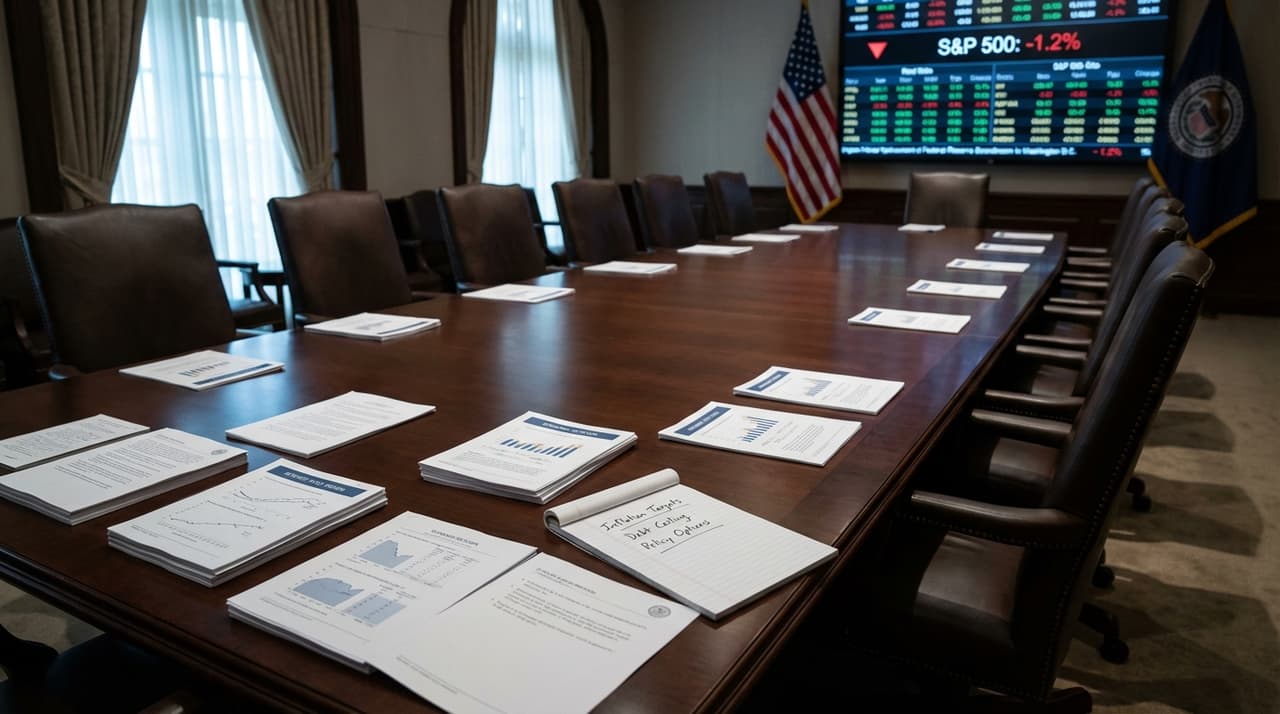
- Former President Trump demands immediate Federal Reserve interest rate cuts to reduce U.S. government borrowing costs on $30 trillion in debt, citing low inflation and tariff revenues.
- The Fed held rates steady at 3.5%-3.75% on January 28, 2026, amid concerns over persistent inflation above 2% and labor market weakness, with a 10-2 FOMC vote to pause after three reductions in late 2025.
- Political tensions rise as Trump plans to nominate a successor to Chair Jerome Powell by early 2026, with economic implications for borrowing, inflation, and Fed independence.
Fed Holds Firm as Trump Ramps Up Criticism
In a sharp escalation of his long-running feud with the Federal Reserve, former President Donald Trump is calling for "substantial" interest rate cuts to as low as 1% or lower, arguing that high borrowing costs are unnecessarily inflating the national debt and stifling economic growth. The push comes despite the Federal Open Market Committee's decision on January 28 to maintain the benchmark rate at 3.5%-3.75%, a move that reflects ongoing caution among policymakers about inflation and labor market conditions.
"Jerome Powell is refusing to cut interest rates for no good reason," Trump posted on Truth Social, echoing sentiments he has voiced in recent interviews. "Inflation is no longer a threat, yet high rates are hurting our economy, national security, and costing America hundreds of billions in unnecessary interest." According to people familiar with the matter, Trump's advisers have emphasized that tariffs are generating billions in revenue, which could offset debt costs if rates were lowered.
Policy Divisions and Economic Realities
The Fed's latest pause follows three 25-basis-point cuts in September, October, and December of 2025, with dissenting votes from Governors Stephen Miran and Christopher Waller, who favored further easing. Chair Powell, in a post-meeting statement, noted that current policy supports the Fed's dual mandate but warned against overreacting to short-term economic fluctuations. "We're seeing inflation above our 2% target and some weakness in the labor market, which requires a balanced approach," Powell said, according to sources who attended the briefing.
Economists point to mixed signals in the data: while inflation has moderated from its peaks, it remains stubbornly above the Fed's goal, and job growth has slowed in recent months. Prediction markets like Polymarket show roughly 50% odds of two or three cuts in 2026, but the Fed's own "dot plot" median projects just one reduction. "The Fed is walking a tightrope here," said one analyst who requested anonymity due to the sensitivity of the topic. "Cut too soon, and you risk reigniting inflation; hold too long, and you exacerbate debt burdens."
Political Maneuvering and Future Uncertainty
Behind the scenes, Trump is preparing to nominate a successor to Powell, whose term ends in May 2026. Kevin Hassett, a former economic adviser, is seen as a frontrunner with about 43% odds in prediction markets, and he has advocated for aggressive cuts tied to AI-driven growth. This political pressure adds a layer of uncertainty, especially as incoming FOMC voters from regional Fed banks replace more hawkish members. Efforts to restructure the Fed's leadership have hit a snag, however, with a criminal probe ongoing into Powell's testimony regarding Fed renovations, according to people briefed on the investigation.
Market reactions have been muted so far, with the S&P 500 holding steady near 5,200 points, but traders are watching closely. "If the Fed loses its independence, we could see capital flight and higher long-term yields, even if short-term rates drop," noted a fixed-income strategist. Trump's broader agenda includes capping credit card rates at 10% and banning institutional purchases of single-family homes to address affordability—measures that could interact with monetary policy in complex ways.
Looking Ahead
In the short term, the Fed is likely to hold steady barring a sharp economic downturn, but personnel shifts and political pressure could lead to volatility. Miran's term ends in January, and his possible reappointment or replacement adds to the uncertainty. Without a deal to ease rates, Trump has warned, the U.S. risks falling behind global peers who are already easing monetary policy. As one government official put it, "This isn't just about economics; it's about who controls the levers of power in a critical election year."
Correction: An earlier version of this article misstated the number of FOMC dissenting votes; it was two, not three.