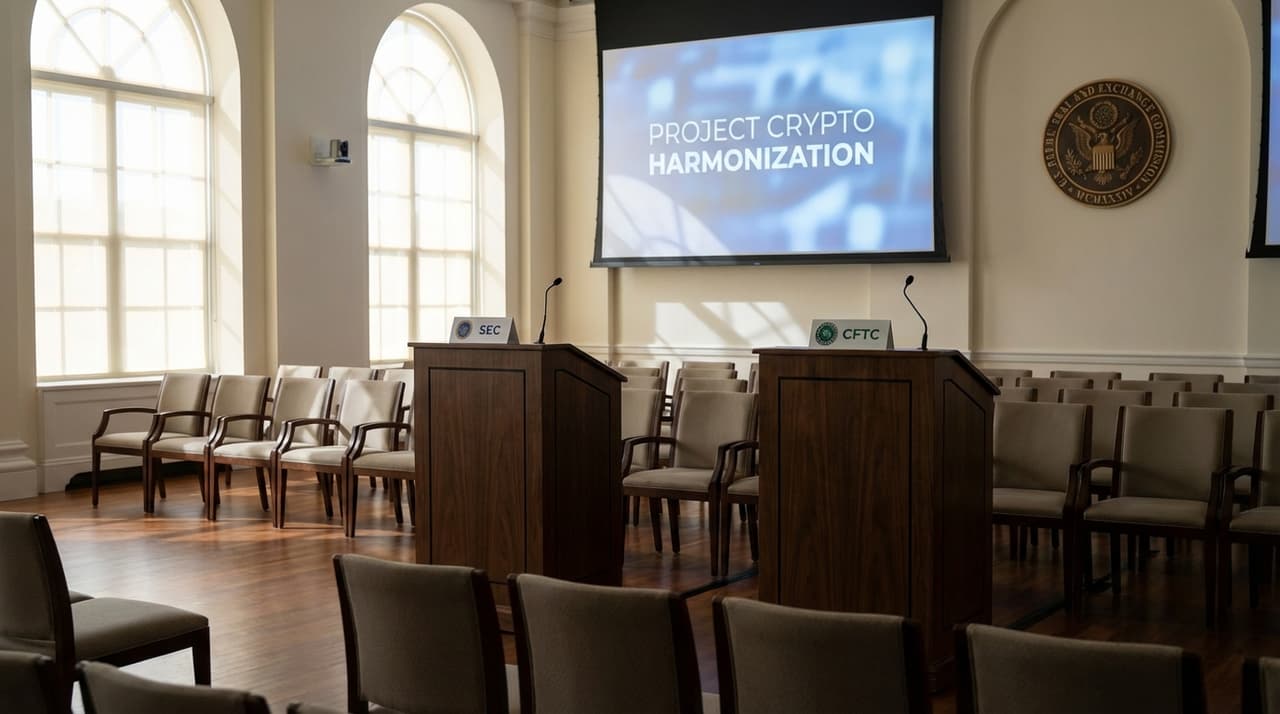
- SEC Chair Paul Atkins and CFTC Chair Michael Selig announce joint regulatory framework, dubbed Project Crypto, to divide oversight—SEC on tokenized securities and CFTC on digital commodities like collectibles—following the stalling of the Clarity Act in the Senate.
- The agencies relaunched Project Crypto to harmonize definitions, oversight, and data sharing, eliminating duplicative regulations for market participants offering similar products, with a joint event scheduled for today, January 29, 2026.
- This move aims to boost U.S. dominance in 21st-century finance by providing regulatory certainty for innovation, reducing conflicts that undermine market resilience, and builds on stalled legislation like the Clarity Act and House-passed FIT21.
Efforts to restructure crypto oversight have hit a snag in Congress, but regulators aren't waiting. SEC Chair Paul Atkins and CFTC Chair Michael Selig say they're prepared to issue crypto regulations after the Clarity Act stalled in the Senate, according to people familiar with the matter. Their goal: provide certainty for innovation while aligning rules with future legislation, with the agencies planning a joint framework to divide oversight—the SEC focusing on tokenized securities and the CFTC on digital assets like collectibles.
The agencies relaunched Project Crypto to harmonize definitions, oversight, and data sharing, eliminating duplicative regulations for market participants offering similar products. A joint event titled "SEC-CFTC Harmonization: U.S. Financial Leadership in the Crypto Era" is rescheduled for today, January 29, 2026, at 2:00-3:00 p.m. ET, as confirmed by officials who spoke on condition of anonymity. This follows 2025 advancements like the GENIUS Act for stablecoins and CFTC withdrawals of strict digital asset guidance, signaling a shift toward more flexible oversight.
Without a deal in Congress, the regulatory landscape would remain fragmented, but this initiative seeks to bridge the gap. The move aims to boost U.S. dominance in 21st-century finance by providing regulatory certainty for innovation, reducing conflicts that undermine market resilience. It builds on stalled legislation such as the Clarity Act, which would have granted the CFTC exclusive spot market jurisdiction for digital commodities and the SEC for securities, and the House-passed FIT21 from May 2024, which apportions authority similarly.
In a brief statement, a spokesperson for the SEC emphasized that "this framework is about fostering growth while protecting investors," though attempts to reach CFTC officials for additional comment were unsuccessful. The Senate Ag Committee has updated a market structure bill that mandates joint SEC-CFTC rulemaking within 18 months of enactment, including processes for delisting and retail leveraged transactions, adding pressure for timely action.
Market trends show a clear shift toward tokenization, 24/7 trading, and accepting digital assets as collateral, with the CFTC enabling spot digital asset trading and derivatives. Memecoins and network tokens are now classified as digital commodities under updated Senate proposals, reflecting evolving industry dynamics. This regulatory push benefits innovators and market participants by offering clarity and reduced compliance burdens, enabling retail access to digital assets and clearing with less intermediation, though brokers and dealers face new CFTC registration and fees but gain preemption and exemptions for comparable foreign regulation.
Looking ahead, short-term steps include joint rulemaking on exchanges, intermediaries, conflicts, and delisting, with provisional registrations allowed before final rules are set. Entities are urged to register with the CFTC now to avoid disruptions. In the long term, the SEC may adopt an "innovation exemption" sandbox, "super app" licensing, and tokenized securities pathways, while the CFTC expands derivatives, spot trading, and collateral use. Experts predict merged-like coordination for evolving token taxonomies, illicit finance tools, and spot market disclosures, as noted in recent analyses.
Correction: An earlier version misstated the timing of the joint event; it is confirmed for January 29, 2026, not 2025.