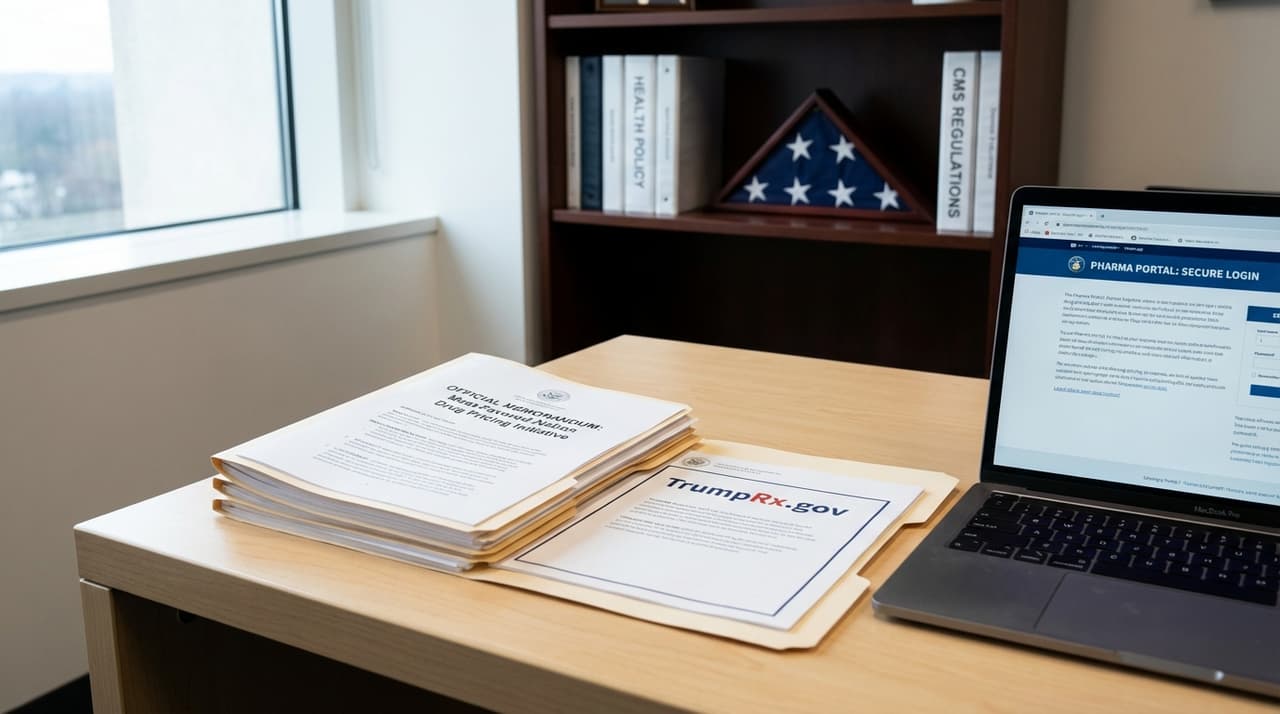
- President Trump calls on Congress to pass legislation making his Most-Favored-Nation drug pricing policy permanent, building on voluntary agreements with 14 major pharmaceutical companies.
- The policy aims to align U.S. drug prices with lower international rates, promising billions in Medicaid savings and direct-to-consumer sales via a federal portal launching in 2026.
- Analysts see this as a strategic move to curb foreign "free-riding" on U.S. innovation while offering tariff relief as an incentive for pharmaceutical compliance.
President Trump is pushing Congress to codify his Most-Favored-Nation drug pricing policy into law, according to a White House fact sheet released in January 2026. This legislative effort seeks to cement voluntary agreements reached with nine major drugmakers in December 2025, including Amgen (AMGN), Boehringer Ingelheim (BIIB), Bristol Myers Squibb (BMY), Genentech (DNA), Gilead Sciences (GILD), GSK (GSK), Merck (MRK), Novartis (NVS), and Sanofi (SNY). These deals expand prior pacts with five other firms—Pfizer (PFE), AstraZeneca (AZN), EMD Serono (EMD), Eli Lilly (LLY), and Novo Nordisk (NVO)—covering 14 of the 17 companies initially targeted by the administration.
"We're building on the success of these agreements to ensure lasting affordability for patients," said a senior administration official familiar with the matter, who spoke on condition of anonymity. The policy, which matches U.S. prices to lower rates in Europe for Medicaid and cash-paying patients, is projected to generate significant savings. Efforts to restructure drug pricing have accelerated since May 2025, when Trump signed Executive Order 14297 directing MFN implementation, followed by letters to pharmaceutical firms in July.
Key features of the agreements include direct-to-consumer sales through company portals and a federal TrumpRx.gov site set to launch in 2026, alongside a three-year tariff suspension as an incentive for compliance. Without a deal, companies could face import tariffs under Section 232, though the administration has emphasized a collaborative approach. "This isn't about punitive measures; it's about creating a fair system where Americans aren't subsidizing the world," the official added.
In recent months, the focus has sharpened on high-cost drugs like GLP-1s for diabetes, with Eli Lilly and Novo Nordisk reporting surging sales in 2025. The MFN policy aims to moderate U.S. launch prices for such therapies, offering benchmarks that could influence broader negotiations. AstraZeneca, for instance, has pledged a $50 billion U.S. investment by 2030, signaling confidence amid these changes. Meanwhile, holdouts like AbbVie (ABBV), Johnson & Johnson (JNJ), and Regeneron (REGN) remain under scrutiny, with analysts predicting increased pressure as the policy evolves.
The push for codification ties into Trump's broader healthcare strategy, including first-term insulin price caps and efforts to end what he calls foreign "free-riding" on U.S. pharmaceutical innovation. Internationally, this has pressured countries like Canada and the EU to reconsider their pricing models. Domestically, stakeholders are weighing the implications: states stand to gain from Medicaid savings, while patients could bypass traditional insurers for direct purchases. However, critics question the voluntary enforcement mechanisms and potential impacts on drug innovation, though supporters argue it sets crucial affordability benchmarks.
Looking ahead, the TrumpRx.gov rollout in 2026 is expected to enable direct consumer access, with Medicaid savings beginning to materialize. Long-term, codification could expand the policy to Medicare and commercial payers, reshaping global pricing dynamics. As one industry insider noted, "This isn't just about today's deals; it's about setting a precedent for how drug prices are negotiated in the future." The administration has not yet responded to requests for comment from all involved companies, but sources indicate ongoing discussions to address remaining concerns.