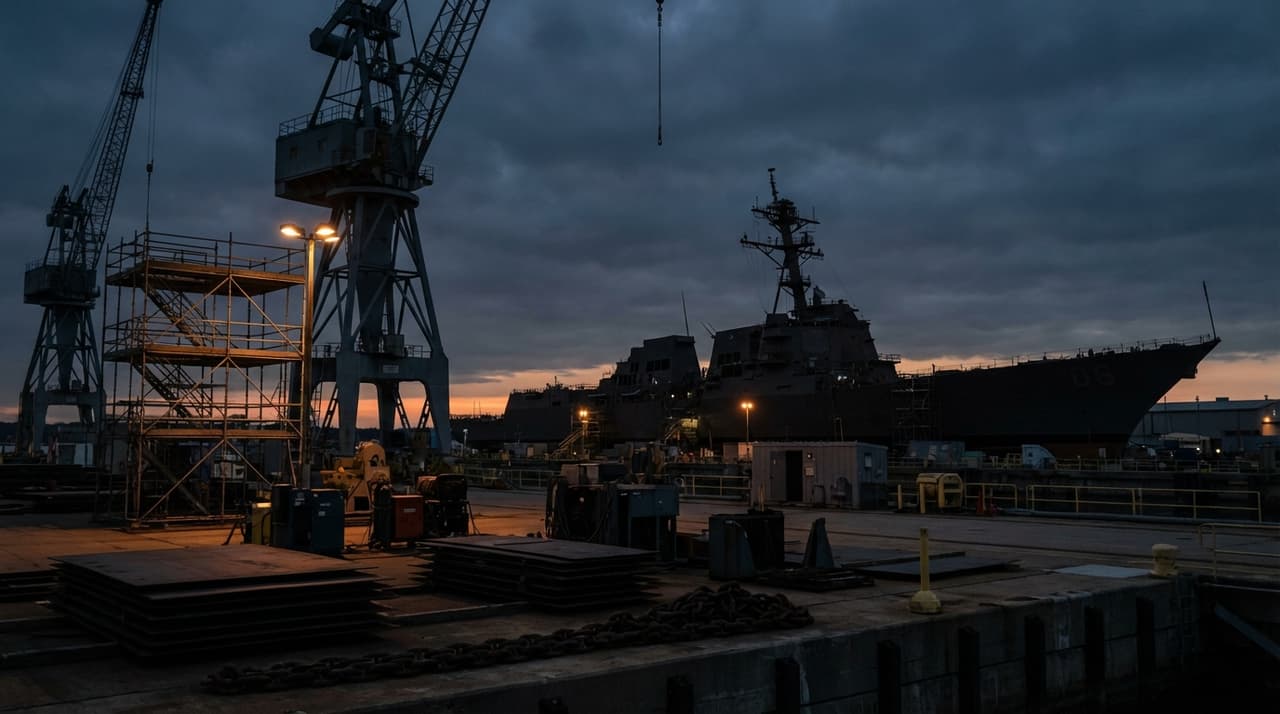
- The U.S. Navy announces a new FF(X) frigate class under President Trump's "Golden Fleet" initiative, based on a Huntington Ingalls Industries (HII) (HII) Coast Guard patrol ship design, with the first hull targeted for 2028.
- The move accelerates naval production by leveraging existing designs to address shipyard delays and cost overruns, as highlighted in a GAO March 2025 report.
- Political backlash emerges from Senator Tammy Baldwin (D-WI), who criticizes the plan for cutting Wisconsin-built Constellation-class frigates and potentially diverting funds without congressional approval.
A Swift Naval Shift
President Trump's 4:30 PM announcement today, involving Defense Secretary Pete Hegseth and Navy Secretary John Phelan, has set the stage for a significant pivot in U.S. shipbuilding strategy. The centerpiece is the new FF(X) frigate class, which aims to fast-track production by adapting a proven HII Coast Guard patrol ship design, according to officials familiar with the matter. This initiative, part of Trump's broader "Golden Fleet" push, targets getting the first hull in the water by 2028, a timeline that underscores the administration's focus on rapid deployment amid ongoing global tensions, including recent U.S.-Venezuela flare-ups.
Efforts to restructure naval procurement have hit a snag with this announcement, as it directly impacts the Constellation-class program awarded to Fincantieri (FCT.MI) Marinette Marine in Wisconsin. Without this deal, the Navy risks falling further behind in addressing critical shortages, with small surface combatants currently at one-third of needed levels. The FF(X) design, based on the Legend-class National Security Cutter built by HII, is seen as a pragmatic move to avoid the delays and cost overruns that have plagued other projects, such as the Constellation-class, which has faced setbacks despite over $1 billion in funding secured by Senator Baldwin since 2021.
Industrial and Political Ripples
Huntington Ingalls Industries, the largest independent U.S. military shipbuilder with a market cap around $13.57 billion, stands to gain from this shift. The company, which reported trailing twelve-month revenue of $12.01 billion with 7.4% growth over three years, has faced profitability challenges from declining margins and insider selling, but this new contract could bolster its position. In a brief statement, a Navy spokesperson emphasized that "getting the right ships in the water" is paramount, echoing sentiments from Admiral Caudle and Secretary Phelan about prioritizing adaptable, multi-mission frigates for surface warfare and unmanned systems.
However, the announcement has ignited a fierce political debate. Senator Tammy Baldwin swiftly condemned the move, calling it an abandonment of Wisconsin workers and alleging illegal fund diversion without congressional approval. "This decision undermines the expertise and investment in our shipyards," Baldwin said in a press release, demanding inclusion for Wisconsin in any new production plans. The controversy ties into the recent $900 billion defense bill and highlights the broader societal impact, affecting thousands of workers in Marinette, Green Bay, and Sturgeon Bay. Attempts to reach HII for additional comment were unsuccessful at press time.
Looking ahead, the Navy plans to prioritize multi-yard production to scale the FF(X) rapidly, emphasizing lessons from past programs like the Arleigh Burke destroyers. Industry experts note that this approach could help fill critical gaps in naval combat power, particularly for operations in regions like the Red Sea and Caribbean. As the White House establishes a new Office of Shipbuilding to oversee these efforts, the focus remains on balancing speed with sustainability, avoiding the "perpetual triage" that has characterized recent naval projects. Market watchers are eyeing HII's stock, anticipating a potential boost from increased defense spending post the $900 billion bill.
Correction: An earlier version misstated the timeline for the first FF(X) hull; it is targeted for 2028, not 2027.