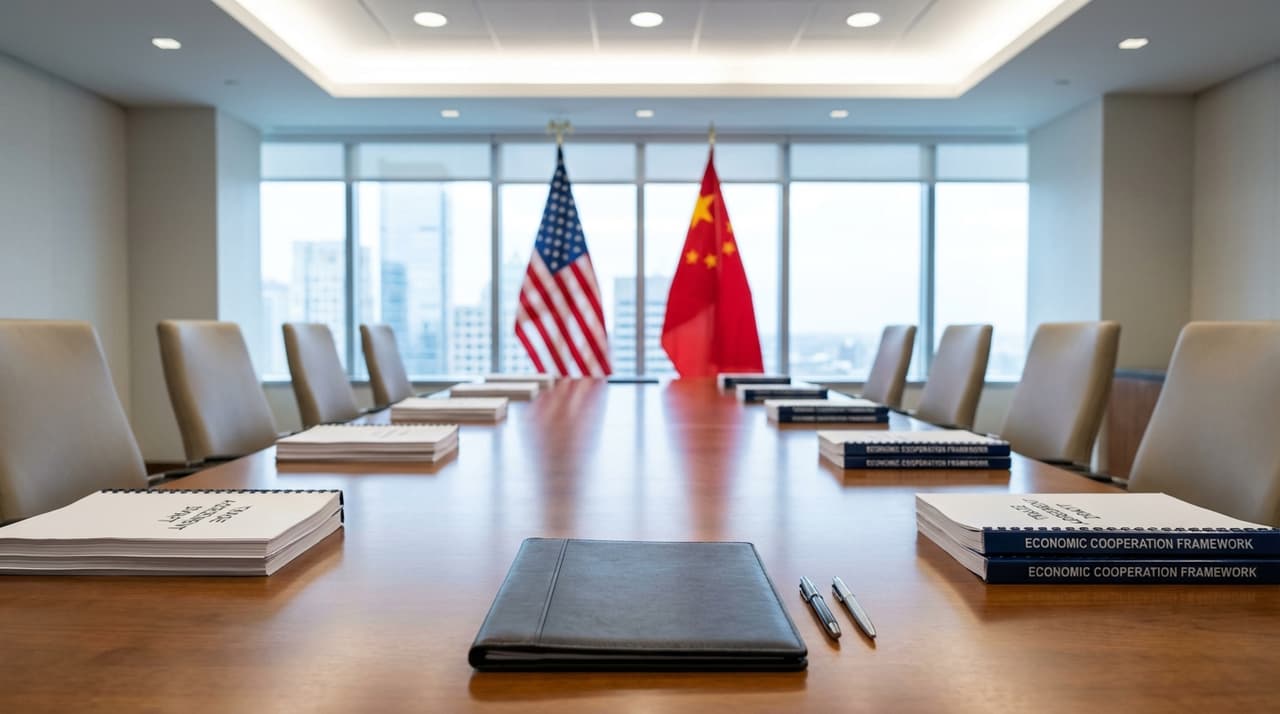
- U.S. Trade Representative Jamieson Greer frames Washington's goal as achieving more "balanced, managed trade" with China, emphasizing structured purchase commitments and reciprocal market access.
- A tariff truce, extended through November 2026, has slashed reciprocal rates from peak levels of 145% (U.S.) and 125% (China) to around 10% for most goods, easing pressure on exporters and consumers.
- The de-escalation follows a major 2025 escalation, with ongoing negotiations focused on codifying enforcement mechanisms and sector-specific agreements, particularly in agriculture and energy.
U.S. Trade Representative Jamieson Greer has articulated Washington's objective in the current U.S.–China trade negotiations as pursuing more "balanced, managed trade" with Beijing, according to people familiar with the discussions. This framing comes amid a fragile truce that has significantly reduced bilateral tariffs after a sharp escalation earlier this year, offering a respite to global supply chains and export-dependent sectors.
On May 12, 2025, after talks in Geneva involving U.S. Treasury Secretary Scott Bessent and Ambassador Greer, the two sides agreed to slash reciprocal tariffs from peak levels—145% imposed by the U.S. and 125% by China—to around 10% for most goods, initiating a 90-day truce. The U.S. maintained a separate 20% "fentanyl" tariff on Chinese goods, pushing the effective rate on many imports to 30% initially. Following two extensions, an October 30, 2025 summit in Busan between former President Donald Trump and Chinese leader Xi Jinping locked in the 10% reciprocal tariffs for one year, through November 10, 2026, with the U.S. cutting the fentanyl tariff to 10%. In return, China lifted retaliatory tariffs of 10–15% on U.S. agricultural goods and extended some tariff exemptions on U.S. imports through at least end-2026.
Greer's emphasis on "managed trade" reflects a shift toward structured agreements, such as long-term Chinese commitments to purchase U.S. farm products and industrial goods, echoing language in recent economic understandings. "What we're seeing is a move away from pure tariff warfare to a more calibrated approach," said an analyst who requested anonymity due to the sensitivity of the talks. "It's about creating predictable flows, especially in sectors like agriculture where market access has been volatile." Efforts to reach Greer's office for further comment were not immediately successful.
The truce has provided relief to U.S. farmers and agribusiness, who benefit from China lifting retaliatory tariffs on soybeans, corn, pork, and beef, restoring a key export market. Similarly, Chinese exporters of consumer and intermediate goods face lower U.S. border taxes, though sectors like electric vehicles, batteries, and strategic technology remain under tighter U.S. trade restrictions due to separate Section 301 tariffs. J.P. Morgan (JPM) and other analysts note that while tariffs remain above pre-war levels, the reduction eases uncertainty and may modestly support global trade, with forecasts suggesting the earlier tariff spikes could have trimmed global merchandise trade by about 0.2%.
Politically, the de-escalation follows a major escalation under Trump's second term in early 2025, when successive hikes triggered the high-tariff confrontation and Chinese countermeasures, including adding some U.S. firms to its "Unreliable Entity List." U.S. policy continues to be shaped by a consensus in Washington that trade with China should be more "fair" and security-screened, even as tariffs are partly rolled back. Internationally, the truce is viewed as a tactical move rather than a full reset, with both sides maintaining industrial policies and controls in sensitive sectors like semiconductors and critical minerals.
Looking ahead, short-term negotiations are likely to focus on codifying purchase targets and enforcement mechanisms that embody Greer's "managed trade" vision, potentially stabilizing bilateral trade volumes through late 2026. In the long term, experts anticipate persistent strategic rivalry, with both sides expected to keep or expand targeted controls on advanced technology, reinforcing a trend toward more politicized trade relationships. As one industry insider put it, "This isn't about returning to the old normal; it's about managing a new, more contentious reality with clearer rules of engagement."