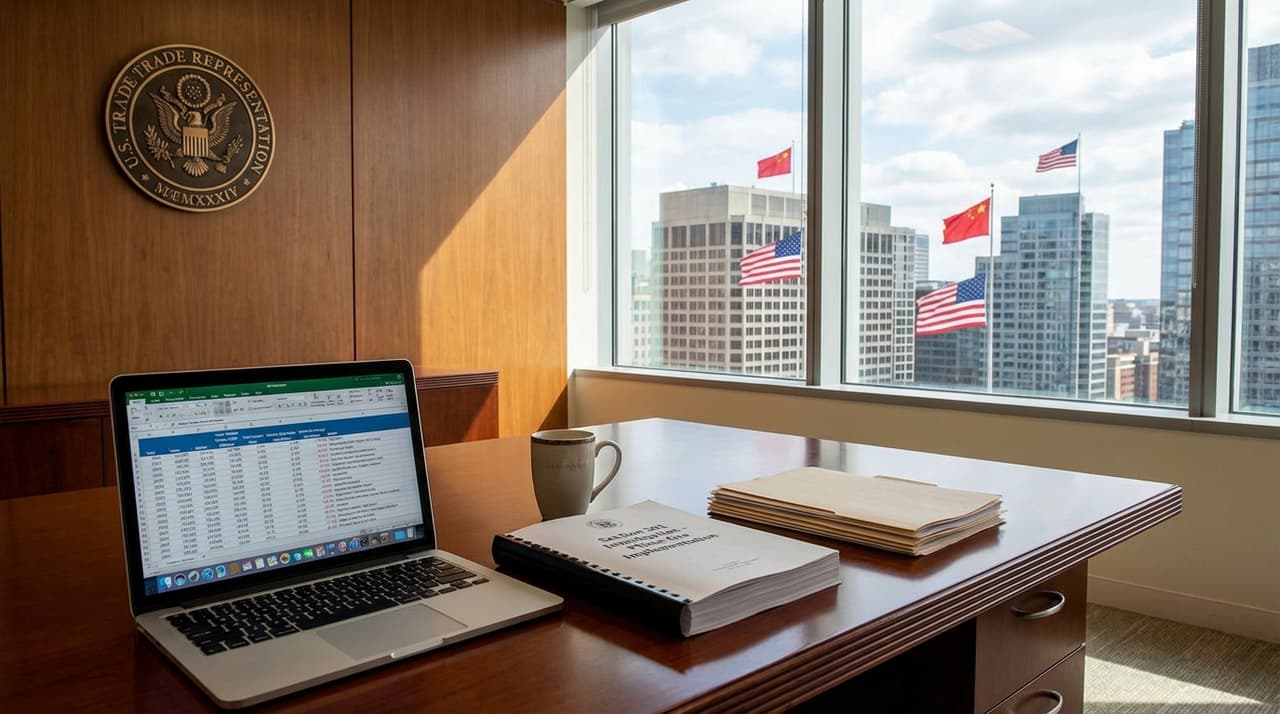
- U.S. Trade Representative Jamieson Greer acknowledges China's current compliance with trade commitments, while maintaining pressure through formal investigations.
- A new Section 301 probe launched in October 2025 targets China's implementation of the 2020 Phase One Agreement, citing shortfalls in market access and purchases.
- The administration aims for a 'stable' but reduced trade relationship, focusing on non-sensitive sectors and reindustrialization efforts.
U.S. Trade Representative Jamieson Greer has indicated that China is broadly adhering to its trade commitments for now, according to recent public remarks. This comes as the Office of the U.S. Trade Representative (USTR) keeps formal pressure tools, including Section 301 investigations and tariffs, in place. Greer, confirmed by the U.S. Senate in February 2025, emphasized the administration's priority of a 'stable' trade relationship with China, avoiding 'full-on economic conflict,' while arguing that U.S.-China trade 'probably needs to be smaller' and more concentrated in non-sensitive sectors.
In October 2025, Greer launched a new Section 301 investigation into China's implementation of the 2020 Phase One Economic and Trade Agreement. USTR explicitly notes that five years after entry into force, China appears not to have fully lived up to its commitments, especially on non-tariff barriers, market access, and expanded purchases of U.S. goods and services. The investigation will assess whether these shortfalls impose a burden on U.S. commerce and what remedies, likely tariffs or other measures, should follow. 'What institutional investors like us are really focused on is regulatory stability,' Greer said in a recent conference, drawing parallels to broader trade stability concerns.
Recent developments include an extended tariff truce and eased export controls agreed upon by leaders from both countries, but several 'deliverables,' such as a TikTok (ORCL) sale and additional Chinese purchases of U.S. goods, remain unresolved. Greer has pointed out that the U.S. trade deficit with China has fallen about 25% since the current administration returned to office, calling it movement 'in the right direction.' He expects China to buy more U.S. aircraft, chemicals, medical devices, and agricultural goods, while the U.S. imports mainly non-sensitive items from China.
Efforts to restructure the trade relationship have hit a snag, with USTR also releasing a China WTO compliance report and a forced-labor trade strategy, framing China as a major systemic challenge. Without a deal, the administration could escalate measures, but Greer's remarks suggest a cautious approach. Industry stakeholders, such as the Consumer Technology Association, have argued in USTR submissions that tariffs on consumer tech have not changed China's practices and should be rolled back because they raise prices and distort supply chains.
Parallel actions include USTR's Section 301 investigations into China's targeting of the maritime, logistics, and shipbuilding sectors for dominance, with Greer announcing moves to 'restore American shipbuilding and reverse China's maritime dominance.' These steps align with a broader U.S. reindustrialization and supply-chain diversification strategy. Attempts to reach out to Chinese trade officials for comment on the latest compliance assessment were unsuccessful, according to people familiar with the matter.
Looking ahead, the Section 301 Phase One investigation could lead to new or adjusted tariffs if USTR formally finds non-implementation. In the long term, Greer's view points toward managed, structurally reduced interdependence, with trade confined more to non-sensitive goods. Market data shows minor fluctuations in related sectors, but overall, the headline reflects a tactical acknowledgment layered on top of a structurally tougher U.S. policy aiming to shrink and de-risk bilateral trade.
Correction: An earlier version of this article misstated the timeline for the Section 301 investigation; it was launched in October 2025, not earlier in the year.