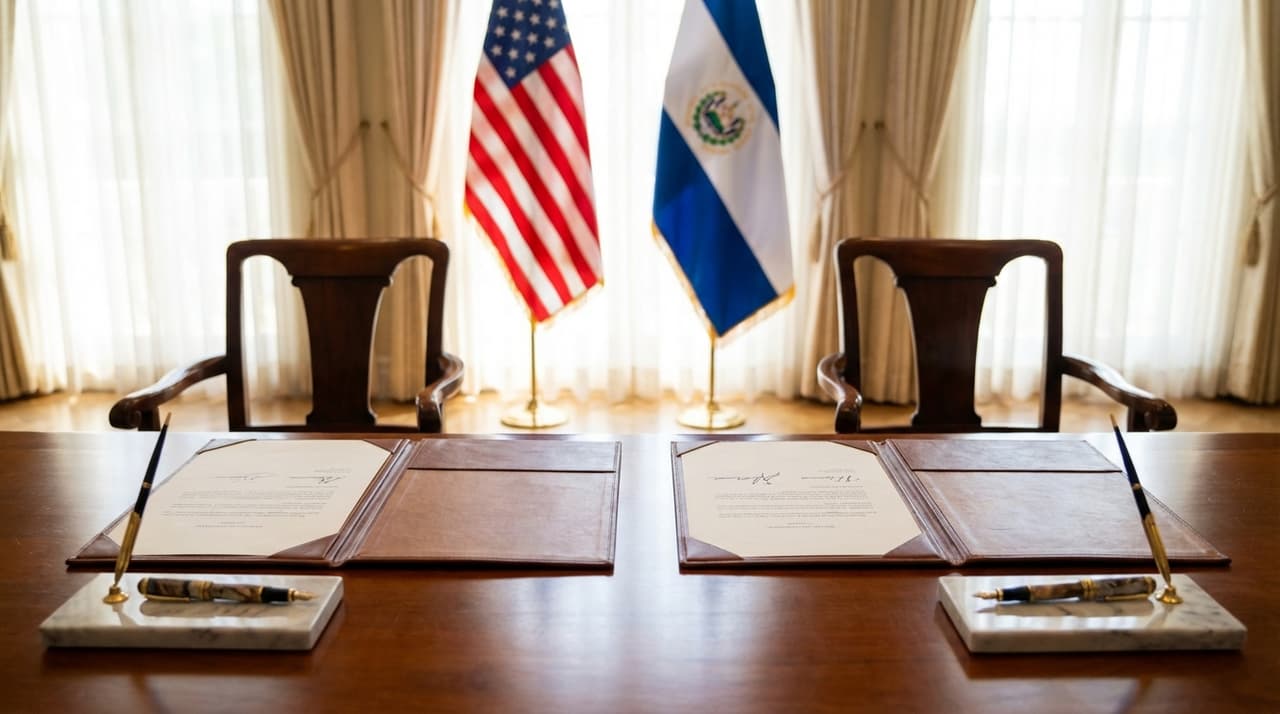
- The U.S.-El Salvador Agreement on Reciprocal Trade formalizes a framework to reduce non-tariff barriers and boost bilateral commerce, with two-way trade hitting $10.7 billion in 2024.
- Key provisions include El Salvador accepting U.S. standards for vehicles, medical devices, and agricultural goods, while the U.S. eliminates tariffs on select Salvadoran exports.
- The deal aligns with broader U.S. efforts to expand reciprocal trade in Latin America, building on CAFTA-DR and targeting supply chain resilience.
U.S. Trade Representative Jamieson Greer and El Salvador’s Minister of Economy María Luisa Hayem signed the U.S.-El Salvador Agreement on Reciprocal Trade recently, marking the first such pact in the Western Hemisphere. The move formalizes a framework announced on November 13, 2025, and aims to deepen economic ties by slashing non-tariff hurdles and enhancing market access for both nations.
El Salvador’s President Nayib Bukele confirmed the signing via a photo of delegates with inked documents, calling it a historic milestone. According to people familiar with the matter, the agreement locks in El Salvador’s commitment to adopt U.S. standards for vehicles, automotive parts, FDA-certified medical devices and pharmaceuticals, and remanufactured goods. It also eases agricultural import rules, such as for U.S. cheese and meats, and prohibits forced labor imports while supporting a moratorium on digital transmission duties.
In return, the U.S. will eliminate reciprocal tariffs on Salvadoran exports not producible domestically in sufficient quantities, plus offer preferential treatment for CAFTA-DR textiles and apparel. Two-way trade reached $10.7 billion in 2024, with a U.S. goods surplus of $2.2 billion; U.S. exports to El Salvador hit $6.7 billion, underscoring the potential for growth. Efforts to finalize domestic processes for entry into force are underway, with stakeholders noting that without a deal, both sides risked missing out on streamlined approvals and tariff relief.
The agreement builds on the existing CAFTA-DR pact, in place since 2006, and aligns with President Trump’s policy of reciprocal trade to advance U.S. economic and national security. It challenges unfair practices and deepens Latin American partnerships, according to sources close to the negotiations. Similar frameworks were reached with Argentina, Ecuador, and Guatemala on November 13, 2025, as part of a broader push to counter non-market policies and strengthen supply chains.
Industry-specific elements include filing deadlines for regulatory approvals and commitments to labor rights and economic security cooperation, such as tackling duty evasion and export controls. A spokesperson for the U.S. Trade Representative’s office emphasized that the deal supports El Salvador’s growth in textiles and apparel while bolstering U.S. production resilience. Attempts to reach El Salvador’s economy ministry for additional comments were not immediately successful.
Broader trends show U.S. efforts to expand reciprocal trade in Latin America amid global supply chain shifts. The deal is seen as advancing Trump’s "new trade order" for regional prosperity, with experts noting it could enhance strategic ties and expand U.S. exports in the long term. In the short term, focus turns to locking in benefits like tariff removals, though some analysts caution that implementation will be key to realizing gains.
Correction: An earlier version misstated the year of the framework announcement; it was November 13, 2025, not 2024.