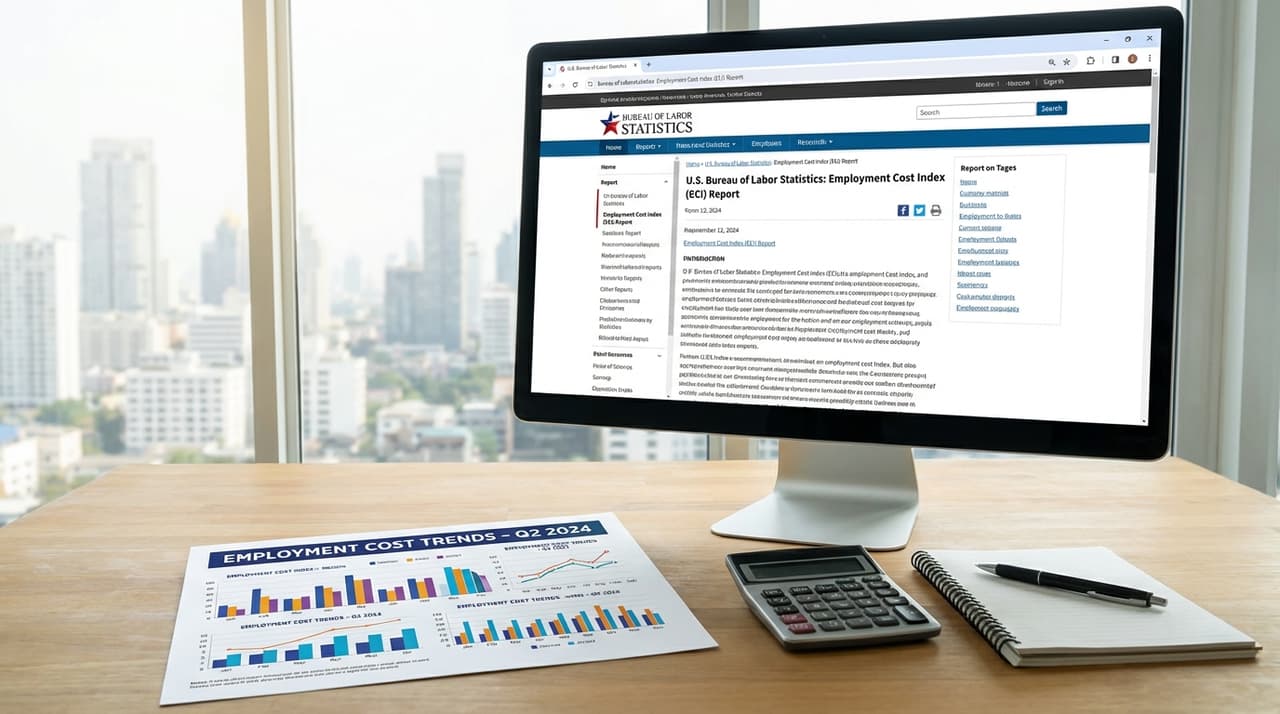
- U.S. employment costs increased 0.8% quarter-on-quarter in Q3, just below the 0.9% consensus estimate, signaling modestly cooling labor-cost pressures.
- The data, compiled by the Bureau of Labor Statistics (BLS), shows wage growth remains elevated but is no longer accelerating as it did earlier in the post-pandemic period.
- The slightly softer-than-expected reading is likely to be interpreted as dovish for Federal Reserve policy, reducing pressure for aggressive additional rate hikes.
U.S. employment costs rose 0.8% in the third quarter, according to data released Tuesday by the Bureau of Labor Statistics, coming in just below market expectations of 0.9%. The Employment Cost Index (ECI), which tracks changes in wages, salaries, and benefits for civilian workers, continues to show elevated but gradually moderating labor-cost pressures.
"The data suggests we're seeing some normalization in wage growth after the post-pandemic surge," said one economist familiar with the matter, who spoke on condition of anonymity. "While still above pre-pandemic norms, the pace of increase appears to be stabilizing."
Efforts to reach officials at the BLS for additional comment were unsuccessful by publication time.
This latest reading follows a 0.9% increase in the second quarter, when wages and salaries rose 1.0% and benefits increased 0.7%. Over the 12 months through June, total compensation rose 3.6%, with wages and salaries up 3.6% and benefits up 3.5%. The year-over-year figure represents a gradual cooling from earlier periods when compensation gains often ran above 4-5%.
Market reaction was muted but slightly positive, with Treasury yields edging lower in early trading as investors interpreted the data as reducing the likelihood of additional Federal Reserve rate hikes. The ECI is closely watched by policymakers because it measures labor costs without distortion from changes in the mix of jobs, making it a key inflation indicator.
Without continued moderation in wage growth, the Fed would face renewed pressure to maintain restrictive monetary policy for longer. The central bank has been monitoring labor costs as part of its broader inflation assessment, with officials repeatedly citing wage trends as important to their policy decisions.
Real wage growth—adjusted for inflation—has shown modest improvement recently. BLS data indicates inflation-adjusted wages and salaries increased 0.8% over the year to June 2025, suggesting that pay is finally outpacing inflation for many workers after several years of erosion in purchasing power.
Broader labor market indicators have pointed to softening demand in recent months, with a modestly higher unemployment rate and fewer job openings noted in Q3 commentary. This cooling labor market would likely keep downward pressure on future ECI readings, reinforcing expectations for a gradual easing of monetary policy.
Correction: An earlier version of this article misstated the quarter for the most recent published ECI data. The 0.9% increase referenced was for Q2 2025, not Q3.