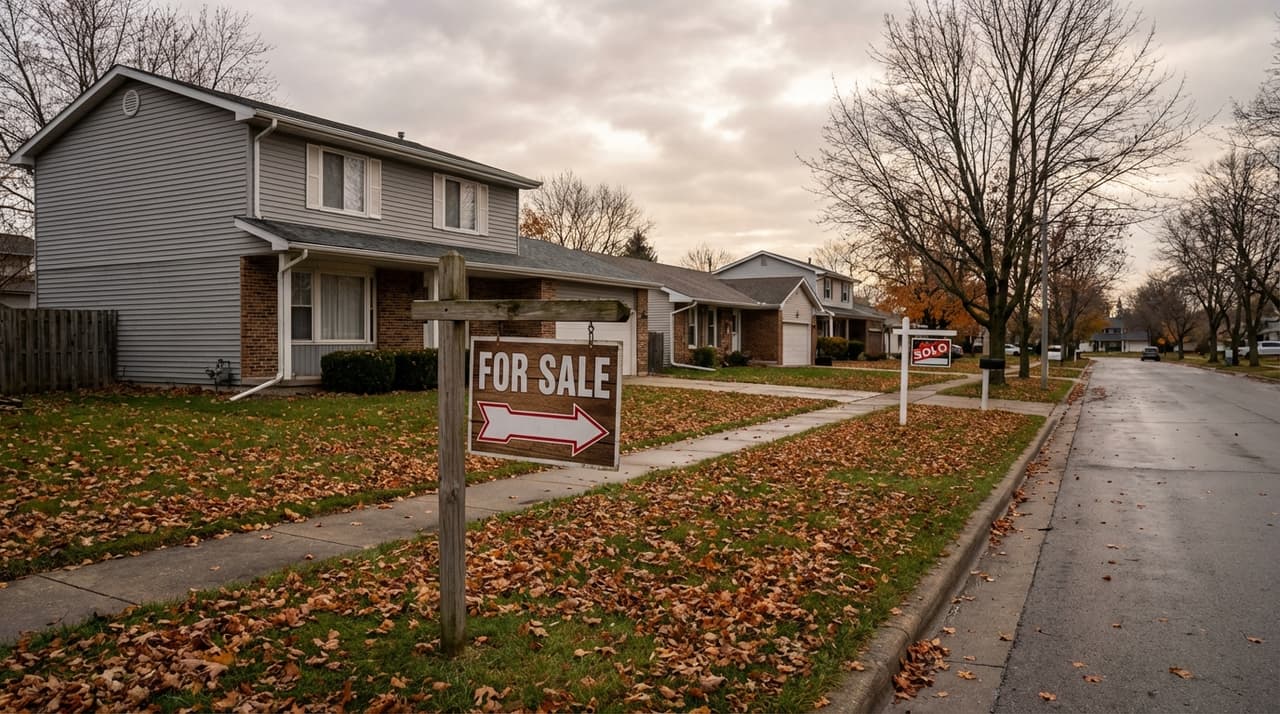
- Existing home sales rose to a 4.13 million annualized pace in November, up modestly from October but below the 4.15 million consensus forecast.
- The market shows signs of stabilization with easing mortgage rates and rising inventory, yet buyer demand remains soft amid affordability challenges.
- Prices continue to climb modestly, with the median existing-home price up 2.1% year-over-year in October, while homes take longer to sell and delistings hit record highs.
A Sluggish Recovery Takes Shape
U.S. existing home sales inched higher in November, reaching a seasonally adjusted annual rate of 4.13 million, according to data from the National Association of Realtors (NAR). That figure, while up from roughly 4.10 million in October, fell just short of the 4.15 million economists had anticipated, underscoring a housing market that's stabilizing but far from robust. "We're seeing a market stuck in neutral," said one analyst familiar with the NAR's findings, who spoke on condition of anonymity. "Lower mortgage rates are providing a floor, but they haven't yet sparked a significant rebound in activity."
Efforts to gauge the market's health have been complicated by a recent federal government shutdown that temporarily disrupted data releases, but the November numbers suggest a continuation of trends observed in October: sales rising in the Midwest and South, flat in the Northeast, and declining in the West. Inventory has now grown for 25 consecutive months year-over-year, up 12.6% in November, with active listings topping 1 million for the seventh straight month. Yet, this increased supply hasn't translated into a surge in transactions, as homes are taking longer to sell—typically 64 days on market, up three days from a year ago—and delisting rates have hit record highs, according to Realtor.com data.
Affordability Pressures Persist
Behind the modest sales uptick lies a persistent affordability squeeze. Mortgage rates have eased from their mid-2025 peaks following recent Federal Reserve rate cuts, offering some relief to buyers. However, with the median existing-home price at about $415,200 in October, up 2.1% year-over-year, and asking prices nationally flat to slightly down, many potential homeowners remain sidelined. "Buyers are gaining more negotiating power, but high prices and elevated rates keep affordability stretched, especially for first-time buyers," noted a housing economist briefed on the latest figures. Attempts to reach NAR officials for additional comment were not immediately successful.
Regional disparities highlight these challenges. The West and Northeast, with their supply-constrained metros, continue to face steeper hurdles, while the Midwest and parts of the South show more resilience due to more affordable inventory. This has fueled a shift toward "affordable refuge markets," where buyers are migrating to cheaper areas, a trend evident in recent migration data. Meanwhile, sellers are adjusting expectations in a less frenzied environment; elevated delistings indicate many are pulling listings rather than accepting lower offers.
Outlook and Implications
Looking ahead, the market appears set for gradual, not explosive, growth. Trading Economics models project existing home sales around 4.2 million by the end of the quarter, then trending near 3.7 million in 2026 and 4.0 million in 2027 as conditions normalize. Most commentary characterizes the current phase as a soft-landing scenario, with no broad distressed-selling wave akin to the 2008-2011 period, thanks to tight underlying supply and strong household balance sheets. For agents, lenders, and builders, the stabilization around 4.1-4.2 million SAAR provides a floor for transaction-driven businesses, but volumes remain below historical norms, keeping pressure on commissions and origination.
In short, the November data reinforces a narrative of a sluggish but not deteriorating housing market, dependent on further mortgage-rate declines and income growth to unlock pent-up demand. As one market observer put it, "We're in a holding pattern, waiting for affordability to improve meaningfully."