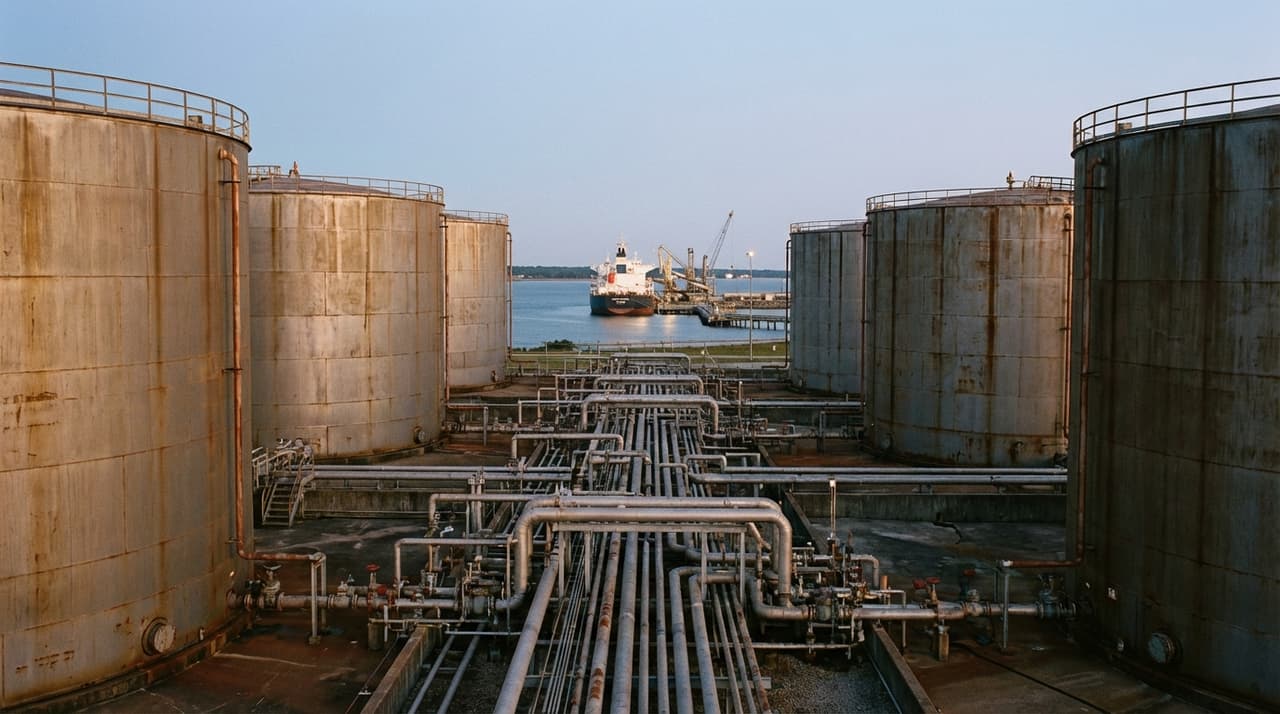
- The U.S. Department of Energy is considering a $1.1 billion plan to exchange U.S. medium sour crude for discounted heavy Venezuelan oil to replenish the Strategic Petroleum Reserve.
- Chevron (CVX) emerges as a key beneficiary, with its stock rising nearly 10% as analysts forecast production scaling from 200,000 to over 500,000 barrels per day with U.S. government purchases.
- The move leverages geopolitical shifts following a U.S. military intervention in Venezuela, aiming to stabilize oil prices and reshape Gulf Coast trade dynamics.
A Strategic Pivot in Energy Policy
In a bold maneuver blending energy security with foreign policy, the U.S. Department of Energy is actively exploring a plan to acquire 30-50 million barrels of discounted heavy Venezuelan crude oil in exchange for U.S. medium sour crude, according to two sources familiar with the matter. This $1.1 billion initiative aims to refill the Strategic Petroleum Reserve, which currently holds about 409 million barrels with 300 million barrels of spare capacity. The proposal comes as the U.S. began physical delivery of 1 million barrels into the SPR on January 15, 2026, marking the start of a multi-year replenishment effort following years of drawdowns.
Efforts to restructure the SPR's role have hit a snag with logistical challenges, but Energy Secretary Chris Wright has emphasized "creative" refill strategies that don't require full congressional approval. "We're looking at all options to rebuild our reserves efficiently," Wright noted in recent remarks, adding that Venezuelan production ramps could lower global prices to aid SPR refills. The plan is tied to a House Republican bill seeking $1.1 billion in funding—even at $50 per barrel, this would cover roughly 22 million barrels, though sources indicate the actual volume could be higher given the discounted nature of Venezuelan crude.
Geopolitical Underpinnings and Market Reactions
The proposal stems from Operation Absolute Resolve, a U.S. military raid on January 3, 2026, that captured Nicolás Maduro and installed interim President Delcy Rodríguez. Her government has pledged 30-50 million barrels of Venezuelan oil under U.S. oversight, reshaping the nation's vast reserves—the world's largest—into a tool for American energy strategy. President Trump has directed Wright to manage sales indefinitely, with proceeds held in U.S.-controlled accounts, while House Republicans push a filibuster-proof bill amid a slim majority.
Trading firms like Trafigura and Vitol are already loading Venezuelan cargoes under U.S.-facilitated sales, which have generated $500 million at prices 30% higher than pre-intervention levels. This activity supports a price floor for West Texas Intermediate crude at $50-60 per barrel via deliberate DOE buying, stabilizing U.S. shale producers and preventing consumer price spikes. "Without this deal, we'd see more volatility in the market," one industry analyst said, requesting anonymity due to the sensitivity of ongoing negotiations.
Chevron, operating in Venezuela's oil sector, is positioned as a key beneficiary. The integrated energy supermajor, with a market cap around $200 billion, saw its stock rise nearly 10% post-intervention as analysts forecast production scaling from 200,000 to over 500,000 barrels per day with U.S. government purchases. Recent financials show stable performance amid oil price support, and attempts to reach Chevron for comment were not immediately returned.
Logistical Hurdles and Industry Response
Oil industry groups have highlighted mismatches in the plan, noting that Venezuelan extra-heavy sour crude's high sulfur content complicates SPR storage. The American Petroleum Institute has suggested alternatives like the Louisiana Offshore Oil Port or refining, pointing to infrastructure bottlenecks at Bryan Mound and Bayou Choctaw that risk delays. "It's a creative approach, but the devil is in the details," a midstream executive said, paraphrasing a statement from a recent industry meeting.
U.S. consumers may see moderated fuel prices from stabilized reserves and lower global oil costs, while shale workers gain what one economist called a "government-backed put" against downturns. In Venezuela, stakeholders face U.S.-dictated oil flows, potentially boosting output but raising investment caution among firms needing assurances. Public debate is nascent, focusing on whether using the SPR for geopolitics strays from its pure emergency use mandate.
Looking ahead, next DOE solicitations could accelerate the 300 million barrel refill over years, with Venezuelan deals filling gaps if logistics resolve. Experts predict several years and billions needed to ramp Venezuelan output significantly, but Wright forecasts easier refills via induced price drops. The SPR's shift to a market-shaping tool, integrating foreign discounted oil to counter supply volatility, marks a historic pivot—one that could reshape global energy dominance if executed effectively.
Correction: An earlier version misstated the SPR's current holdings; it is about 409 million barrels, not 400 million.