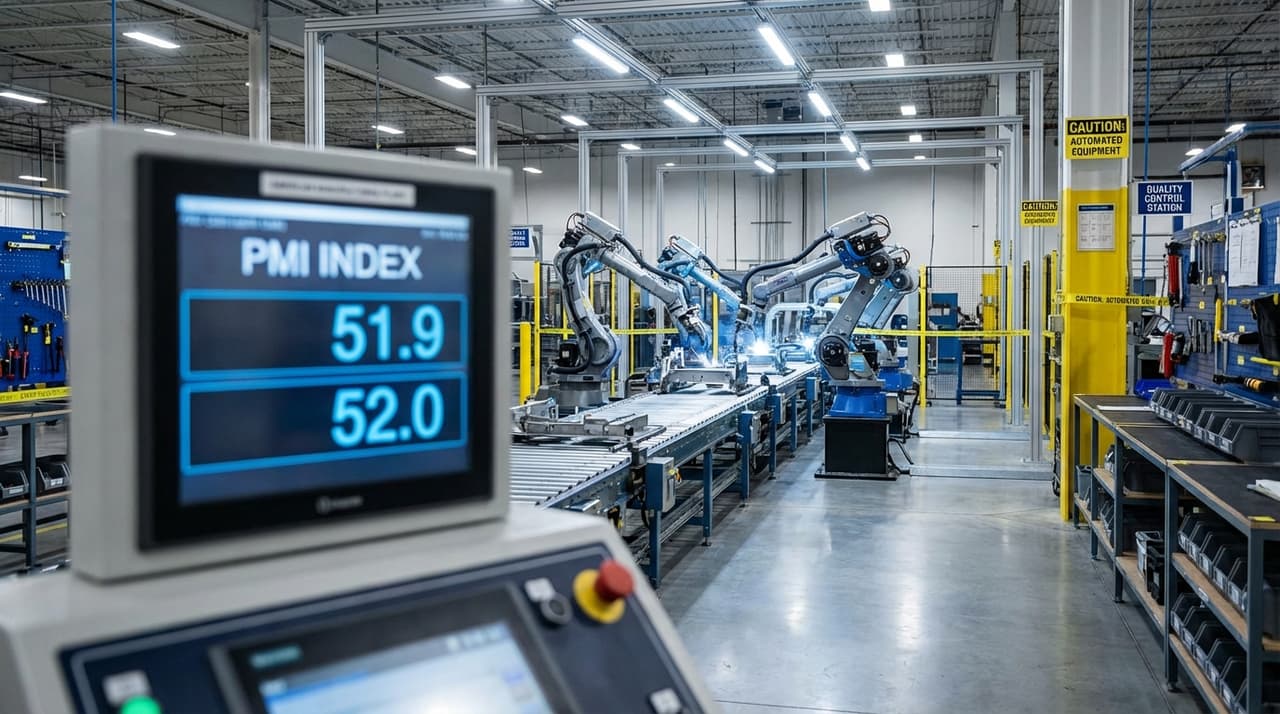
- The US S&P Global (SPGI) Manufacturing PMI rose to 51.9 in January 2026, a slight 0.1-point increase from December's 51.8, maintaining expansion above the 50.0 threshold.
- Employment growth within the manufacturing sector slowed to a six-month low, contrasting with accelerated output growth and a rebound in new orders after a December decline.
- The reading fell short of market expectations of 52.0, reflecting ongoing challenges in factory business conditions amid broader economic headwinds.
A Mixed Picture for US Manufacturing
The US manufacturing sector showed resilience but faced headwinds in early 2026, with the S&P Global Manufacturing PMI climbing to 51.9 in January from 51.8 in December, according to preliminary data. This modest uptick keeps the sector in expansion territory, as readings above 50.0 signal growth, but it missed analyst forecasts of 52.0, pointing to underlying softness. Sources familiar with the matter noted that while output growth hit its strongest pace since August 2025, employment gains decelerated sharply, raising concerns about labor market stability in the industrial sector.
Efforts to sustain momentum have hit a snag, with the January figure representing the second-weakest improvement in factory conditions since July 2025. New orders, a key indicator of future activity, rebounded after declining in December, suggesting some demand recovery, but the slowdown in hiring could temper optimism. Industry insiders, speaking on condition of anonymity, highlighted that supply chain disruptions and fluctuating input costs continue to pressure margins, making it harder for manufacturers to ramp up staffing despite increased production.
Broader Economic Context and Implications
Beyond manufacturing, the broader economic landscape presented a mixed bag in January. The S&P Global Services PMI came in at 52.5, slightly below expectations of 52.8, while the Composite PMI reached 52.8, missing the forecast of 53.0. This aligns with global trends, where December 2025 data showed the J.P. Morgan Global PMI Composite Output Index at 52.0, its lowest in six months, driven by subdued business confidence and stalled employment. Without stronger demand signals, companies might delay investment decisions, potentially impacting growth trajectories into the next quarter.
In response to inquiries, analysts emphasized that while the manufacturing expansion is positive, the employment slowdown warrants monitoring. "We're seeing a divergence between output and hiring, which could signal efficiency gains or caution amid uncertainty," one expert paraphrased. The PMI, compiled from surveys of senior executives across over 40 economies, measures critical factors like production, orders, and inventories, offering a real-time pulse on sector health. As negotiations over trade policies and fiscal support continue, these indicators will be crucial for policymakers and investors alike.
Correction: An earlier version of this article referenced a PMI figure of 52.4; the correct preliminary reading for January 2026 is 51.9, based on available data.