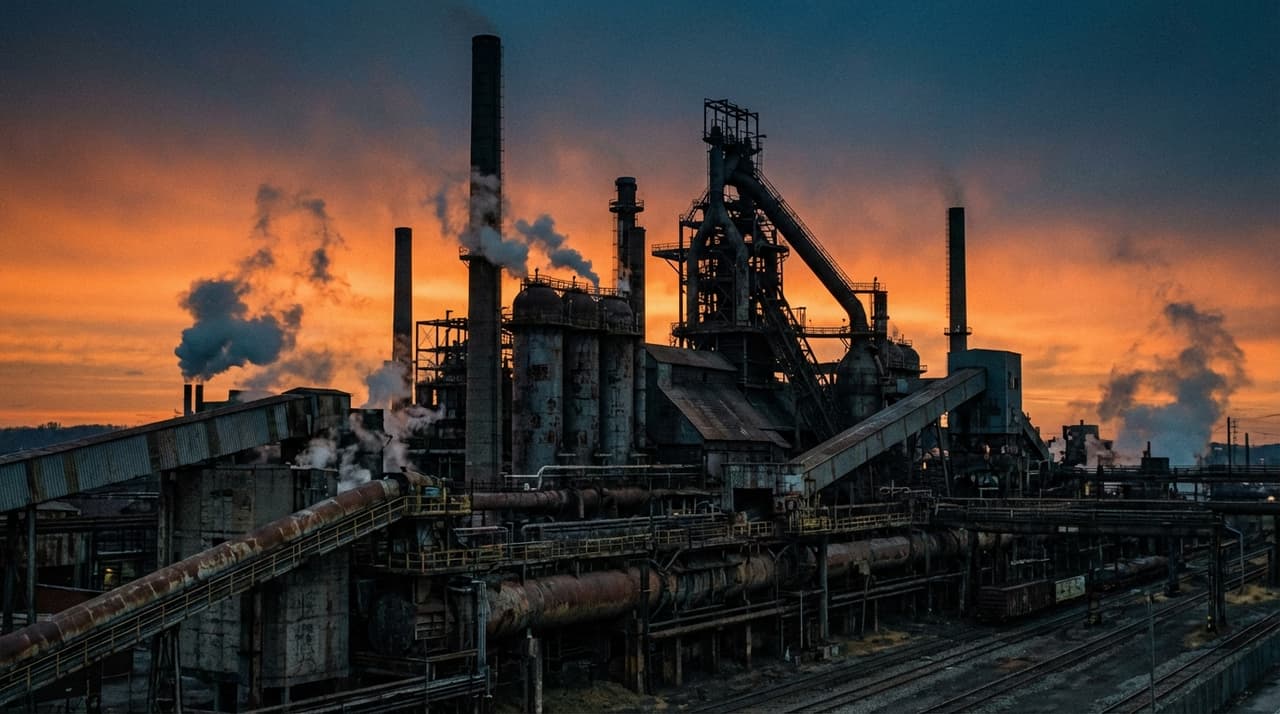
- US steel output reached 82 million metric tons in 2025, overtaking Japan's 80 million metric tons amid a 3.1% increase versus Japan's declines.
- Global crude steel production hit 1.8494 billion tonnes, with non-China output rising 1% as emerging markets like India gain while traditional hubs like Japan face drops across all steel categories.
- The shift reflects lower US energy costs boosting competitiveness and Japan's structural challenges, including a halving of domestic demand since 1990 and capacity reductions by major players like Nippon Steel (5401.T).
A Turning Point in Global Steel Rankings
In a notable shift for the global steel industry, the United States has edged past Japan to become the world's third-largest steel producer in 2025, according to recent production data. US output climbed to 82 million metric tons, a 3.1% increase that propelled it ahead of Japan, where production fell to around 80 million metric tons from 84 million in 2024. This reversal aligns with claims made by former President Donald Trump highlighting US resurgence, though it stems from broader economic trends rather than political rhetoric alone.
December figures underscore the momentum: US output was 6.9 million metric tons, up 3.6% year-over-year, while Japan's dropped 4.8% to 6.6 million metric tons. "We're seeing a realignment driven by cost advantages and shifting demand patterns," said one industry analyst familiar with the matter, who spoke on condition of anonymity. Efforts to reach Nippon Steel, Japan's largest steelmaker, for comment were not immediately successful, but the company has been restructuring aggressively, reducing capacity by 20% from FY2019 levels through blast furnace closures to achieve ¥150 billion in annual cost savings.
Underlying Factors and Market Dynamics
Behind the numbers, lower energy costs in regions like Texas have bolstered US competitiveness, with production expenses reportedly below $800 per tonne compared to Japan's higher costs tied to energy imports and aging infrastructure. Meanwhile, Japan's steel demand has halved to about 50 million metric tons since its 1990 peak, linked to population decline and falling housing and auto output. This has forced producers to rely more on exports, with Japan's steel scrap exports rising 17.9% year-over-year in 2025 to 7.71 million metric tons, primarily to Vietnam.
Globally, crude steel production reached 1.8494 billion tonnes in 2025, with non-China output up 1% to 888.6 million tonnes, reflecting a gradual pivot toward emerging markets. Capacity is set to grow by 68 million metric tons from 2024 to 2026, led by ASEAN and India, which account for 88.9% of Asia's additions. However, China's surplus exports of around 110 million metric tons per year continue to depress prices by roughly $100 per tonne, squeezing profits worldwide by an estimated ¥30 trillion annually. "Without a deal to curb excess capacity, the industry risks prolonged price wars," noted a source close to OECD discussions, referencing warnings of a dual CO2 and overcapacity crisis through 2026.
Strategic Moves and Future Implications
In response, Japanese firms are adapting. Nippon Steel recently finalized a partnership with U.S. Steel (X) to expand in high-grade US and European markets, though this could face regulatory scrutiny in the US over foreign investment concerns. The tie-up aims to leverage growth opportunities abroad as domestic prospects dim. "Japan's capacity reductions now exceed additions, mirroring trends in China where net cuts are marginal," explained an industry insider, highlighting how global excess capacity remains high compared to 2015 levels.
Short-term, the US is likely to hold its top-three position if current trends persist, while Japan may export more scrap amid stagnant capacity into 2026. Long-term, experts predict a continued overseas shift to India and the Middle East, with advanced economies like the US and Japan focusing on high-value steel segments. For now, the ranking shift—with China at No. 1, India at No. 2, the US at No. 3, Japan at No. 4, and Russia at No. 5—marks a symbolic moment in an industry grappling with overcapacity and evolving trade dynamics.
Correction: An earlier version misstated Japan's 2024 steel output; it was 84 million metric tons, not 85 million.