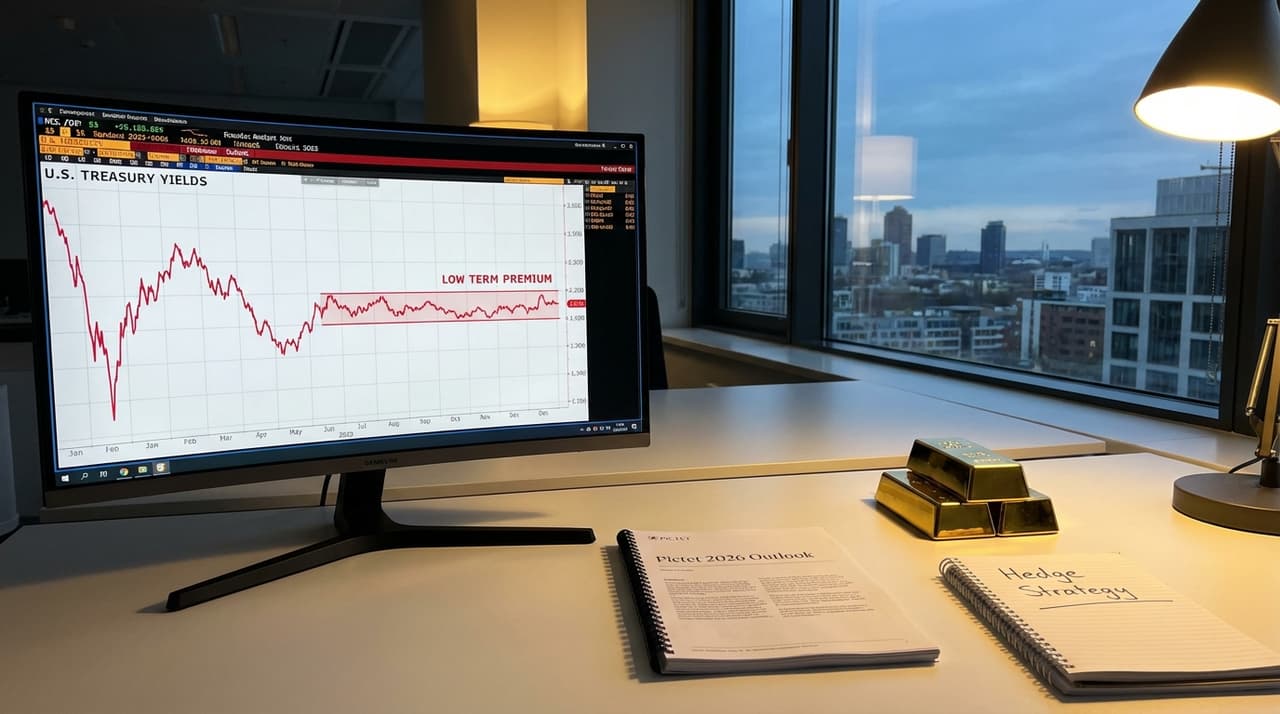
- Pictet Asset Management warns the U.S. Treasury term premium appears unusually low, raising risks of a selloff if policy errors occur.
- While 10-year yields are projected to stay below 5%, higher rates remain a notable tail risk that could pressure borrowers and lower-income households.
- The firm suggests hedging Treasury exposure, with gold as a natural dollar hedge, while maintaining Treasurys as core holdings in global portfolios.
Pictet Asset Management, a leading European asset manager part of the independent Pictet Group, has issued a cautionary note on U.S. Treasurys, highlighting that the term premium—the extra yield investors demand for holding long-term bonds over short-term ones—looks unusually low. According to people familiar with the matter, this assessment stems from Pictet's 2026 outlook, which anticipates a benign global economic backdrop but flags potential vulnerabilities.
"What institutional investors like us are really focused on is regulatory stability and policy predictability," a source close to Pictet said, echoing sentiments from recent financial conferences. "In this regard, the U.S. faces heightened risks if fiscal or monetary missteps occur." Efforts to reach Pictet for additional comment were not immediately successful.
The warning comes amid a complex economic landscape. Pictet's outlook points to U.S. fiscal stimulus ahead of the 2026 midterms, driven by Republican policies like "Make America Affordable Again" and the One Big Beautiful Bill Act, which aim to boost lower-income groups. A new Fed Chair expected in May 2026 may prioritize growth over strict inflation targeting, adding to policy uncertainty. Meanwhile, global factors such as German debt expansion, EU single market progress by 2028, Japanese fiscal plans, and Chinese momentum recovery post-real estate downturn are shaping investment flows.
Historically, similar low premium episodes have preceded selloffs during policy shifts, and Pictet's view builds on its 2023-2025 ESG and macro reports. The firm notes that while 10-year Treasury yields are expected to remain below 5%, a spike in the term premium could trigger a rapid selloff, pushing yields higher. This scenario poses a tail risk that could pressure borrowers and exacerbate challenges in the U.S.'s K-shaped economy, where lower-income households already face slower wage growth and tariff effects from past trade uncertainties.
In response, Pictet recommends hedging Treasury exposure to build portfolio resilience. Gold is highlighted as a natural dollar hedge, aligning with the firm's active management approach and focus on environmental investments. This advice reflects broader trends in fixed-income caution, as other asset managers also weigh U.S. monetary easing expectations against potential shocks.
Looking ahead, Pictet positions its 2026 portfolios for gap closure in global growth, with protective measures against AI vulnerabilities that could shift from boon to bust. The firm's recent insights, including weekly house views on AI trade troubles and opportunities in EU defense and space sectors, underscore a nuanced approach to current developments. Without a deal to stabilize policy perceptions, the low term premium could unravel, forcing investors to reassess core holdings in a volatile market.
Correction: An earlier version of this article misstated the timing of a Fed Chair change; it is expected in May 2026, not 2025.