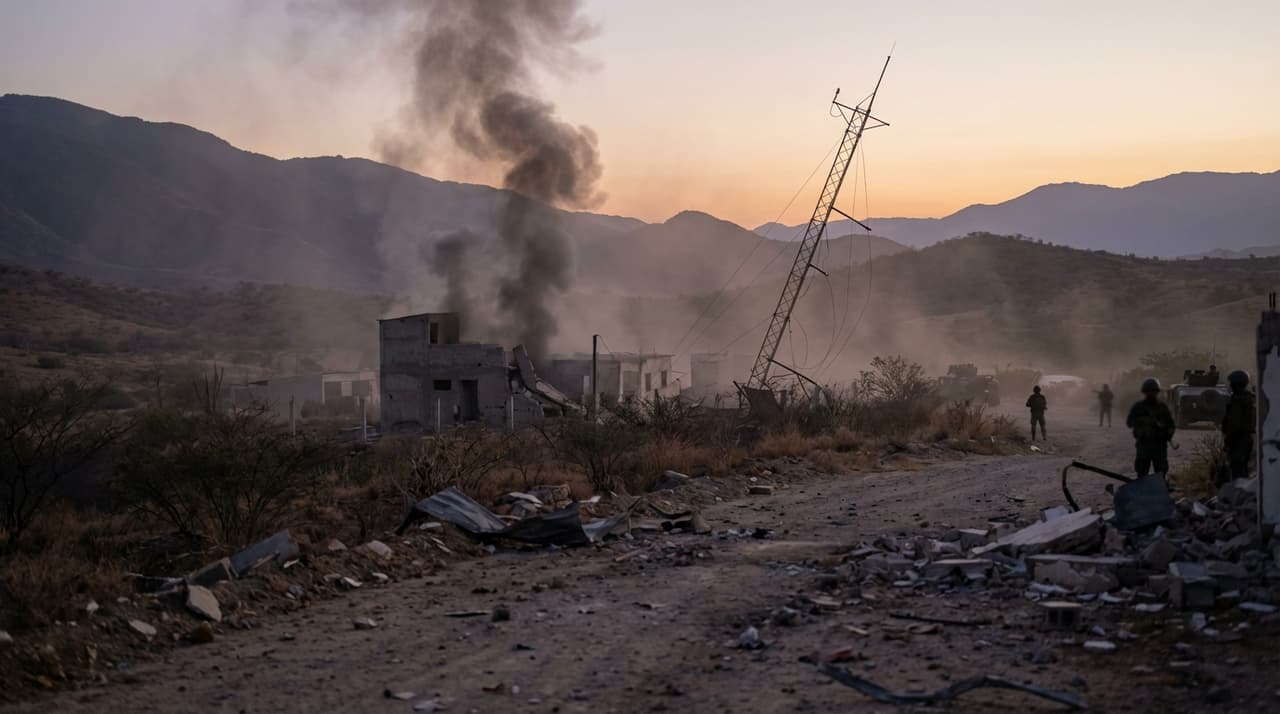
- U.S. airstrikes targeted Venezuelan military sites on January 3, 2026, but local security forces retain control of key locations.
- President Trump announced the capture of Nicolás Maduro, though Venezuelan officials demand proof of life amid conflicting reports.
- The operation escalates U.S. pressure on Venezuela's oil industry, with prior naval quarantines and calls for greater involvement in its energy sector.
Airstrikes and Conflicting Narratives
On January 3, 2026, U.S. forces under Operation Southern Spear conducted half-hour airstrikes on Venezuelan military targets, including Fort Tiuna, Miranda Airbase, La Guaira port, and antennas in Cerro El Volcán. The strikes, which caused power outages in southern Caracas and resulted in some U.S. injuries from a hit helicopter, targeted alleged criminal networks tied to Maduro's government, according to people familiar with the matter. Venezuelan officials reported civilian casualties, prompting Maduro—before his reported capture—to declare a national emergency and label the action "imperialist aggression."
In a post on Truth Social, President Trump claimed that Maduro and his wife Cilia Flores were captured by Delta Force and flown to the U.S. to face narcoterrorism charges, a statement confirmed by Attorney General Pam Bondi. However, Venezuelan Vice President Delcy Rodríguez reported them missing and demanded proof of life, with no visible signs of U.S. control in the country as local security forces continue to secure key sites like military bases and ports. Efforts to reach U.S. and Venezuelan officials for further comment were unsuccessful by press time.
Economic and Political Fallout
The strikes intensify U.S. pressure on Venezuela's oil industry, following prior naval quarantines that seized tankers since December 2025. Vice President JD Vance has demanded the return of "stolen oil," with Trump stating aims for greater U.S. involvement in the sector. This escalation builds on U.S. designations of Venezuelan gangs like Cartel de los Soles—allegedly led by Maduro—as terrorist organizations, disrupting global oil markets amid accusations of Venezuela operating as a "narco-state."
Politically, the action follows U.S. claims of fraud in Maduro's 2024 election, where opposition data showed Edmundo González winning. Prior deployments, including the USS Gerald R. Ford in November 2025 and CIA covert operations, set the stage. Maduro's government called for UN Security Council action, while U.S. officials justify the strikes under presidential Article II authority to counter threats. Domestic reactions split along party lines: Republicans like Mike Lee and Lisa McClain praise it as anti-narcoterrorism, but Democrat Brian Schatz opposes escalation absent vital interests, with some U.S. officials questioning the international legality of the strikes.
Short-Term Risks and Market Implications
Without a clear resolution, Venezuela could face power instability or retaliation, though Senator Mike Lee cited Secretary of State Marco Rubio anticipating no further U.S. action post-capture. Defense Minister Vladimir Padrino López and Attorney General Tarek William Saab cited "innocent victims" from the urban strikes, with the U.S. Embassy ordering shelter-in-place and the FAA banning U.S. flights over Venezuela. Opposition figures like David Smolansky noted hits on key sites, while some Venezuelan opposition sources suggested Maduro's capture was a "negotiated exit," adding to the uncertainty.
In the oil markets, the situation injects volatility, with traders monitoring potential supply disruptions. The long-term outlook could involve U.S. oil access or regime transition, but for now, the focus remains on immediate developments. Public debate in the U.S. splits, with Republicans framing it as protecting Americans from drugs, highlighting the human and economic stakes at play.
Correction: An earlier version of this article misstated the date of the airstrikes; it was January 3, 2026, not January 4.