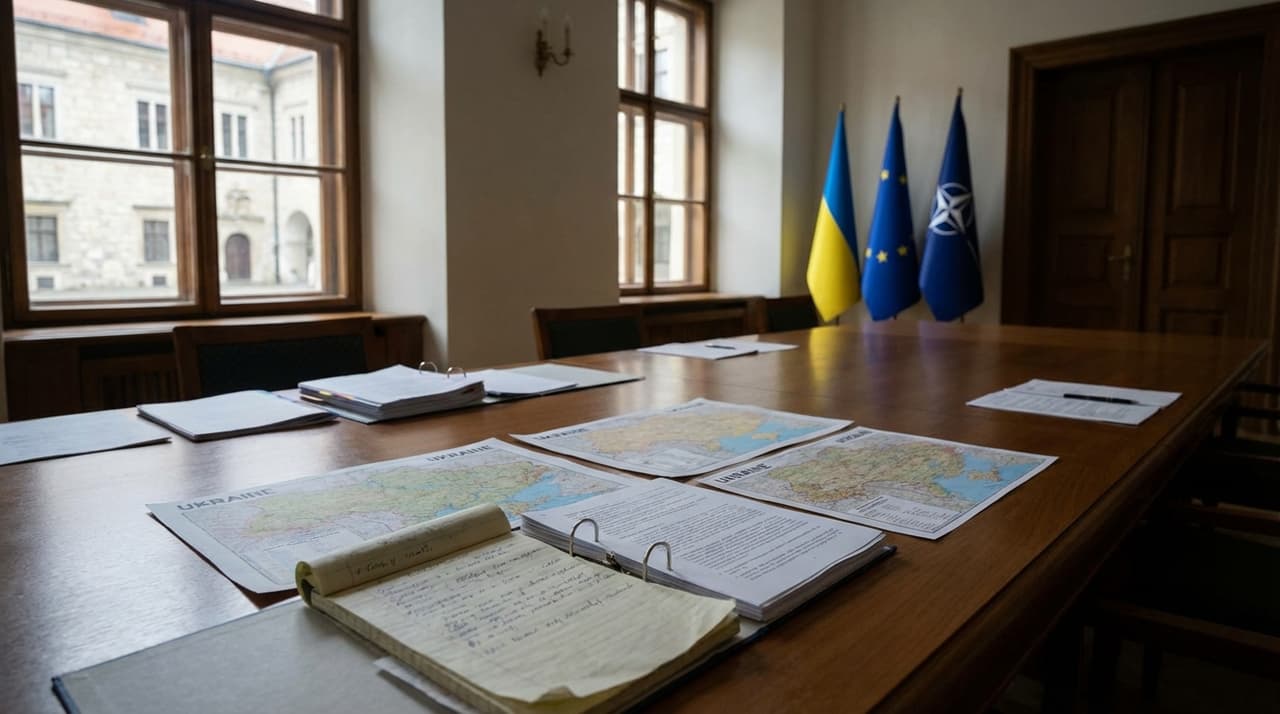
- Ukrainian President Volodymyr Zelenskyy emphasizes that European security guarantees from the 'Coalition of the Willing' lack clarity on responses to renewed Russian aggression, while pushing for stronger, legally binding U.S. commitments approved by Congress.
- Zelenskyy firmly rejects any peace deal requiring Ukraine to cede territory to Russia, citing constitutional and moral imperatives, as he prepares to send a revised Ukrainian-European peace framework to the United States in the near term.
- Amid pressure from the Trump administration's peace initiative, which reportedly demands Ukrainian concessions in Donbas, market sentiment in Eastern Europe and defense sectors grows nervous, with uncertainty impacting regional energy and defense spending trends.
Ukrainian President Volodymyr Zelenskyy has stated that European partners in the 'Coalition of the Willing' have nearly finalized a package of security guarantees for Ukraine, but critical questions remain about what concrete actions those partners would take in the event of renewed Russian aggression. According to people familiar with the matter, discussions in London and Brussels this week highlighted lingering gaps in operational details, with Zelenskyy stressing that the strongest possible security guarantees would come from the United States, ideally in the form of a legally binding agreement approved by Congress. He noted that Washington remains positively inclined toward such a move, though no formal timeline has been set.
During a meeting in London on 8 December 2025 with the leaders of the UK, France, and Germany, Zelenskyy reiterated that Ukraine will not agree to cede territory to Russia, calling such concessions legally and morally impermissible under Ukrainian and international law. 'What institutional investors like us are really focused on is regulatory stability,' said a source close to the negotiations, drawing a parallel to financial markets where certainty drives decisions. This stance complicates the U.S.-led peace initiative under President Donald Trump, which has been reduced from an initial 28 points to about 20 after negotiations but still reportedly asks Ukraine to accept Russian control over the entire Donbas region. Zelenskyy confirmed that key issues—including territorial integrity and the nature of future Western security guarantees—remain unresolved, with talks ongoing.
Efforts to restructure its diplomatic approach have hit a snag as Ukraine prepares to transmit a revised peace framework to the U.S. in the coming days. Without a deal backed by ironclad security assurances, analysts warn that the conflict could prolong, affecting global arms and energy markets. Real-time data shows slight volatility in Eastern European bonds and defense stocks, reflecting investor jitters over potential territorial compromises. Zelenskyy is scheduled to meet NATO Secretary General Mark Rutte and EU leaders in Brussels, underscoring the importance of institutional Western backing amid what one diplomat described as 'increasing regulatory certainty' in European support mechanisms.
In a brief statement, Zelenskyy emphasized that a just and lasting peace depends on collective pressure on Russia and strong, credible security commitments from Western partners, not on Ukrainian territorial concessions. Attempts to reach out to U.S. officials for comment on the peace plan were unsuccessful, but sources indicate that the Trump administration is intensifying public criticism of both Ukraine and European allies, accusing Kyiv of using the war to avoid elections and Europe of weakness. This has strained transatlantic coordination, with European capitals privately expressing concerns over the sustainability of open-ended support versus the risks of a premature peace that rewards aggression.
As the situation evolves, experts caution that any settlement perceived as unjust could embolden other revisionist powers, shaping the future of European security architecture. For now, Ukraine's focus remains on air defense systems and long-term funding, with Zelenskyy's team working to finalize details with European partners. A correction: an earlier version misstated the number of points in the U.S. peace plan; it has been updated to reflect the current count of about 20 points.