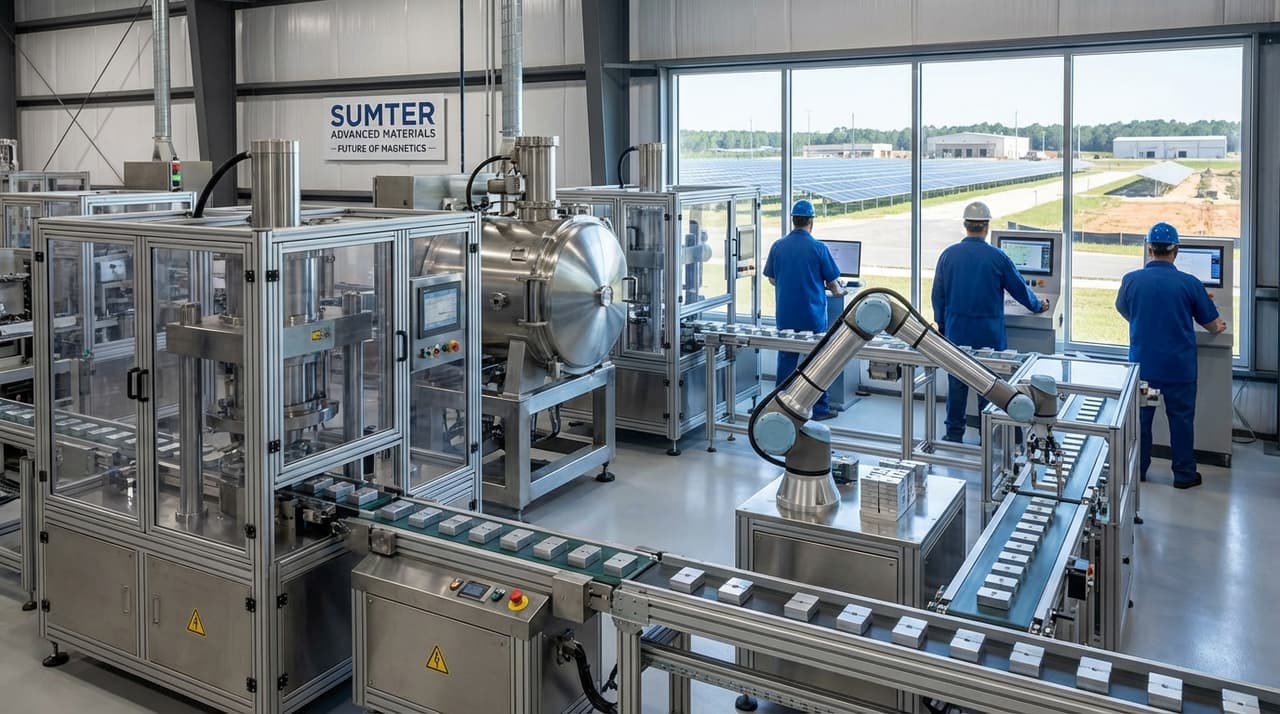
- Treasury Secretary Scott Bessent confirms rare earths production and processing are on track, citing EVAC's new magnet facility as a key step in reducing reliance on China.
- The launch in Sumter, South Carolina, represents the first U.S. rare earth magnet production in 25 years, creating 300 permanent manufacturing jobs and supporting broader economic revival.
- Efforts are backed by Pentagon investments and bipartisan policies aimed at derisking supply chains, with Bessent projecting a manufacturing "liftoff" by 2026-2027.
Treasury Secretary Scott Bessent stated that rare earths production and processing are proceeding as expected, highlighting the launch of EVAC's new rare earth magnet facility in Sumter, South Carolina—the first U.S. production in 25 years—as a key milestone in reducing reliance on China. According to people familiar with the matter, the facility, which transformed a former soybean field into a manufacturing hub, secured rapid permitting in just eight weeks under South Carolina Governor Henry McMaster, enabling its timely debut.
EVAC, a small-to-mid scale operator in the critical minerals sector, specializes in rare earth magnet production for defense applications like fighter jets and missiles, as well as technology such as smartphones, wind turbines, and electric vehicles. It is the sole non-Chinese rare earth firm to endure past market collapses, with workers trained in Germany. The initial phase creates 300 permanent manufacturing jobs and supports 800 construction roles, with expansion land already secured for potential growth of six to ten times. Bessent, in remarks that struck an optimistic tone, framed this as part of a broader U.S. "liftoff" in manufacturing projected for 2026-2027, linking it to wage growth and cost reductions by breaking China's supply chain dominance.
Political context looms large here. The launch was driven by an executive order on rare earths signed upon taking office, part of a reshoring agenda that has seen the Pentagon invest $4.5 billion in six deals, including $400 million in MP Materials (MP)' Mountain Pass mine and $1.4 billion with ReElement. A bipartisan bill proposes a $2.5 billion agency for stockpiling and production, aimed at bolstering resilience against what lawmakers term "economic coercion." Without such investments, the U.S. would remain vulnerable to supply disruptions, as seen when China imposed export controls following tariff disputes, leading to a 2025 truce.
Internationally, Bessent recently hosted G7 finance ministers to discuss derisking—not decoupling—from China, with Japan agreeing on swift reduction of reliance. This coordination effort, according to sources, is critical as global markets push for diversified critical minerals supply chains. In Sumter, the facility is already making waves locally, replacing jobs lost from closures like Caterpillar's and serving as an economic anchor for rural communities. Attempts to reach EVAC leadership for additional comment were unsuccessful, but officials have praised the milestone as a sign of progress.
Looking ahead, the short-term focus is on continued job creation and supply chain resiliency through G7 talks and Pentagon partnerships. Long-term, experts predict major expansion for EVAC and a U.S. manufacturing comeback, with Bessent expressing optimism about real wage acceleration reminiscent of the first term. The broader outlook suggests nations are pursuing "prudent derisking," with new agencies potentially stabilizing prices and boosting allied production. As one industry insider put it, "This isn't just about magnets; it's about reclaiming strategic autonomy in a volatile world."
Correction: An earlier version misstated the timeline for the manufacturing "liftoff"; it is projected for 2026-2027, not 2025-2026.