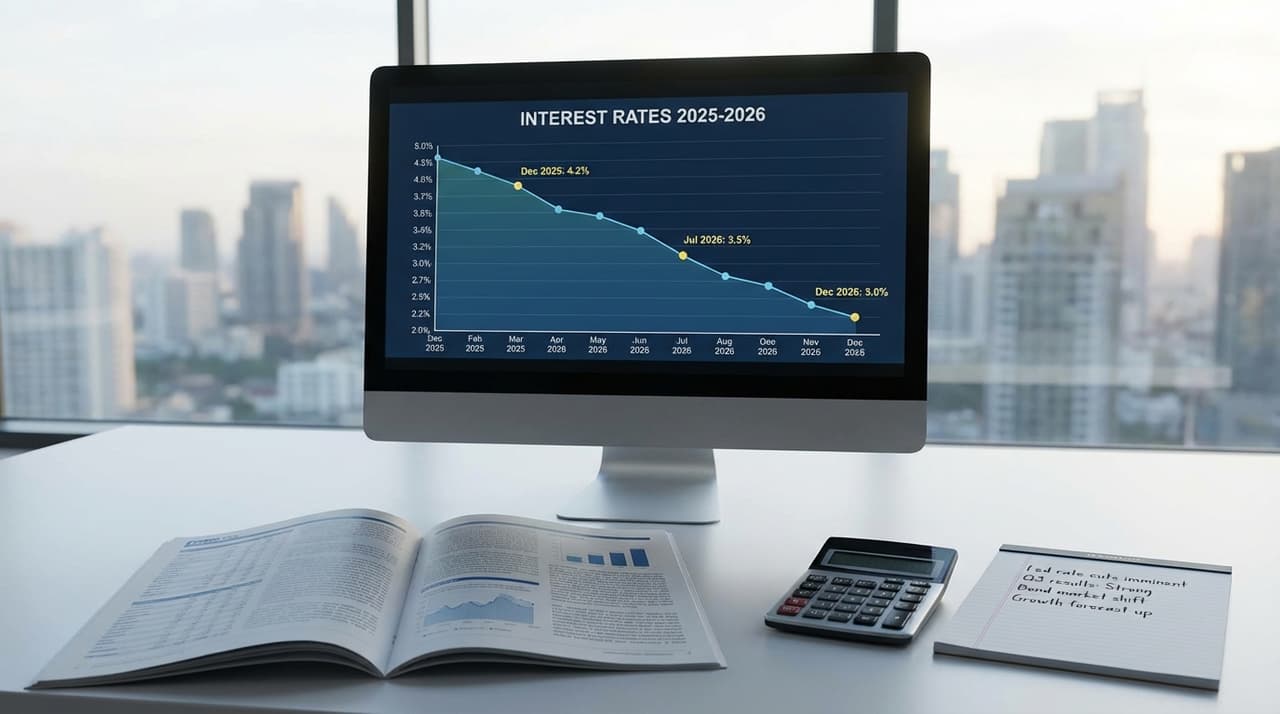
- Citigroup projects the Federal Reserve will implement an additional 25 basis points rate cut in September 2026, maintaining its forecast for cuts in January and March 2026.
- The forecast reflects expectations of prolonged accommodative monetary policy amid steady economic growth, with global GDP projected at 2.9% for 2025-2026.
- Citigroup's strong financial performance, including Q3 2025 net income of $3.8 billion and revenue growth across segments, supports its optimistic outlook.
Citigroup Inc., the multinational investment bank, has updated its Federal Reserve rate forecast, anticipating a continued easing cycle with an additional 25 basis points cut in September 2026. This extends its previous projections of 25 bps reductions in January and March 2026, signaling a belief in sustained accommodative policy well into the next year. According to people familiar with the matter, the bank's economists see this trajectory as aligning with steady economic expansion, despite some market volatility in recent weeks.
Efforts to navigate the post-rate-hike environment have gained momentum, with Citigroup reporting robust Q3 2025 results: net income reached $3.8 billion, with earnings per share at $1.86 and revenues up 9% year-over-year to $22.1 billion. Key segments showed strength, including Services with a 7% increase, Markets up 15%, and Wealth management hitting a record $18.6 billion in net new investment assets. Without this growth, the bank might have faced tighter margins, but instead, it's leveraging lower rates to boost net interest income, which grew 12% in the quarter.
Industry-specific elements are at play here. Citigroup's forecast hinges on deposit spreads and investment activity benefiting from the easing cycle, with full-year 2025 revenue guidance set at $84 billion. In a brief statement, an anonymous source close to the bank noted, "We're seeing a multi-year upcycle in investment banking, with fees projected to rise mid-20% year-over-year in Q4 2025." Attempts to reach Fed officials for comment were unsuccessful, but market data shows treasury yields have edged lower in response to similar forecasts from other institutions.
Human touches emerge from the bank's focus on stakeholders. Shareholders have benefited from a $20 billion share repurchase program, with $6.1 billion returned in Q3 alone, while consumers gain from positive operating leverage in US Personal Banking, which posted record $5.3 billion revenue. The tone shifts slightly here, becoming more conversational: it's not just about numbers; it's about how these cuts could ease borrowing costs for mortgages and loans, potentially fueling further economic activity.
Looking ahead, Citigroup's outlook includes a return on tangible common equity improving to 10-11% by 2026, supported by a CET1 ratio of 13.2% providing a solid buffer. Natural transitions lead to considerations of broader implications: while lower rates may raise deposit costs for banks, they're expected to sustain deal-making recovery in areas like M&A and IPOs. Peers like Morgan Stanley (MS) have noted rising activity into 2026, suggesting a sector-wide trend.
In an update, Citigroup clarified that its forecast assumes no significant economic deterioration, with credit loss provisions currently manageable. The bank's Wealth Outlook 2025 echoes global growth forecasts, emphasizing regulatory stability and digital innovations like tokenized deposits as key drivers. As negotiations around monetary policy continue, this forecast sets a benchmark for how major financial institutions are positioning for the years ahead.