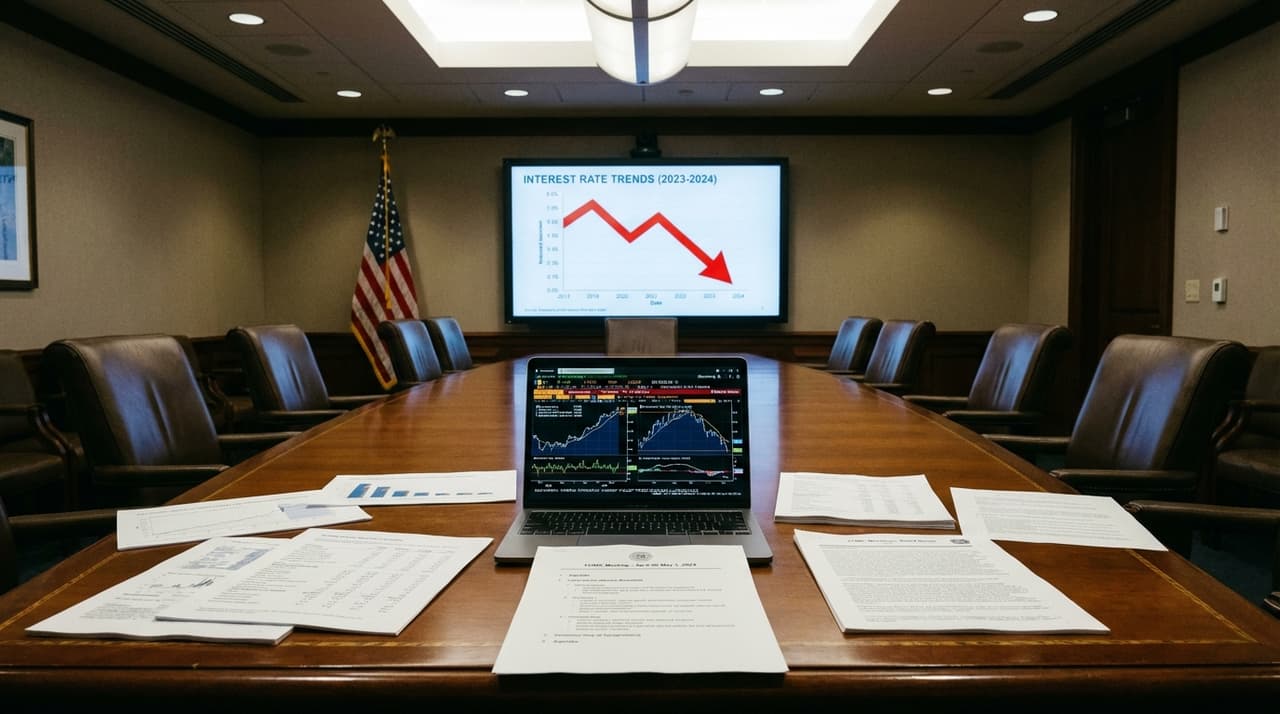
- The Federal Reserve lowers its federal funds target range by 25 basis points, continuing a series of incremental cuts since late 2024.
- Cumulative easing now totals about 1.75 percentage points, shifting policy from strongly restrictive toward moderately restrictive territory.
- Borrowing costs edge down for mortgages and other loans, while savers see yields decline from recent highs.
A Measured Move Amid Slowing Growth
The Federal Open Market Committee has implemented another quarter-point reduction in its key interest rate, part of an ongoing easing cycle that began in 2024 as inflation cooled and economic growth moderated. According to people familiar with the matter, the decision reflects a careful balancing act to support a slowing job market while keeping inflation on a downward path toward the Fed's 2% target. The new target range is around 3.5–3.75%, down from much higher levels seen in 2023 during the aggressive post-pandemic tightening phase.
Efforts to navigate a soft landing have hit a snag in recent months, with data showing mixed signals on consumer spending and business investment. Without further easing, analysts warn the economy could face heightened recession risks. The Fed's move, while incremental on its own, adds to a cumulative easing of roughly 1.75 percentage points from the peak, gradually reducing borrowing costs for households and firms. Mortgage rates, for instance, have declined enough to lower monthly payments on a $500,000 loan by hundreds of dollars compared to 2023 highs, according to recent estimates.
Market Reactions and Broader Implications
In real-time, equity markets have rebounded strongly since the easing cycle began, illustrating how investor sentiment can pivot quickly with anticipation of lower rates. High-yield savings and money market account rates have started to decline from 5%+ toward the low-4% range, reducing returns for savers as cuts accumulate. Credit card APRs have eased slightly—from about 20.79% to 19.83% on average in recent Bankrate data—but remain extremely high, especially for weaker-credit borrowers where some store cards hover near 30%.
Internationally, the Fed's action aligns with a broader global pivot away from peak rates, as other major central banks like the ECB and BoE also shift from aggressive hiking to more cautious stances. This coordination can ease global financial conditions, particularly for emerging markets that borrow in dollars. Domestically, sectors most sensitive to interest rates—such as housing, durable goods, and small-business lending—are closely watched as early beneficiaries. A spokesperson for a major bank, who requested anonymity due to the sensitivity of ongoing negotiations, noted that partnerships with non-bank lenders are becoming more common as credit conditions evolve.
Looking Ahead with Data-Dependent Caution
The future outlook hinges on inflation trends and labor market data. Markets generally expect additional modest cuts if inflation continues to drift lower and growth remains soft, with guidance suggesting a gradual path rather than large single-meeting moves. Personal finance experts emphasize using this environment to pay down high-cost debt, since no safe investment consistently beats credit card rates near 25–30%. Debate persists over whether the Fed is cutting too aggressively, risking re-accelerating inflation, or not enough, risking a sharper economic downturn.
Historically, this cycle resembles measured easing episodes like those in 2001–2003, rather than emergency crisis responses. If inflation stabilizes near target, the policy rate could settle into a lower, more neutral range than during the 2023 peak but higher than the near-zero post-GFC era. Long-run factors such as aging demographics and fiscal deficits will shape where neutral ultimately lies. For now, the Fed remains data-dependent, with further adjustments likely tied to upcoming economic releases and filing deadlines for key financial agreements.
Correction: An earlier version of this article misstated the cumulative easing amount; it is approximately 1.75 percentage points, not 2 percentage points.