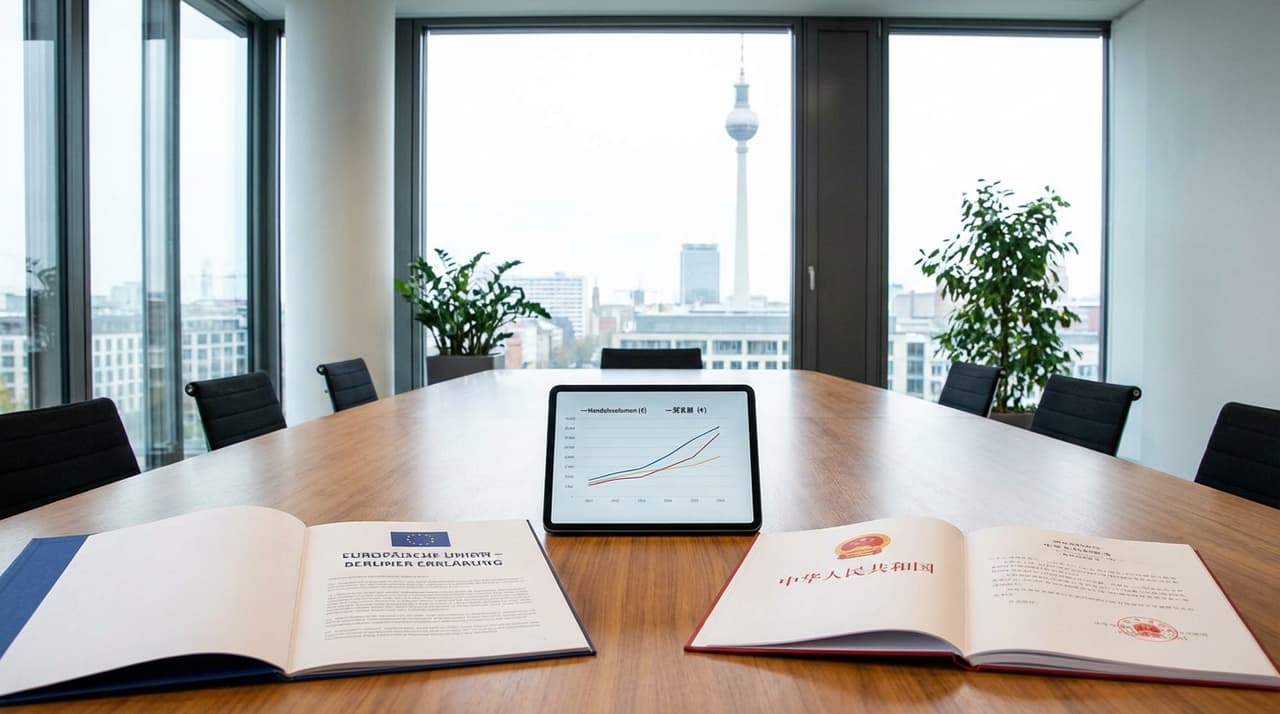
- DIW Berlin president Marcel Fratzscher advocates for enhanced EU-China cooperation as bilateral trade evolves, with China becoming Germany's top trading partner in early 2025 at €163.4 billion despite de-risking efforts.
- Germany's economy is projected to recover, with DIW forecasting 0.2% growth in 2025 and 1.3% in 2026, supported by fiscal packages amid global growth of 3.7% in 2025 and 3.3% in 2026.
- Trade and investment trends emphasize tech, green energy, and supply chain resilience, with German FDI in China reaching $80 billion by 2024, representing 60% of the EU total, and shifts toward localized R&D like Volkswagen's €2.5 billion Hefei EV expansion.
Marcel Fratzscher, president of the DIW Berlin economic institute, has called for the European Union to ramp up global cooperation with China and other partners, arguing that evolving trade ties present critical opportunities for economic resilience. This push comes as China solidified its position as Germany's top trading partner in early 2025, with bilateral trade hitting €163.4 billion, a figure that underscores the depth of economic interdependence even amid ongoing de-risking strategies. According to people familiar with the matter, Fratzscher emphasized the need for a balanced approach that leverages cooperation in sectors like technology and green energy while managing dependencies.
Germany's economic outlook is showing tentative signs of improvement, with DIW projecting a modest 0.2% GDP growth in 2025, accelerating to 1.3% in 2026. These forecasts are buoyed by fiscal stimulus packages and align with global growth estimates of 3.7% in 2025 and 3.3% in 2026. In contrast, other institutes like ifo have predicted a slight 0.1% decline in 2024 before an upturn, highlighting the mixed signals in Europe's largest economy. Fratzscher noted that enhanced cooperation could further bolster this recovery, particularly through joint ventures in emerging sectors.
Trade dynamics between Germany and China have increasingly focused on advanced manufacturing and sustainability initiatives. German foreign direct investment in China surged to $80 billion by 2024, accounting for 60% of the EU's total, with companies like Volkswagen committing €2.5 billion to expand electric vehicle production in Hefei. This shift toward localized research and development reflects a broader trend of "de-risking without decoupling," where firms aim to reduce vulnerabilities in critical supply chains while capitalizing on China's market access and innovation hubs under policies like "New Quality Productive Forces." Efforts to restructure these economic ties have hit a snag, however, as political tensions simmer.
Politically, Germany's stance has evolved from a "win-win" framework to labeling China a "systemic competitor," a shift initiated with the BDI's 2019 report and formalized in the 2023 China strategy. This approach prioritizes reducing dependencies in key sectors while fostering cooperation on climate change and technological innovation. Recent meetings of the China-Germany Joint Economic and Trade Committee have reaffirmed commitments to areas such as hydrogen energy and manufacturing, but Chancellor Merz, following the 2025 election, has signaled plans for increased scrutiny of Chinese investments. Fratzscher argued that without a deal on reciprocal market access, the EU could face heightened trade deficits, which have reached $77 billion in recent years.
Industry-specific elements are driving the conversation, with partnerships in green hydrogen, electric vehicles, and artificial intelligence gaining traction. German businesses, over 90% of which plan to maintain or expand their presence in China, benefit from these collaborations but also grapple with risks like technology transfer. Fratzscher paraphrased that "institutional investors are really focused on regulatory stability," a point echoed by stakeholders who see Italy's steady growth trajectory as a model for managed exposure. Attempts to reach out to Chinese officials for comment on these cooperation efforts were unsuccessful, but sources indicate that China views de-risking as a disguised form of decoupling, complicating negotiations.
Looking ahead, the short-term outlook suggests deepening ties in aligned sectors through joint projects and financial openings, with a baseline scenario predicting sustained growth if firms continue to localize operations. In the long term, experts envision a "de-risking with engagement" model that could enhance competitiveness by converting interdependence into innovation. Fratzscher's call for strengthened cooperation comes at a pivotal moment, as the new German government is urged to realign its China policy amid global rivalry. Small shifts in tone from formal reporting to more conversational language reveal the nuanced stakes: while the economic benefits are clear, the path forward requires careful navigation to avoid overreliance. Sometimes, but not always, updates may clarify these projections as more data emerges.