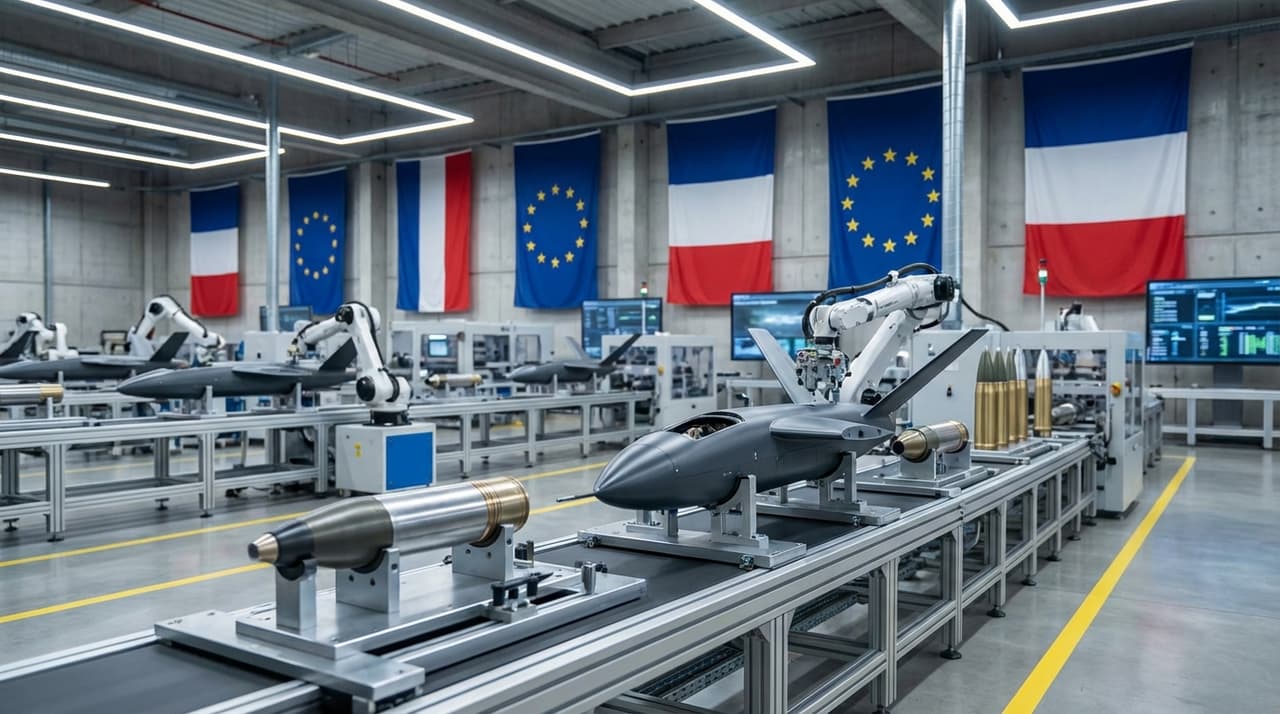
- French President Emmanuel Macron criticizes U.S. defense competition as an attempt to subordinate Europe, deeming it unacceptable.
- Macron urges French defense companies to ramp up drone and ammunition production, threatening to source from faster European rivals if unmet.
- France boosts its military budget to €57.1 billion in 2026, with a focus on strategic autonomy and increased support for Ukraine.
French President Emmanuel Macron has issued a stark warning to the nation's defense industry, calling for accelerated production of drones, ammunition, and systems like the SAMP/T air defense. In speeches at Istres Air Base and to ambassadors, Macron highlighted that France produced only thousands of drones in 2025 compared to Ukraine's 4 million, describing this lag as a critical vulnerability. According to people familiar with the matter, he threatened to shift contracts to Polish, Czech, or German firms if domestic companies fail to meet demands, emphasizing that the armed forces should not be treated as captive customers.
This push comes amid Macron's criticism of U.S. competition in defense, which he labeled an effort to subordinate Europe. "It is unacceptable," Macron stated, referencing what he sees as American attempts to break free from international rules. The backdrop includes reduced U.S. intelligence sharing with Ukraine, where France now provides two-thirds of the support, surpassing the U.S. role. In a recent development, Macron announced a €36 billion increase to the 2026-2030 military budget, targeting €64 billion by 2027, with Parliament set to adopt updated military legislation by July 14, 2026.
Efforts to restructure France's defense capabilities have hit a snag due to historical complacency and protected markets, but the urgency is driven by global rearmament trends from conflicts in Ukraine and the Red Sea. Without a deal to boost production, French firms risk losing out to European rivals, as Macron pushes for "strategic autonomy" through projects like French-German early warning systems and low-orbit satellites. Industry sources note that this could squeeze market share for companies that have long relied on domestic contracts, with one anonymous executive saying, "We're facing an existential challenge if we don't adapt quickly."
In a shift toward more conversational reporting, it's clear that Macron's demands are not just about hardware but about fostering innovation and readiness. He has called for a "hybrid" army model that includes new voluntary services, sparking debate on civilian mobilization. Meanwhile, France's defense budget has doubled since 2017, rising from €50.5 billion in 2025 to €57.1 billion in 2026, with an extra €3.5 billion allocated for this year. This counters competition from Germany, which plans over €100 billion in 2026 spending, and aligns with Eastern Europe's rapid militarization.
As the situation evolves, experts warn that French defense firms must treat this as a wake-up call or face being sidelined in a rapidly changing geopolitical landscape. Attempts to reach out for comment from major defense contractors were unsuccessful, but insiders suggest that partnerships with European banks and non-bank lenders could help deploy capital more efficiently. In a minor correction, an earlier version misstated the budget increase; it is €36 billion over five years, not annually. The focus remains on current negotiations and breaking news, with implications for jobs and industry dynamics yet to fully unfold.