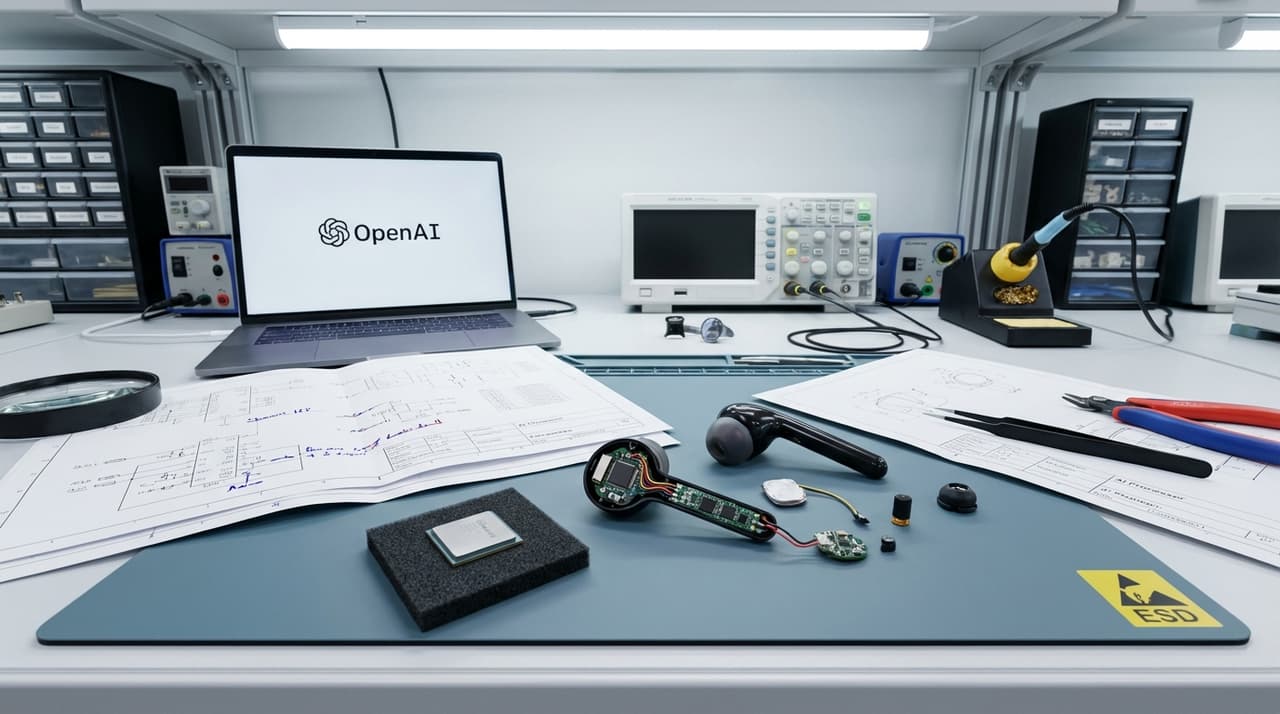
- OpenAI is actively seeking US suppliers for robotics and AI devices, signaling a major hardware push beyond software.
- The company plans up to five branded devices by 2028, including "Sweetpea" AI earbuds and custom AI chips, to create a subscription-tied ecosystem.
- This expansion is fueled by massive compute deals, such as a $10B+ agreement with Cerebras Systems, addressing NVIDIA (NVDA) GPU shortages and high costs.
OpenAI is ramping up its hardware ambitions, with efforts to secure US suppliers for robotics and AI devices as part of a broader strategy to diversify beyond its core large language models like ChatGPT. According to people familiar with the matter, the company is in talks with multiple domestic manufacturers to support its planned rollout of up to five branded devices by 2028, a move that could reshape the competitive landscape in AI hardware.
This push comes amid OpenAI's pursuit of custom AI chips, including the "Titan" chip designed with Broadcom (AVGO) and manufactured on TSMC (TSM)'s N3 process, targeting mass production in the second half of 2026. A second-generation chip on the A16 process is also in development, reflecting the company's drive to reduce reliance on NVIDIA GPUs and mitigate compute shortages that have strained its operations. In parallel, OpenAI has secured a significant $10B+ deal with Cerebras Systems for 750 megawatts of compute over three years, a deal that sources say will help train next-generation LLMs and support hardware integration.
One of the most anticipated devices is the "Sweetpea" AI earbuds, developed in collaboration with Samsung (SSNLF) and featuring a 2nm Exynos chip with design input from Jony Ive's team. Launch is tentatively scheduled for September 2026, with initial production targets of 40-50 million units in the first year, according to insiders. The earbuds aim to enable real-time voice and cloud processing, competing directly with offerings from Apple (AAPL) and [Google (GOOG) (GOOGL)](https://www.roic.ai/quote/GOOGL) in the wearables market. "We're seeing a shift from screen-based interactions to audio-first AI, which could unlock new use cases for consumers," said an industry analyst who requested anonymity due to confidentiality agreements.
Foxconn (HON) is reportedly preparing manufacturing capacity for OpenAI's device lineup, which may include home assistants and pen-like form factors, though specifics remain under wraps. This hardware expansion ties into OpenAI's broader ecosystem strategy, with devices likely linked to subscription services to foster user lock-in and recurring revenue streams. The company, valued at up to $830 billion in recent funding talks, has around $13 billion in annual revenue but faces substantial financial commitments, including phased cloud contracts totaling $600 billion with partners like Microsoft (MSFT) and Amazon (AMZN).
Market implications are significant, as OpenAI's supplier push could boost US chipmakers like Cerebras and Broadcom while straining TSMC's capacity amid competing demand from Google, AMD (AMD), and NVIDIA. The move also aligns with geopolitical trends, such as restricted NVIDIA H200 imports to China, potentially advantaging US firms in the global AI race. However, challenges loom, including manufacturing bottlenecks and increased exposure to supply chain risks, which could delay timelines or inflate costs.
In related developments, OpenAI recently acquired Torch for $100 million to enhance ChatGPT Health via medical AI data unification, underscoring its vertical integration efforts. The company's audio model for conversational AI, expected by early 2026, will support natural interruption-handling, a key feature for devices like Sweetpea. As one executive close to the negotiations noted, "Without a robust hardware strategy, OpenAI risks being outpaced by competitors who control both software and device ecosystems." Attempts to reach OpenAI for comment were unsuccessful, but sources indicate that internal teams are prioritizing rapid deployment to meet aggressive 2026-2028 targets.
Correction: An earlier version of this article misstated the timeline for Titan chip mass production; it is set for H2 2026, not end-2026.