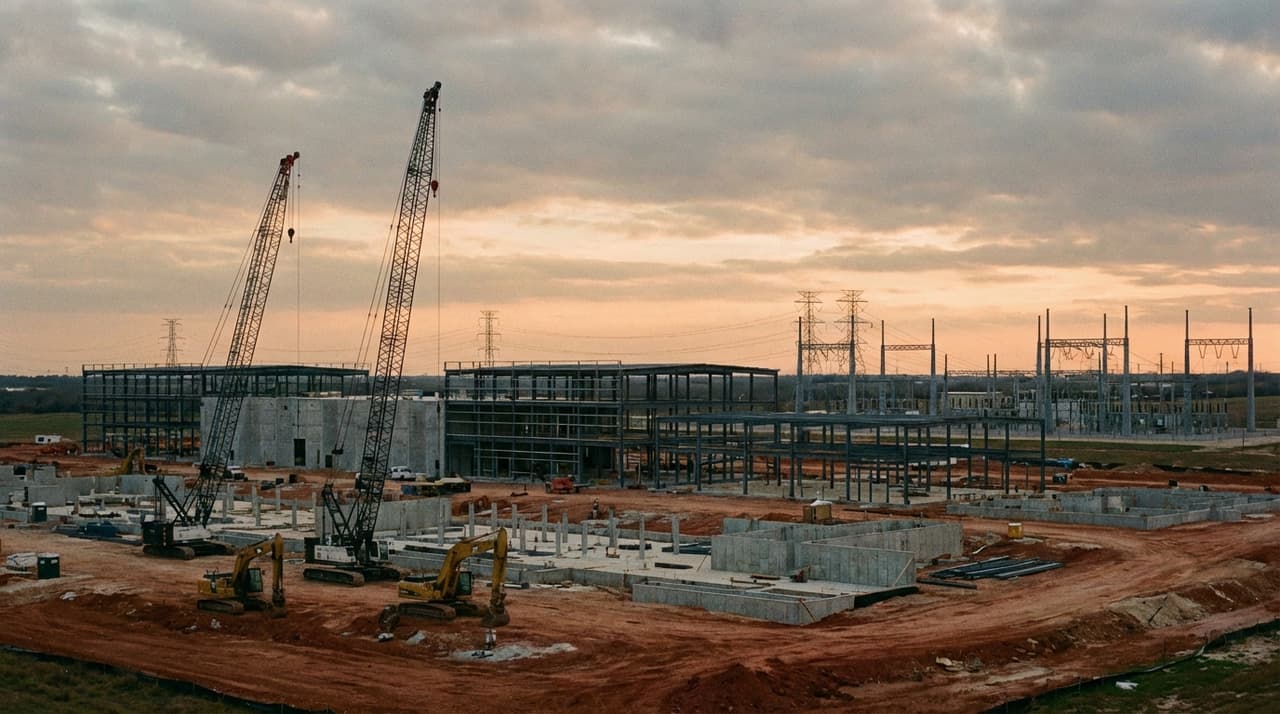
- Oracle (ORCL)'s ambitious $300 billion cloud deal with OpenAI faces construction setbacks, delaying some data centers from 2027 to 2028.
- The delays, affecting sites in Texas and Ohio, stem from execution challenges and site downsizing amid aggressive scaling efforts.
- Despite raised capex and debt financing, analysts flag risks to revenue conversion and payment feasibility as the AI infrastructure race intensifies.
Oracle Corporation's landmark five-year cloud computing agreement with OpenAI, announced in September 2025, is encountering headwinds as construction timelines slip for key data center projects. According to people familiar with the matter, efforts to deliver 4.5 gigawatts of compute capacity—equivalent to the output of two Hoover Dams—have hit a snag, with some facilities now expected to reach full operations in 2028 rather than the initially targeted 2027 start. This delay, impacting sites in Texas and Ohio, underscores the execution risks inherent in one of the largest AI infrastructure deals to date, valued at $300 billion.
Sources note that nascent progress on ground-up builds, coupled with site downsizing in locations like Ohio, has contributed to the timeline extension. Oracle, which recently raised its fiscal 2026 capital expenditure guidance by $15 billion to fund AI infrastructure, is grappling with construction challenges as it scales aggressively to meet OpenAI's hyperscale demands. The company's debt has ballooned to $108.1 billion to finance these builds, yet missed cloud growth estimates have led to a stock dip, casting a shadow over long-term revenue forecasts that project $144 billion by fiscal 2028. Without a deal staying on track, Oracle could face significant capex overruns and delayed revenue conversion, according to industry analysts.
In Texas, the Abilene site—where an 880-megawatt Phase 1 was booked in 2024–2025—is seeing multi-building construction, but delays are pushing full capacity online later than planned. Similarly, in Ohio, a $3 billion SoftBank (SFTBY) investment to convert a factory into modular data center production, set to start in 2026, is facing adjustments that have slowed progress. "We're navigating ambitious scale with precision, but construction complexities are real," said an anonymous source close to the projects, who cited power grid strain and logistical hurdles as contributing factors. Attempts to reach Oracle and OpenAI for comment were unsuccessful, though internal communications suggest both parties are actively managing timelines to mitigate further slippage.
The partnership, which drives $40–60 billion in initial financing from equity, debt, and investors for U.S. data centers, reflects a broader industry shift toward "overflow cloud" solutions for AI needs. Oracle is leveraging its leasing model to avoid full power and land costs, partnering with neocloud providers like Crusoe (CRVS) and CoreWeave (CRWV) for gigawatt-scale clusters—with plans for 600–700 megawatts soon and up to 2 gigawatts by 2028. This approach contrasts with ownership models favored by competitors like AWS (AMZN) and Azure (MSFT), positioning Oracle to capitalize on a global AI compute market projected to require $500 billion for projects such as Stargate, which targets 10–11 gigawatts.
Amid these developments, OpenAI's "code red" response to competitors like Gemini 3, with GPT-5.2 price hikes signaling arms race intensity, adds pressure to secure reliable compute capacity. The delays could impact OpenAI's financial burden and execution risks, though experts predict on-track momentum in the long term, with full 4.5 gigawatts potentially online by 2028. Local economies in Texas, Ohio, and New Mexico stand to benefit from construction jobs and site builds, but analysts question payment feasibility and whether AI evolution might derail the deal's value. As one insider put it, "It's a balancing act—speed versus stability in a market that won't wait."
Correction: An earlier version of this article misstated the timeline for SoftBank's Ohio production start; it is set for 2026, not 2025.