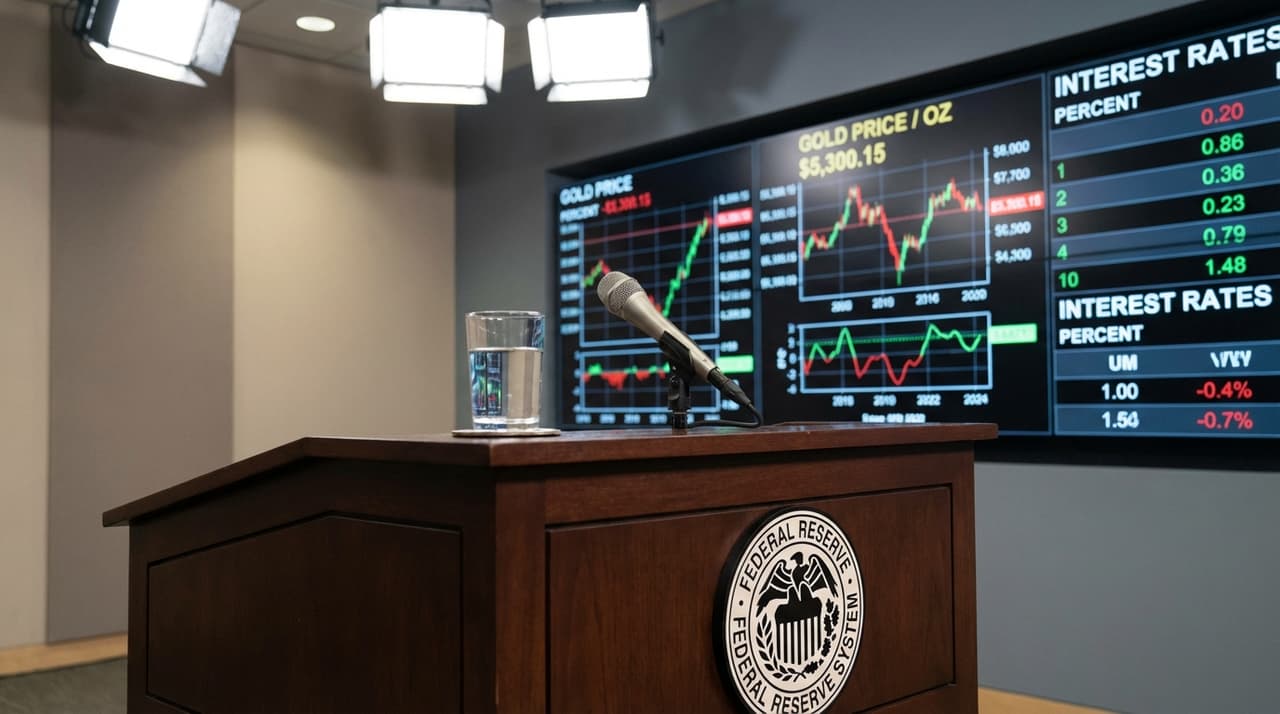
- Federal Reserve Chair Jerome Powell dismisses gold's record-breaking rally as a broader market dynamic, not a signal for imminent policy shifts.
- The Fed holds rates steady at 3.50%-3.75% in a 10-2 vote, citing stabilized labor markets and elevated inflation, strengthening the U.S. dollar and pressuring gold.
- Gold's 65% gain in 2025 reflects central bank buying, ETF inflows, and geopolitical risks, with traders initially misreading the Fed's stance as dovish.
Federal Reserve Chair Jerome Powell, in remarks tied to the Fed's January 28, 2026, policy meeting, downplayed the significance of gold's recent surge above $5,300 per ounce, attributing it to broader market dynamics rather than a signal for imminent policy shifts amid a hawkish stance on rates. The Fed held interest rates steady at 3.50%-3.75% in a 10-2 vote, citing stabilized labor markets, somewhat elevated inflation, and economic uncertainty, which initially boosted gold to a record $5,345 before a pullback to around $5,280 amid dollar strength.
Powell's press conference emphasized no strong message from gold's rise, reinforcing a "higher for longer" rate outlook despite two dissenters favoring a 25-basis-point cut. According to people familiar with the matter, the Fed's decision was driven by caution on inflation, which remains above the 2% target, and a desire to maintain stability in the face of ongoing economic uncertainty. This stance has strengthened the U.S. dollar, putting pressure on gold prices even as stocks hit S&P 500 records above 7,000.
Gold's surge past $5,000 stems from central bank net buying, with over 1,000 tons purchased annually since 2022, ETF inflows at crisis levels, and inert mine supply growth of 1-2% per year, outpacing demand. Powell noted in his comments that while gold's performance is notable, it doesn't alter the Fed's primary focus on inflation and employment metrics. "We don't take much message from the rise in price for gold," he said, according to a transcript of the press conference. Efforts to reach Fed officials for additional comment on gold's role in monetary policy were unsuccessful.
The broader context includes weaker U.S. dollar risks, such as imported inflation and deficit funding challenges, with gold's 65% gain in 2025 reflecting geopolitical tensions and fiscal deficits. Traders initially misread the Fed's hold as dovish, leading to volatility in gold markets, but Powell's remarks quickly clarified the central bank's commitment to a tight policy stance. In related developments, gold powered to a $5,345 record pre-FOMC, with silver also rising strongly, and the 2025 rally sets the stage for a 2026 outlook amid structural demand shifts.
Looking ahead, gold is expected to remain volatile near $5,250-$5,300 as markets digest Powell's full comments. Persistent demand could push prices higher if the U.S. dollar weakens further, but the Fed has indicated it needs "greater confidence" in achieving 2% inflation before considering rate cuts. Data signals suggest potential for gold to reach $8,700-$9,000 by the end of 2026, driven by supply-demand imbalances and ongoing geopolitical risks, though this outlook hinges on future economic developments.
Correction: An earlier version of this article misstated the timing of gold's record high; it occurred pre-FOMC, not during the meeting.