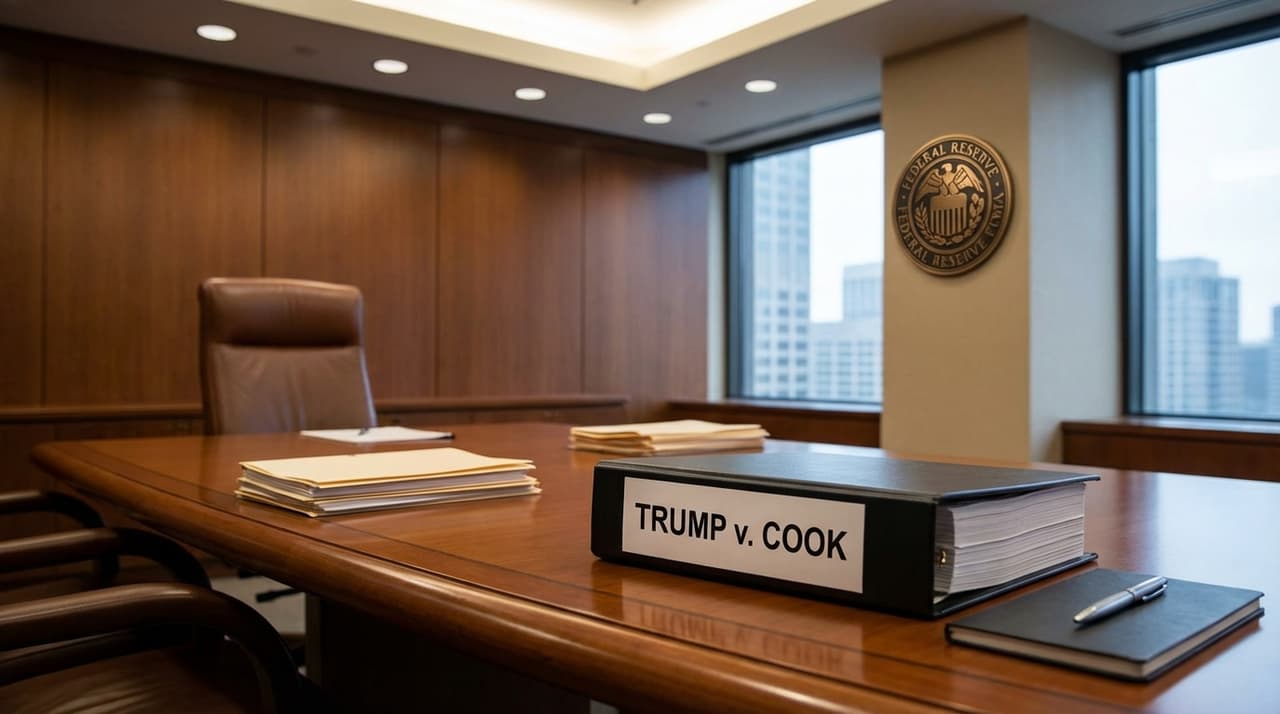
- Federal Reserve Chair Jerome Powell calls the Supreme Court case over Governor Lisa D. Cook's removal "perhaps the most important legal case in the Federal Reserve's history," amid ongoing litigation.
- Oral arguments in Trump v. Cook occurred on January 21, 2026, focusing on Fed independence and whether presidential removal authority requires "cause" under federal law.
- Cook remains on the Board and able to vote, with a ruling expected in spring 2026, affecting monetary policy decisions amid inflation debates.
Federal Reserve Chair Jerome Powell has described the legal case involving Governor Lisa D. Cook as potentially the most important in the Federal Reserve's history, according to people familiar with his remarks. This comes as the Supreme Court hears litigation over former President Trump's attempt to remove her, a move that has sparked intense scrutiny over central bank independence.
Oral arguments in Trump v.. Cook took place on January 21, 2026, with justices expressing concerns about presidential influence over interest rates via removals. The case stems from Trump's disputed dismissal of Cook in August 2025, citing "deceitful and potentially criminal conduct" related to a pre-tenure loan issue—a claim Cook has dismissed as political. A district court blocked the removal on September 9, 2025, and an appeals court upheld this decision on September 15, 2025, before the Supreme Court allowed her to stay pending arguments on October 1, 2025.
Cook, the first Black woman governor on the Board since 2022, remains in her role and able to vote in Federal Open Market Committee meetings. Her status is critical as the Fed grapples with inflation and stability debates in 2026, with her removal potentially shifting policy toward Trump's preferences, such as lower rates. Prediction markets as of late January 2026 show uncertainty, with bets on her leaving by January 1, 2027, reflecting the high stakes for financial stability.
Efforts to restructure the Fed's governance have hit a snag with this case, testing the 1913 Federal Reserve Act's precedents—no prior governor has been ousted mid-term. Cook's 14-year term runs to 2038, and her confirmation in May 2022 came after partisan fights, including a 51-50 Senate vote with Vice President Harris breaking a tie. Republicans had called her "unqualified" during confirmation, highlighting the political divisions that now play out in court.
Without a clear ruling, the Fed faces ongoing volatility in its appointments and policy direction. Experts predict that the outcome could redefine "for cause" removal standards, risking further politicization of the central bank or affirming its independence. In the short term, Cook is expected to participate in upcoming FOMC meetings, with market watchers closely monitoring any shifts in rate decisions.
Attempts to reach the Federal Reserve for additional comment were unsuccessful, but sources indicate that internal discussions emphasize maintaining operational continuity. The case ties into broader trends in central bank independence amid global rate volatility, with implications for stakeholders ranging from financial markets to minority representation in leadership roles. As the Supreme Court deliberates, the Fed's $8 trillion balance sheet and its role in monetary policy hang in the balance, making this a landmark moment for U.S. economic governance.