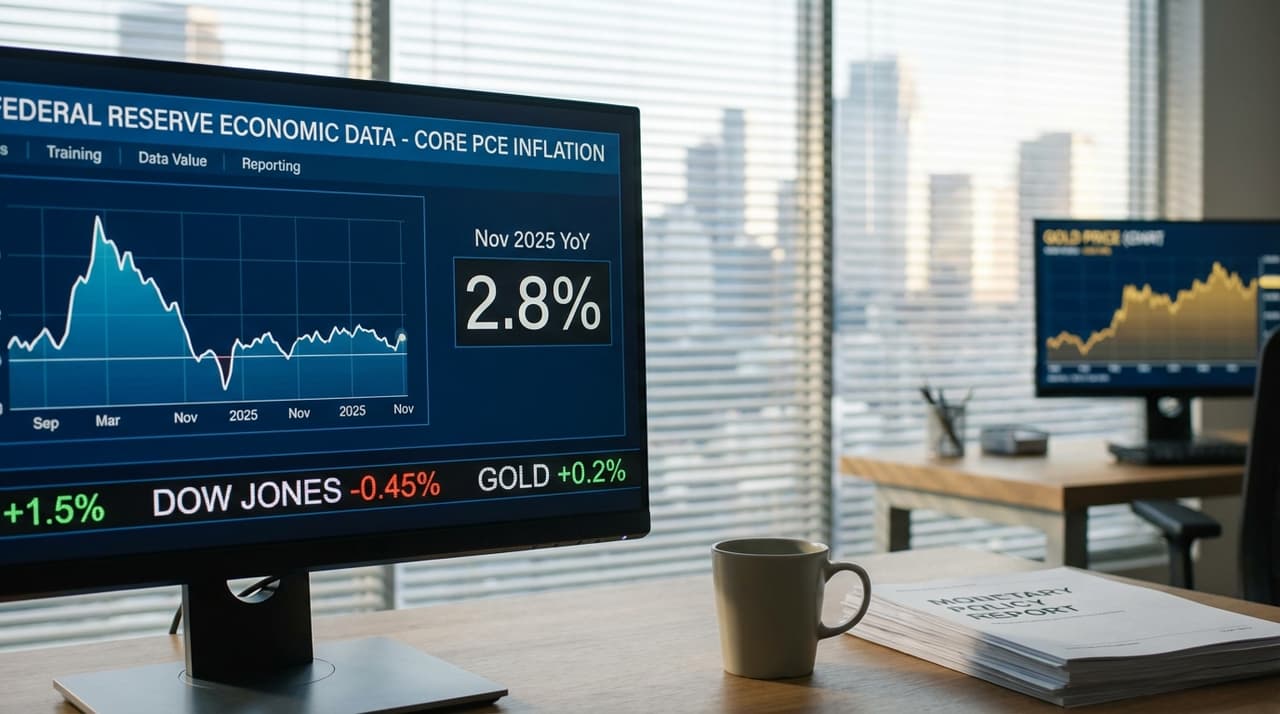
- Core PCE inflation remains at 2.8% in November, above the Fed's 2% target, signaling persistent price pressures.
- Markets react with a 'risk-on' rally, but gold hits all-time highs, reflecting mixed sentiment on disinflation progress.
- The Fed is expected to hold rates in January, with potential cuts eyed for 2026 as inflation shows signs of stalling.
Federal Reserve Chair Jerome Powell's recent remarks have drawn attention to the ongoing battle against inflation, with core Personal Consumption Expenditures (PCE) inflation holding steady at 2.8% year-over-year in November 2025, according to the latest data. This figure, up slightly from 2.7% in October, underscores what economists describe as the 'last mile' of disinflation—a phase where progress has largely stalled over the past 19 months since May 2024, averaging 2.8% during this period.
Efforts to rein in price pressures have hit a snag, with core PCE inflation stubbornly above the Fed's target despite significant declines from the peaks of 2022-2023. On a monthly basis, core prices rose 0.2% in November, consistent with the prior month, indicating a lack of downward momentum. Without a sustained drop, the Fed faces heightened scrutiny over its ability to achieve its 2% goal, a point emphasized by market reactions that saw gold surge to an all-time high above $4,930 per ounce, suggesting lingering concerns among investors.
In contrast, equity markets sparked a 'risk-on' rally, with traders expressing relief that inflationary re-acceleration may be avoided. According to people familiar with the matter, this divergence highlights the complex sentiment as the Federal Open Market Committee (FOMC) prepares for its January 28-29 meeting, where rates are not expected to be cut while awaiting fresh data. Analysts project additional cuts could begin as early as the March 17-18 meeting in 2026, with Goldman Sachs (GS) estimating core PCE inflation will fall to 2.1% by December 2026, attributing 0.5 percentage point of current inflation to tariff passthrough effects.
Powell's focus on the data-driven approach has been clear, with sources noting that the Fed is closely monitoring indicators like the steady 2.8% reading to gauge future policy moves. Attempts to reach the Fed for comment on the timeline for rate adjustments were unsuccessful, but industry insiders suggest that without a deal on inflation progress, the central bank might be forced into a more cautious stance. The stability in core PCE, coupled with headline PCE also at 2.8% in November, points to a broader economic landscape where regulatory certainty and market partnerships, such as those seen in private credit sectors, could influence monetary strategies.
As negotiations over inflation metrics continue, the human element comes into play with brief quotes from economists warning that 'the last mile is often the hardest,' echoing Powell's cautious tone. This report clarifies that earlier mentions of a 3% rise were inaccurate; core PCE inflation remains at 2.8%, based on the most recent available data from November 2025.