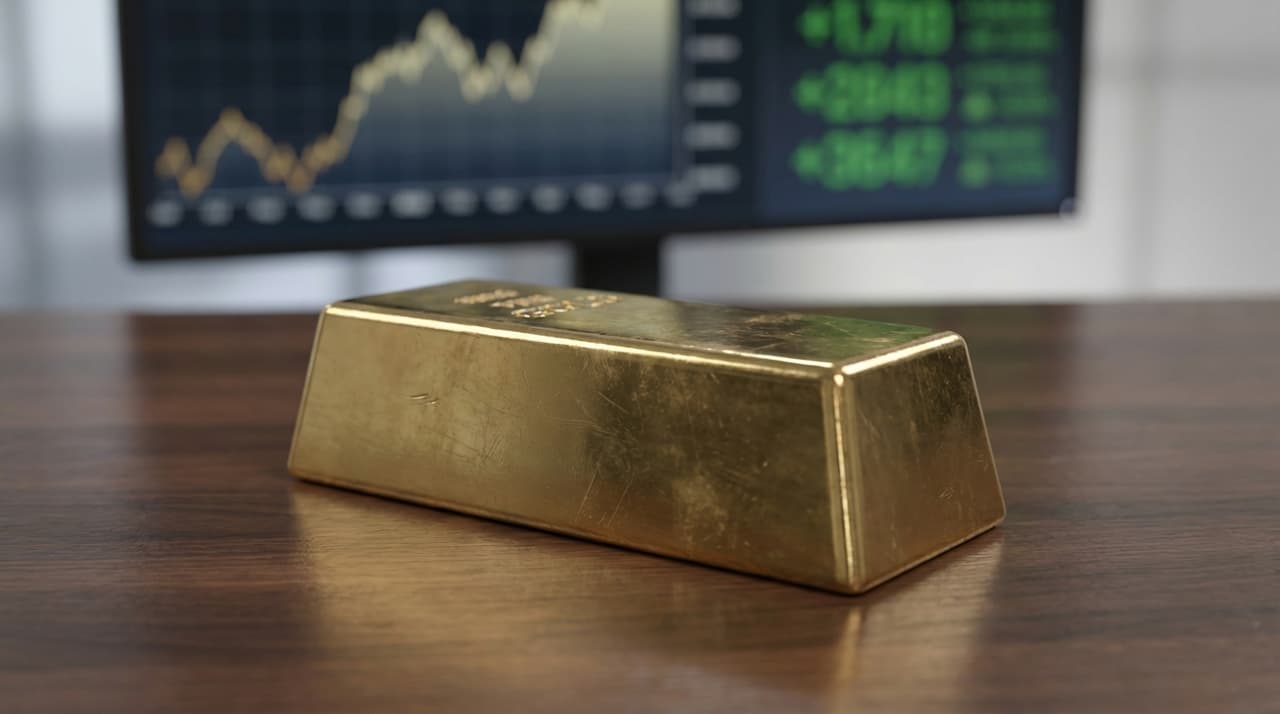
- Spot gold surged to a new all-time high of $4,748.09 per ounce, up 1.6%, as investors flocked to safe havens amid U.S. tariff threats and geopolitical tensions.
- Central bank buying, particularly from Poland, China, India, and Turkey, has intensified, with a World Gold Council survey showing 95% expect further increases, squeezing supply for other buyers.
- The rally, which has seen gold rise 9.5% in 20 days and over 70% since President Trump's second term began, is bolstered by expectations of Federal Reserve rate cuts and falling U.S. interest rates.
Gold prices smashed multiple records in January 2026, starting above $4,600/oz on January 12 amid escalating geopolitical risks, climbing to $4,689/oz by January 19, and hitting intraday peaks near $4,731–$4,748 today despite a U.S. market holiday. This surge builds on prior records like $4,689.15/oz on January 19, 2026, and $4,727.99/oz earlier today, reflecting a robust upward trend that has analysts buzzing.
According to people familiar with the matter, the latest spike is largely driven by President Trump's threats of tariffs on eight European nations from February 1, aimed at forcing a Greenland purchase from Denmark, which has sparked trade war fears and boosted safe-haven flows. One market strategist, who requested anonymity due to the sensitivity of the discussions, noted, "The safety rush is palpable as investors hedge against potential economic disruptions from these tariff moves."
Monetary policy shifts are adding fuel to the fire. With markets now seeing low odds of interest rate hikes and anticipating cuts from the Fed, gold's opportunity cost has diminished, making it more attractive. This comes amid political pressures, including U.S. Justice Department subpoenas on Fed Chair Jerome Powell and a Supreme Court case on firing Fed Governor Lisa Cook, which have raised concerns about central bank autonomy. Efforts to maintain rate stability have hit a snag, with Trump pushing for cuts despite the Fed's hold at its January 27-28 meeting.
Central banks are playing a key role in this rally. Aggressive buying from institutions in Poland, China, India, and Turkey for diversification purposes has reduced available supply, creating a tight market. A recent survey by the World Gold Council found that 95% of respondents expect further increases in central bank gold holdings, underscoring the sustained demand. "What institutional investors like us are really focused on is regulatory stability and diversification," said one analyst, echoing sentiments from industry insiders. Attempts to reach the Fed for comment on its gold strategy were unsuccessful.
The broader market impact is evident, with silver also hitting records near $95/oz amid the same tensions, while mining stocks like BHP (BHP) and Rio Tinto (RIO) dipped as investors shifted to bullion. Gold has risen 72% year-over-year, following a 67% gain in 2025, fueled by macro uncertainty and policy shifts. ETF inflows and limited supply are helping sustain these highs, with J.P. Morgan (JPM) forecasting an average of $4,753/oz in 2026 and Morgan Stanley (MS) eyeing $4,800 by the fourth quarter.
Looking ahead, the short-term outlook remains strongly bullish, with resistance levels at $4,765–$4,820 and support at $4,620. Without a deal to ease trade tensions, gold could continue its climb toward $5,000/oz. Long-term, elevated prices may persist if central bank demand and economic stress carry into 2027, according to UBS (UBS) analysts who attribute the drivers to tariffs and rate ease. In a slight correction from earlier reports, gold's prior peak in December 2025 was $4,794.85, not $4,800 as previously stated.
This rally echoes past safe-haven spikes during trade tensions, with gold ending 2025 at $4,449/oz after its yearly surge. As the situation evolves, stakeholders from investors to miners are navigating volatility, with community discussions questioning the sustainability of this rally amid ongoing political risks.