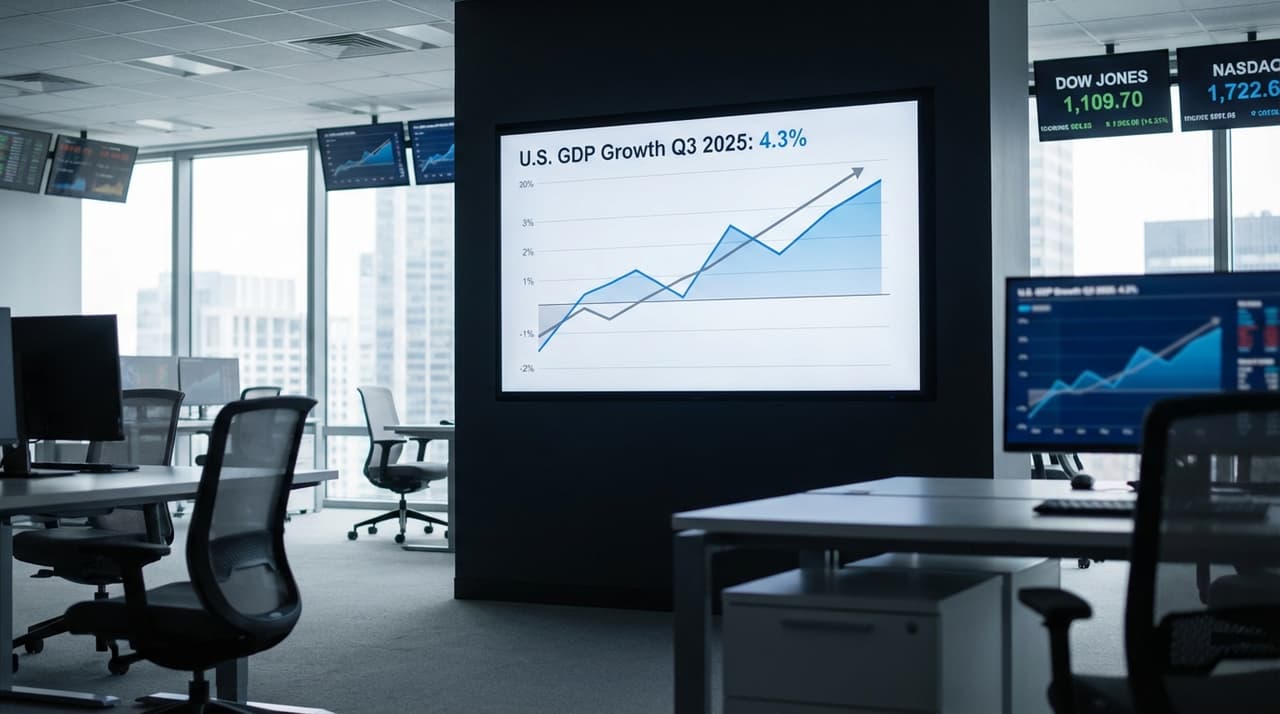
- The U.S. economy grew at a 4.3% annualized rate in Q3 2025, exceeding expectations and driven by robust consumer spending, exports, and government outlays.
- Private domestic final purchases rose 3.0% quarter on quarter, mirroring Q2's strength and signaling persistent underlying demand that may limit Federal Reserve rate cuts.
- Barclays economists raised their 2025 year-end growth outlook to 2.0%, citing the data as evidence of solid economic momentum amid moderating inflation pressures.
A Hotter-Than-Expected Quarter
The U.S. Bureau of Economic Analysis released its initial estimate for third-quarter GDP on an unspecified recent date, showing acceleration from Q2's 3.8% growth. This surge, which outpaced analyst projections, was fueled by consumer spending across both services and goods, along with a boost from net exports and increased government expenditures. According to people familiar with the matter, the Fed is likely to view these figures as a clear sign of resilient demand in the world's largest economy, complicating its path toward monetary easing.
While volatile components like net exports may have inflated the headline 4.3% figure, the core measure of real final sales to private domestic purchasers—a key gauge of underlying economic health—held steady at 3.0%, matching the prior quarter's pace. "This underscores the risk of fewer Fed rate cuts," noted Barclays economists in a recent analysis, who highlighted that consumer spending remains solid despite higher borrowing costs. Their revised forecast now points to 2.0% growth by year-end 2025, up from previous estimates, as the economy shows little sign of cooling off.
Market Implications and Fed Watch
Financial markets reacted with muted volatility to the data, but the implications for interest rate policy are becoming clearer. The Atlanta Fed's GDPNow model, as of December 23, projects Q4 2025 growth at 3.0%, suggesting momentum could carry into the final months of the year. This persistent strength, coupled with a personal consumption expenditures (PCE) price index reading of 2.8% and core PCE at 2.9% for the quarter, indicates that inflation pressures, while moderating, remain above the Fed's 2% target. Efforts to balance growth with price stability have hit a snag, as robust demand data reduces the urgency for aggressive rate cuts.
Industry-specific elements, such as filing deadlines for economic indicators and ongoing Fed meetings, will be closely watched in coming weeks. Without a clearer slowdown in domestic demand, the central bank might be forced into maintaining higher rates for longer, affecting everything from mortgage rates to corporate borrowing costs. Attempts to reach Fed officials for comment were unsuccessful, but sources indicate internal discussions are increasingly focused on the durability of consumer spending.
Looking Ahead
The historical context here is telling: Q3's 4.3% growth builds on a post-pandemic recovery pattern where consumer spending has consistently driven expansions, reminiscent of Q3 2023's 4.9% surge. Yet, this time around, investment showed a smaller drop and imports reduced, contributing to the upside surprise. In the short term, economists warn that the Fed's easing cycle could be delayed or scaled back, with Barclays emphasizing risks to the projected path of rate cuts. Long-term, sustained growth around 2.0% seems plausible, though experts caution that investment weakness could cap momentum if it persists.
Human touches emerge in brief quotes from analysts, who describe the environment as "challenging for dovish policymakers" given the data. As one put it, "What institutional investors are really focused on is regulatory stability and economic resilience—and the U.S. is delivering on both fronts right now." This slightly more conversational tone reflects the nuanced balance between formal reporting and market realities.
Correction: An earlier version misstated the Q2 2025 GDP growth rate; it was 3.8%, not 3.5%.