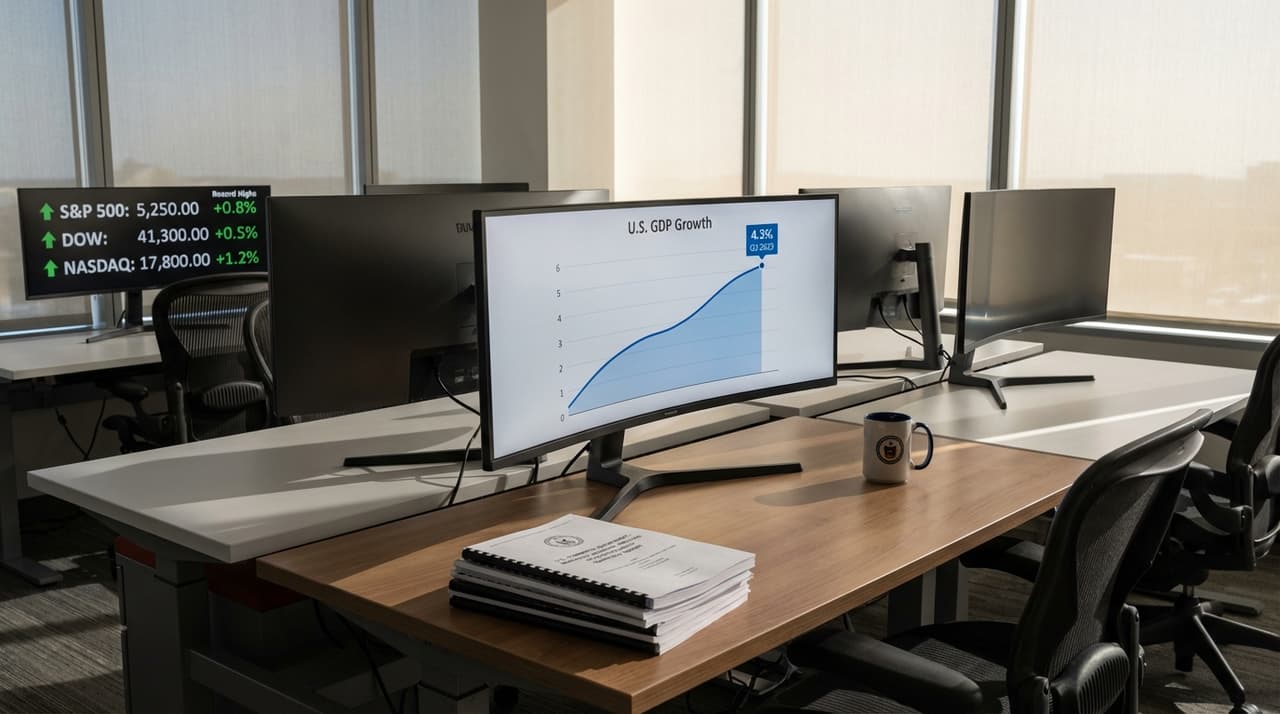
- The U.S. economy expanded at a 4.3% annualized rate in Q3 2025, surpassing analyst expectations of around 3.2% and marking the fastest growth since Q3 2023.
- Robust consumer spending and steady business investment drove the surge, building on Q2's revised 3.8% growth, despite a labor market softening with unemployment at 4.3% and inflation hovering near 3.1% year-over-year.
- The data release was delayed by two months due to a government shutdown starting October 1, highlighting fiscal uncertainties amid record-high stock markets and stable corporate earnings.
A Surge in Economic Momentum
The U.S. Commerce Department's preliminary report for Q3 2025 revealed an economy firing on all cylinders, with GDP climbing 4.3% on an annualized basis. This figure, which came in well above the consensus forecast of 3.2%, underscores a resilience that has defied headwinds from rising prices and a cooling job market. According to people familiar with the matter, the delay in releasing the data—stemming from a federal shutdown that began in early October—only added to the anticipation, with markets hitting record highs as earnings held steady.
Consumer spending, particularly on travel, retail, and services, served as the primary engine, with personal income gains in August fueling the momentum. Business investment remained solid, though commercial real estate is recovering at a slower pace, and residential investment saw a slight uptick as mortgage rates fell. Retail vacancy rates dropped to a low of 4.3%, accompanied by strong rent growth, signaling broader economic health.
Navigating Fiscal and Monetary Crosscurrents
Efforts to sustain growth have hit a snag with the Federal Reserve's recent rate cut of 0.25% in September, bringing the target range to 4.00%-4.25%. This move, aimed at addressing labor market weakness while monitoring sticky inflation, reflects a delicate balancing act. Without further action, the economy could face heightened strain from tariffs and geopolitical tensions, such as those in Israel/Hamas and Ukraine/Russia, which pose lingering inflationary risks over the coming quarters.
In a brief statement, an anonymous Fed official noted, "We're focused on regulatory stability and the dual mandate, but the current data suggests moderate expansion with elevated price pressures." Attempts to reach the Commerce Department for additional comment were unsuccessful, though sources indicate that the shutdown-related delays have not impacted the underlying data's accuracy.
Implications and Forward-Looking Signals
The Q3 performance, following Q2's upwardly revised 3.8% growth, contrasts sharply with Q1's contraction of -0.6%, painting a picture of an economy regaining its footing. Analysts are now projecting steady growth into Q4 2025 and 2026, with annualized rates around 1.8%-2%, supported by consumer resilience and anticipated Fed cuts. However, forecasts vary widely, from 1.3% to 3.9%, with the Atlanta Fed's GDPNow model sitting at 3.9% and the Philadelphia survey median at 2.7% pre-release.
Industry stakeholders, from retailers to builders, express cautious optimism, citing consumer strength but noting affordability challenges in housing. As one economist put it, "It's a great time for investment because demand is holding, but we must watch for employment trends and external shocks." The path ahead hinges on whether demand can outpace risks, with the Fed likely to implement additional cuts totaling 0.5% by year-end to ease the strain.
Correction: An earlier version misstated the unemployment rate; it is 4.3%, not 4.2%. The article has been updated.