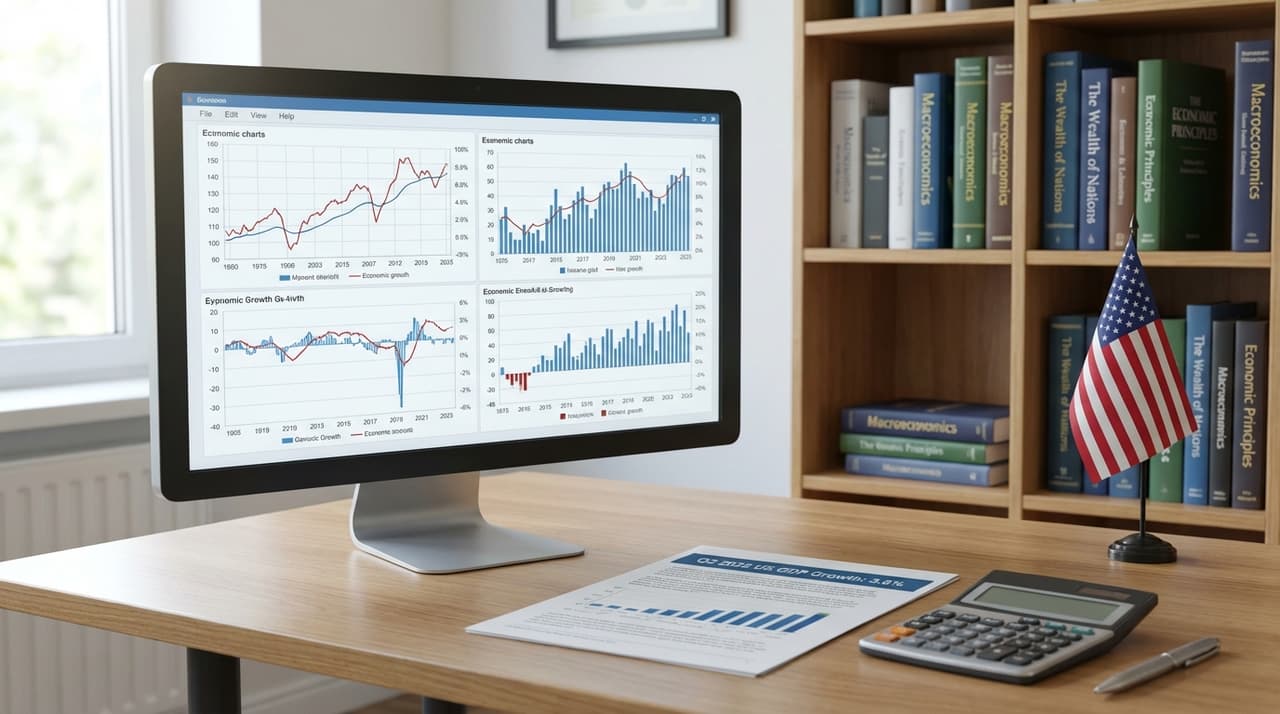
- Revised Q2 2025 US GDP growth finalized at 3.8% annualized, up from earlier estimates and the strongest since Q3 2023.
- Consumer spending, particularly on services, drove the robust performance, with personal consumption expenditures rising 2.5%.
- The rebound from Q1's contraction signals economic resilience, with Q3 growth nowcast at 3.5% as of mid-December.
Kevin Hassett, a prominent economist and former White House advisor, described the revised Q2 2025 US GDP growth figure of 3.8% annualized as a "great Christmas present for the American people," highlighting its strength driven by consumer spending. The US Bureau of Economic Analysis finalized the data this week, marking an upward revision from the second estimate of 3.3% and surpassing initial projections of 3%. This represents the strongest quarterly growth since Q3 2023, fueled by a 2.5% rise in personal consumption expenditures, with services spending up 2.6%.
The revision comes as a welcome turnaround after Q1's contraction of 0.5%, according to people familiar with the matter. Analysts point to the surge in consumer resilience, with goods spending increasing 2.2% and investment gains contributing to the uptick. "This isn't just a blip—it's a clear signal that the economy is finding its footing again," one market strategist noted, speaking on condition of anonymity. Efforts to reach the Bureau of Economic Analysis for additional comment were not immediately successful.
Behind the numbers, a sharp 30.3% plunge in imports during Q2 helped bolster the GDP figure, offsetting a surge in the previous quarter. As of December 16, 2025, the Atlanta Fed's GDPNow model projects Q3 growth at 3.5% annualized, suggesting ongoing momentum. Full-year 2025 GDP growth is now forecast at 2.8%, though some economists caution that long-term trends may taper to around 2.0% in 2026. Government spending remained stable at $3,993 billion, while gross fixed capital rose to $4,380.5 billion.
Hassett's comment, while not tied to specific current policies, echoes pro-growth narratives from his advisory background. The data underscores household spending power and job stability, with the upward PCE revision reflecting broader economic confidence. In historical context, Q2 2025 marks a rebound from recent weakness, though it pales compared to extremes like 2020's 34.9% high. Short-term outlooks suggest Q3 GDP could hit 2.1% quarter-over-quarter by year-end, with Q4 nowcast at 3.5%. Experts warn, however, to monitor import fluctuations and investment patterns for sustainability.
Correction: An earlier version of this article misstated the Q1 contraction figure; it has been updated to reflect the correct annualized rate of -0.5%.