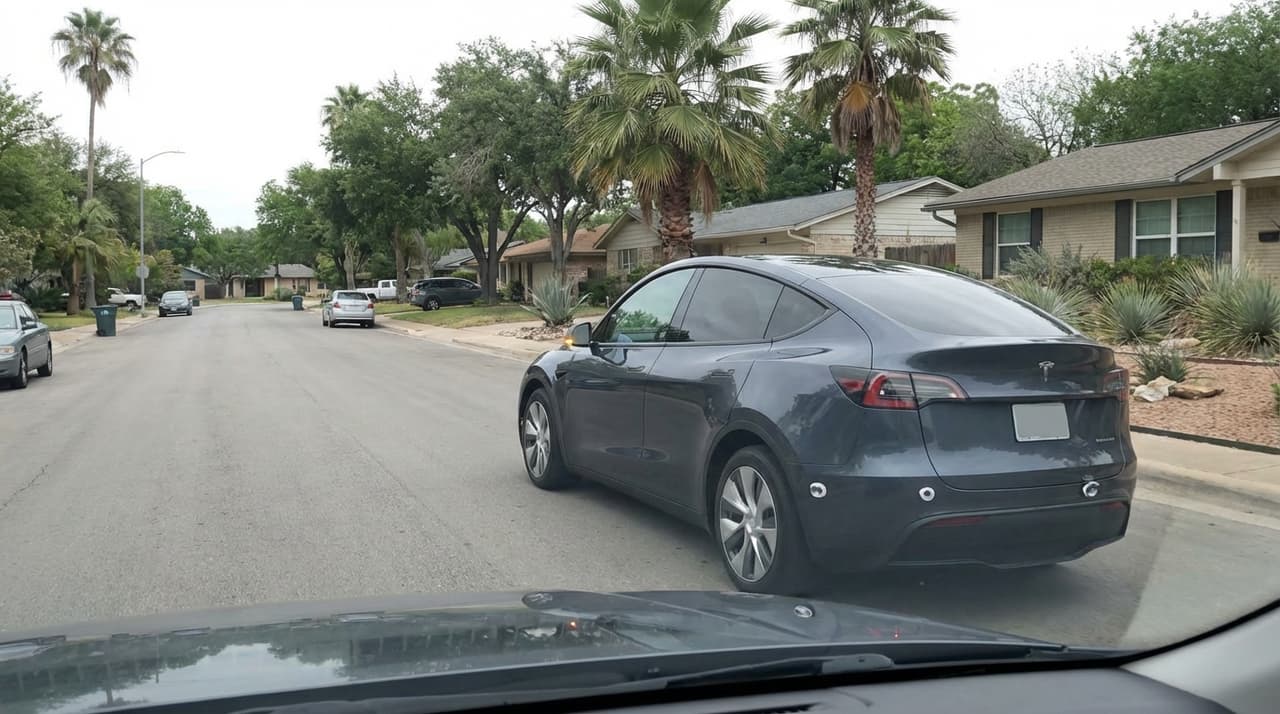
- Tesla (TSLA)'s Full Self-Driving (FSD) system shows a dramatic leap in miles between interventions, jumping from 441 to over 9,200 after version 14.1.x, marking the biggest improvement in four years.
- Data from Austin robotaxi operations suggests approximately 40,000 miles between crashes, implying an FSD-equipped vehicle could go roughly three years without an accident at typical annual mileage.
- Piper Sandler analyst Alexander Potter indicates Tesla is "very close" to removing safety operators from its Austin robo-taxis, with unsupervised rollout expected in select U.S. cities by end of 2025.
Tesla's push toward unsupervised autonomous driving has accelerated significantly, with recent performance data pointing to a potential breakthrough in safety and reliability. According to analysis by Piper Sandler, the FSD Community Tracker recorded a surge in miles to critical disengagement after the release of version 14.1.x in October, leaping from 441 miles to over 9,200 miles—a milestone Potter described as "the biggest sequential improvement in four years of data collection." This jump not only underscores rapid technological advancement but also edges the system closer to operational viability without human oversight.
In Austin, where Tesla operates a robotaxi network, preliminary safety metrics are equally compelling. Based on seven NHTSA incidents across roughly 280,000 miles of operation, the data suggests about 40,000 miles between crashes. For a typical vehicle driven 13,000 miles annually, this translates to roughly three years without an accident, a figure that bolsters confidence in FSD's readiness for broader deployment. "We're seeing tangible progress that could reshape personal transportation," said a source familiar with the matter, who spoke on condition of anonymity due to the sensitivity of ongoing regulatory discussions.
While version 14.2.x has shown weaker early results, analysts attribute this to limited data rather than a regression in capability. Expectations are high for the upcoming v14.3 update, which Elon Musk has hinted could arrive later in 2025 or early 2026, with performance likely to improve as more miles accumulate. Tesla's validation process involves rigorous testing through fleets, employees, and early access users before general rollout, ensuring each build meets safety thresholds. Efforts to reduce safety disengagement prompts, or "nags," are also underway, addressing concerns that drivers might disengage FSD for brief tasks—a practice deemed less safe than continuous system use.
Regulatory hurdles remain a key focus, with Tesla working to secure approvals in the Netherlands as a stepping stone to broader EU and UNECE clearance. Musk has expressed optimism that this could be achieved by year's end, though it involves a complex exemption process. In the U.S., the company plans to launch unsupervised FSD in geofenced areas by end of 2025, starting with the Model Y due to its superior performance. Piper Sandler has reaffirmed a $500 price target and "Overweight" rating on Tesla stock, citing FSD as "the crown jewel of Tesla's auto business" and a potential game-changer for the industry.
As Tesla expands model parameters by up to 10x to handle edge cases more effectively, hardware constraints on AI4 computers pose challenges but also promise more human-like driving behavior. With delivery projections of 1.75 million vehicles in 2026 and 2.00 million in 2027, driven partly by FSD adoption and robotaxi launches, the path to fully autonomous driving appears increasingly tangible. If current trends hold, 2026 could mark an inflection point for unsupervised deployment, though success will hinge on balancing innovation with robust safety validation.