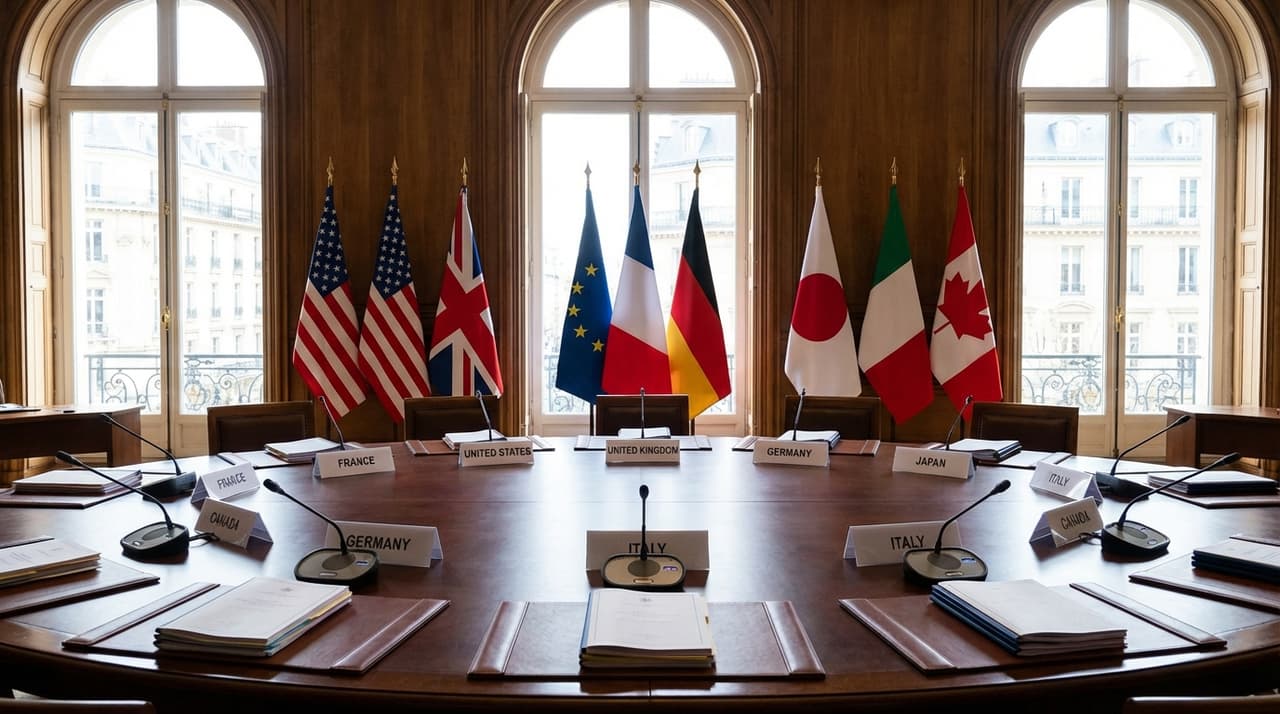
- President Trump will not attend an emergency G7 summit in Paris proposed by French President Emmanuel Macron, as confirmed by a White House official.
- Macron's invitation included non-G7 nations Russia, Ukraine, Denmark, and Syria, reflecting efforts to expand dialogue beyond core members.
- The move follows escalating trade threats, including Trump's proposed 200% tariffs on French wine, and leaked private messages between the leaders.
President Trump has no plans to travel to Paris for a last-minute emergency G7 summit proposed by French President Emmanuel Macron, a White House official confirmed. Macron suggested the meeting via text, including invitations to Ukraine, Denmark, Syria, and Russia, and offered a dinner before Trump returned to Washington. France currently holds the G7 presidency, with the next official summit set for June in Evian-les-Bains.
Macron's outreach comes amid broader tensions, including leaked private messages where Macron expressed confusion over Trump's Greenland ambitions, stating, "My friend, I don't understand what you are doing on Greenland." Trump posted these screenshots on Truth Social after Macron declined his "Board of Peace" initiative, threatening 200% tariffs on French wine and champagne. French officials criticized this as anti-cooperative and called for EU anti-coercion measures, according to people familiar with the matter.
Efforts to coordinate on global economic imbalances have hit a snag, with Macron prioritizing G7 dialogue as a tool for crisis resolution. The proposal coincides with France's 2026 G7 presidency, which began January 1 and focuses on addressing these imbalances through major power discussions. Without U.S. participation, the Paris summit appears unlikely to proceed, potentially stalling emergency talks on issues like Ukraine and Russia.
In a Davos speech on January 20, Macron indirectly referenced Trump, preferring "respect to bullies" and rule of law over brutality, while advocating for European strategic autonomy. The audience responded with laughter at his stability remarks, highlighting the public reaction to escalating rhetoric. Élysée briefings have decried tariff coercion, emphasizing risks to trade-dependent sectors like French wine exports, which face immediate market pressures.
Short-term, Macron may attempt to engage Trump at Davos or through EU mechanisms, but the focus shifts to the official 52nd G7 summit on June 15-17 in Évian-les-Bains, postponed one day due to Trump's scheduling conflicts, including his birthday and a UFC event at the White House. Trump is listed as an attendee alongside leaders like Japan's Sanae Takaichi, in her first summit, and Macron, in his last. Experts anticipate discussions will center on health equity, globalization regulation, and economic imbalances, with Macron having considered inviting China's Xi Jinping, drawing concerns from Japanese officials.
Related developments include France reinforcing its military presence in Greenland with 15 soldiers in Nuuk and a €36 billion defense spending plan for 2026-2030, overlapping with Trump's NATO discussions and a U.S. letter to Norway about Arctic control. An EU extraordinary summit is scheduled for Thursday to address these tensions. Historically, France chairs the G7 in 2026, 50 years after the 1975 G6 in Rambouillet, with Évian previously hosting the 2003 G8 summit, echoing past U.S.-Europe frictions over tariffs and territorial pushes.
Attempts to reach the White House for further comment were unsuccessful, but sources indicate that without a deal, diplomatic strains could worsen, impacting broader economic cooperation. The situation remains fluid, with stakeholders watching for any shifts in tone or new proposals ahead of the June summit.