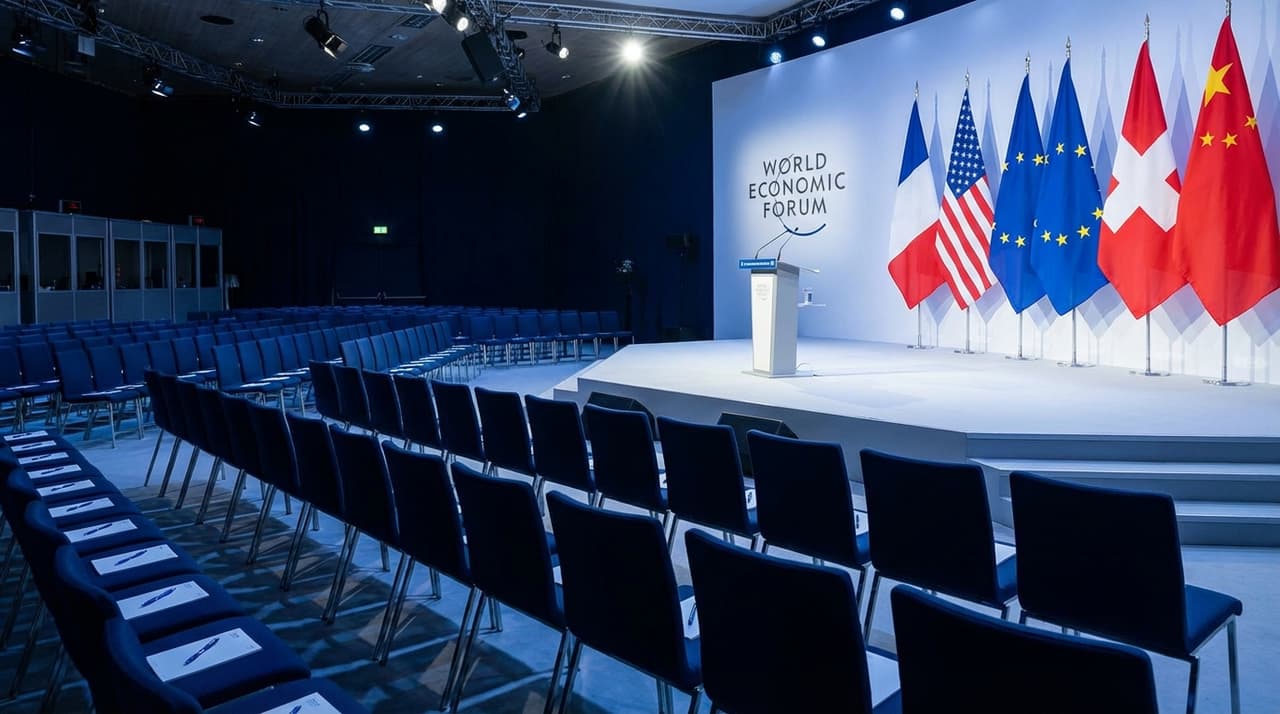
- French President Emmanuel Macron will avoid direct talks with former U.S. President Donald Trump at the 2026 Davos World Economic Forum, signaling a deepening rift over Trump's push to annex Greenland and establish a rival "Board of Peace."
- Trump has threatened steep tariffs on European nations, including a 10% levy on imports from Denmark, Sweden, France, Germany, and others starting February 1, escalating to 25% by June without a Greenland deal, with separate 200% tariffs targeting France over opposition to the Board of Peace.
- The conflict intensified after Trump publicly posted private messages from Macron on Truth Social, revealing Macron's confusion over the Greenland strategy and his proposal for a post-Davos summit involving Ukrainians, Danes, Syrians, and Russians.
A Diplomatic Standoff Unfolds
In a move that underscores the growing transatlantic divide, French President Emmanuel Macron has stated he does not intend to speak directly with former U.S. President Donald Trump at the ongoing Davos World Economic Forum. This decision comes amid escalating tensions triggered by Trump's renewed efforts to annex Greenland and launch a "Board of Peace" as an alternative to the United Nations. According to people familiar with the matter, Macron's stance follows Trump's public disclosure of private messages, which included Macron expressing bewilderment over the Greenland strategy, writing, "I do not understand what you are doing with Greenland." The leaked correspondence, posted on Truth Social, also revealed Macron's proposal for a G7-style summit in Paris after Davos, involving multiple international parties and a bilateral dinner—an overture Trump dismissed diplomatically.
Trump, en route from Mar-a-Lago, has instead announced a Davos meeting focused on Greenland with "various parties," coordinated with NATO Secretary General Mark Rutte, who has pledged support for U.S. achievements in Syria, Gaza, and Ukraine while committing to Greenland talks. As of January 20, 2026, at 14:00 Swiss time, Macron delivered a public speech at Davos warning of a "world without law" in response to Trump's agenda. Trump is scheduled to speak the next day at 14:30, followed by the formalization of the Board of Peace on Thursday, according to sources briefed on the schedule.
Economic and Political Fallout
The standoff has immediate economic implications, with Trump threatening tariffs that could disrupt EU-U.S. trade flows. Germany's Friedrich Merz has warned of retaliation against what he termed "unreasonable" measures while seeking a meeting with Trump, and Norway's prime minister has adjusted his schedule for talks, according to officials. Broader trends point to Trump's tariff-heavy "new global order," risking inflation and supply chain shifts as Davos grapples with rising economic nationalism. In the political arena, core disputes center on the U.S. bid to buy or annex Greenland for security purposes—rejected by Europe, led by Macron, which emphasizes Danish autonomy—and Trump's unilateral Board of Peace, which invites countries like Argentina and Russia to bypass the UN. The EU opposes this as a power grab, especially ahead of a potential Ukraine peace deal.
EU leaders are planning an emergency Brussels summit on Thursday post-Davos, while Rutte has backed Trump selectively on certain issues. Attendees at Davos include Macron, Merz, Ursula von der Leyen, Mark Carney, Javier Milei, and Nigel Farage, showcasing a rift between nationalist and multilateral approaches. Trump arrives with a high-level delegation including figures like Marco Rubio, according to sources. Efforts to reach the French and U.S. delegations for further comment were unsuccessful as of press time.
Implications and Next Steps
Short-term, the Davos speeches and reactions could trigger the implementation of tariffs or last-minute deals, with the Board of Peace signing on Thursday testing global buy-in. Long-term, analysts see risks of fractured transatlantic ties, potential NATO weakening, and the emergence of new U.S.-led blocs. Experts predict that if no compromise is reached, EU retaliation could harden, accelerating a multipolar world. The stakes also affect Arctic indigenous groups in Greenland, who have autonomy concerns, and European consumers facing higher import costs. Public backlash includes European unity against what some call U.S. "bullying," with debates on social media platforms like X and Truth Social over the erosion of diplomatic trust due to leaked messages.
In related developments, Ukrainian President Volodymyr Zelenskyy is seeking a meeting with Trump, though it remains unconfirmed, while Argentina's Javier Milei has aligned with Trump at Davos. The situation revives Trump's 2019 Greenland purchase proposal, rejected by Denmark, and evolves into a 2026 security-nationalist push post his re-assumption, amid gains in Syria and Iran and a stalemate in Ukraine. Parallels are drawn to prior Trump-EU tariff wars, such as those over steel and aluminum, and ongoing UN skepticism. As the forum progresses, all eyes are on whether this diplomatic snub will escalate into a full-blown economic confrontation or if behind-the-scenes negotiations can avert further disruption.