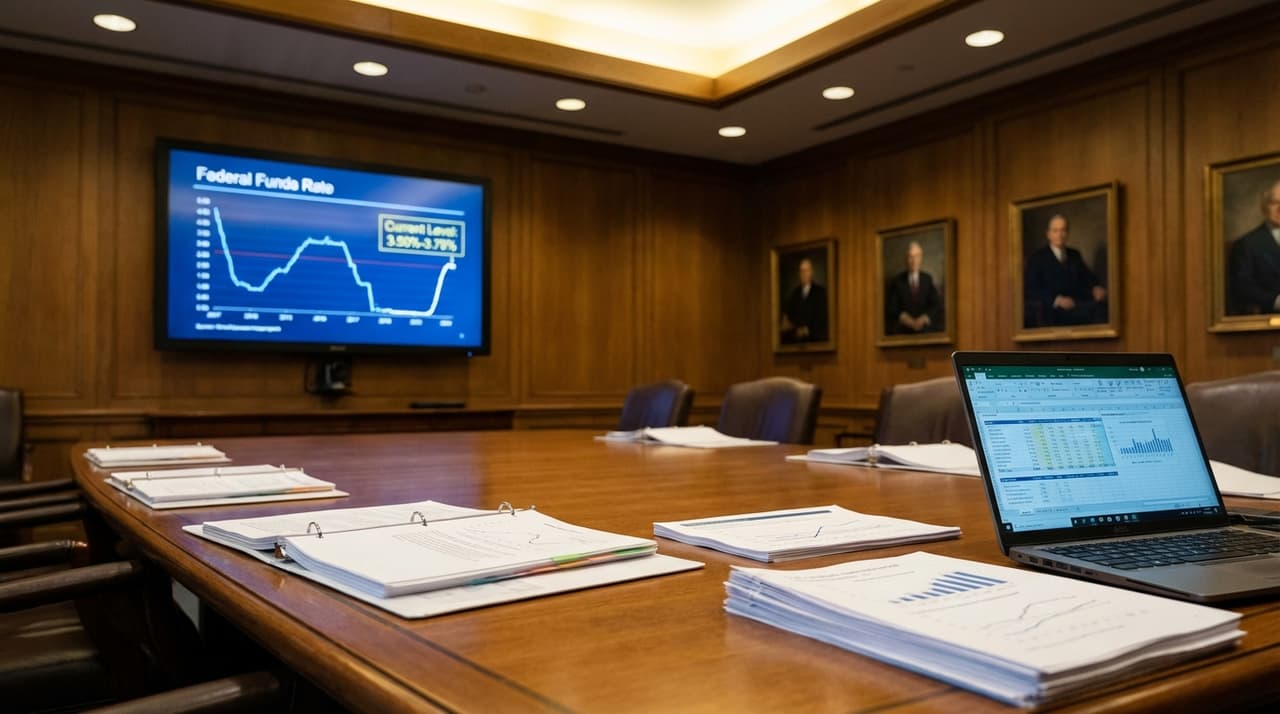
- President Trump publicly urges the Federal Reserve to lower interest rates further, citing benefits for markets and federal debt costs, with the federal funds rate now at 3.5%-3.75% after a December 2025 reduction.
- The Fed cut rates by 25 basis points in December 2025, its third cut of the year, despite internal divisions including dissents for holding or deeper cuts.
- As of January 2026, the FOMC is expected to hold rates steady at its January 28 meeting, with Chair Jerome Powell emphasizing data-driven decisions over political pressure.
President Trump has intensified his calls for the Federal Reserve to slash interest rates, pushing for reductions that he argues would bolster financial markets and ease the burden of servicing the nation's $30 trillion debt. In a December 2025 social media post and subsequent address at Davos, Trump reiterated his desire for a new Fed Chair who would prioritize rate cuts if markets perform well, setting the stage for a potential leadership change when Powell's term ends in May 2026.
The Fed's recent moves have already brought the federal funds rate down to 3.5%-3.75%, a cumulative drop of 1.75 percentage points since September 2024. The December cut, however, was not without controversy; internal divisions surfaced, with some policymakers dissenting in favor of holding rates or implementing deeper cuts. According to people familiar with the matter, the FOMC's January 28 meeting is widely anticipated to result in no change, as Powell and his colleagues weigh robust economic growth against persistent inflation above the 2% target.
Efforts to navigate this delicate balance have hit a snag, with the Fed's latest Summary of Economic Projections (SEP) raising 2026 GDP growth forecasts to 2.3% while trimming inflation expectations to 2.4%. The injection of approximately $100 billion from the One Big Beautiful Bill Act's tax cuts has added fuel to the economy, complicating the path to further easing. Without additional cuts, the administration's goal of a "hot" economy ahead of the midterms could be jeopardized, but moving too quickly risks exacerbating price pressures.
Trump's push is not occurring in a vacuum. He has been interviewing potential Fed Chair candidates, including Christopher Waller, Kevin Warsh, and Rick Rieder, with a clear preference for dovish advocates who might accelerate rate reductions. This political maneuvering has sparked debates over Fed independence, echoing past tensions from the Nixon era. Economists warn that while lower rates could benefit homeowners through cheaper mortgages and reduce government debt costs, they might also inflate prices and squeeze savers with diminished yields.
Market participants are closely watching the odds, with investors currently pricing in a 32% chance of two rate cuts in 2026 and a 30% probability of just one. Higher tax refunds, averaging around $3,500 and up roughly 20% from previous years, could provide a temporary boost to consumer spending but might delay the Fed's easing cycle. In the background, incoming regional Fed presidents like Beth Hammack and Lorie Logan, who lean hawkish, and Anna Paulson, seen as more dovish, are poised to influence future votes.
As the standoff continues, the Fed's job has become much more difficult, according to RSM economist Tuan Nguyen, who projects two cuts later in 2026 but notes a higher bar for action in the first quarter. The long-term outlook suggests a dovish shift in the FOMC could enable total cuts of 0.75 to 1 percentage point, though factors like tariffs and ongoing fiscal stimulus may limit the scope. For now, the central bank remains focused on data, with Powell's team resisting political pressure as they chart a course through an increasingly complex economic landscape.
Correction: An earlier version of this article misstated the federal funds rate; it is currently 3.5%-3.75%, not 3.75% as initially reported.