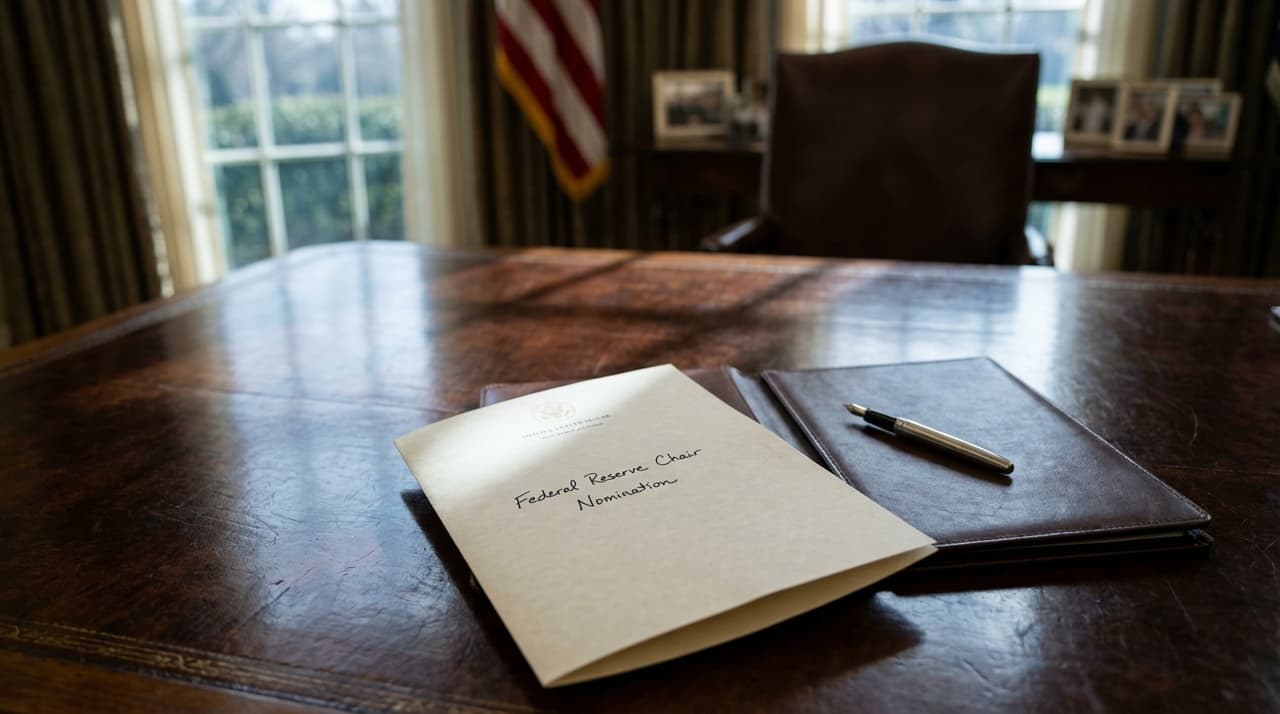
- Kevin Hassett signals President Trump will decide on Jerome Powell's reappointment or a successor within weeks.
- Powell's current four-year chair term runs to May 2026, with the White House needing to act well before that date.
- The decision comes amid ongoing reshuffling of Fed leadership, including recent board changes and regional bank turnovers.
Kevin Hassett's comment indicates that President Trump is poised to make a critical choice on Federal Reserve leadership in the coming weeks, determining whether to renominate Jerome Powell as chair or select a new figure to steer U.S. monetary policy. Powell's current four-year term as chair, confirmed on May 12, 2022, is set to expire in May 2026, according to the Brookings Institution, setting a timeline that requires White House action to avoid market uncertainty.
Efforts to restructure the Fed's top ranks have already seen moves, such as Adriana Kugler's early departure in 2025 and her replacement by Stephen Miran, underscoring the administration's focus on shaping the board ahead of the chair decision. Without a clear announcement soon, speculation could unsettle financial markets, which are closely watching for signals on future interest rate policies. According to people familiar with the matter, internal discussions have intensified, with Trump weighing Powell's performance against potential alternatives who might align more closely with his economic agenda.
"What institutional investors are really focused on is regulatory stability," said one anonymous source close to the administration, echoing sentiments from financial circles. Attempts to reach the White House for comment were not immediately successful, but insiders suggest the decision could tilt the Fed's policy stance for years, given that current board terms, like Lisa Cook's running to 2038, extend well into the next decade. The existing voting coalition, including Trump appointees Michelle Bowman and Christopher Waller, will influence how any new chair navigates upcoming challenges.
Regional Fed leadership is also in flux, with Atlanta Fed President Raphael Bostic announcing he will resign at the end of February 2026, adding another layer of turnover that could affect FOMC debates. This backdrop makes the chair decision particularly timely, as it will mesh with vice chairs' terms—Philip Jefferson's to 2027 and Bowman's to 2029—under a legal framework where the president nominates chair and vice chairs for separate four-year terms. Historically, Powell's role has seen shifts, having been first made chair by Trump in an earlier term and reappointed by President Biden in 2022, marking this as a third presidential call on his leadership.
Markets are bracing for clarity to avoid disruptions, with analysts noting that competition for influence over monetary policy has toughened amid economic uncertainties. If Powell is not reappointed, the Fed could face a period of adjustment, potentially impacting regulatory approaches and financial stability. For now, all eyes are on the White House, where a decision in the next week or two will set the tone for the central bank's direction as it heads toward key filing deadlines and policy meetings.