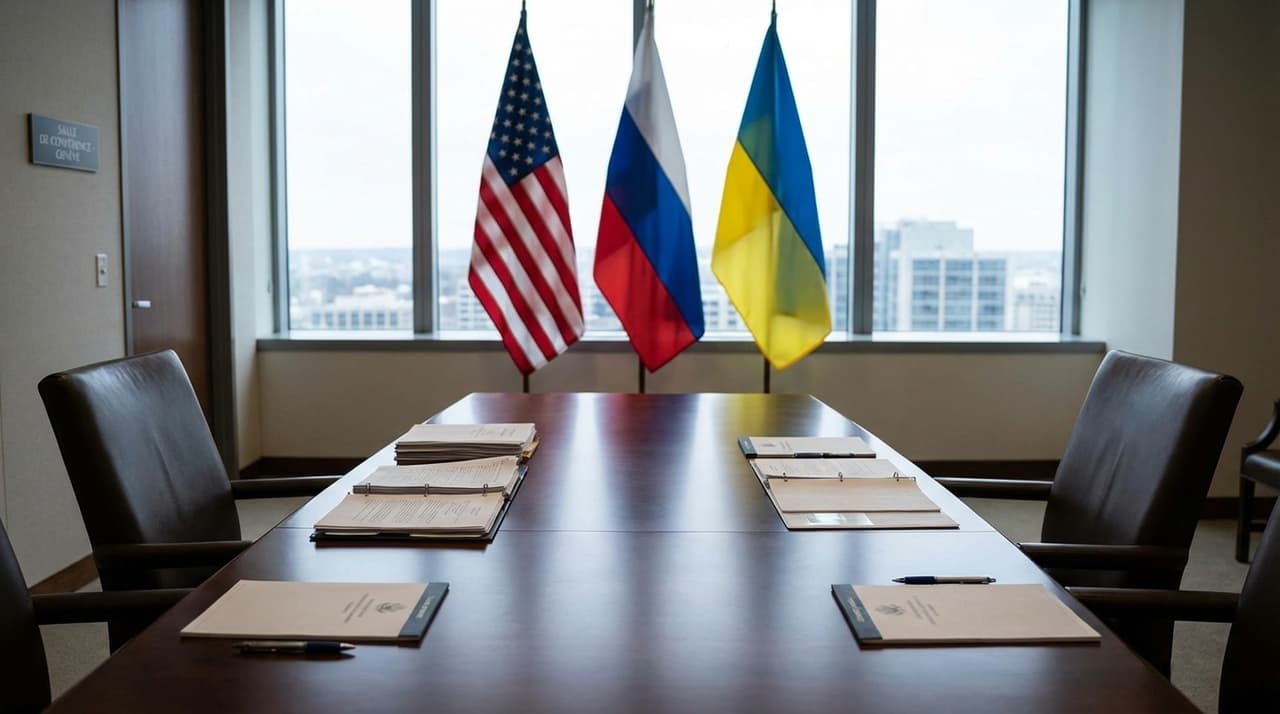
- President Trump's administration pushes for a rapid peace deal, but negotiations face significant hurdles over territorial and security issues.
- Talks have rotated through multiple international venues, with recent meetings described as constructive but yielding no breakthroughs on core disputes.
- Analysts caution that Trump's optimistic timeline may be more about political signaling than a firm forecast, given entrenched positions and previous missed deadlines.
A Race Against Time in Peace Talks
President Donald Trump's assertion that "we will know the outcome of Russia-Ukraine talks in a few weeks" underscores a high-stakes U.S. diplomatic push to broker an end to the conflict, but the path to a deal remains fraught with unresolved gaps. According to people familiar with the matter, negotiations have involved U.S., Russian, and Ukrainian delegations in cities like Geneva, Abu Dhabi, Berlin, and Moscow, with the latest round in Berlin described as offering a "real opportunity" for progress, though no concrete agreements were announced.
Efforts to restructure the peace framework have hit a snag, as earlier U.S. drafts required Ukraine to cede more eastern territory than Russia originally claimed, restrict NATO deployments, and sharply shrink its armed forces—terms Kyiv rejected as "non-starters." Newer versions reportedly scale back some concessions, but disputes over territory, security guarantees, and Ukraine's sovereignty persist. Without a deal, the risk of prolonged conflict and economic strain on European energy and global food markets could intensify.
Trump has publicly framed the talks as making headway, noting after a recent five-hour Kremlin meeting with U.S. envoys that positions are getting "closer" and that Russia "would like to end the conflict." However, Russian officials confirmed "no breakthrough" on key issues, while Ukrainian stakeholders remain wary of any settlement perceived as compromising sovereignty after years of occupation. Attempts to reach Ukrainian and Russian representatives for further comment were not immediately successful.
Unresolved Core Positions and Market Implications
Russia's demands include recognition of all occupied territories as Russian, a bar on Ukraine joining NATO, limits on Ukraine's military, and sanctions relief. In contrast, Ukraine insists on full Russian withdrawal, return of prisoners and abducted children, war-crimes accountability, and robust security guarantees. This deadlock has led to repeated slippages in informal deadlines, such as an earlier Thanksgiving target, fueling skepticism among analysts who view Trump's timeline as political signaling rather than evidence-based.
The economic stakes are high: a ceasefire could ease pressures on European energy prices and global food markets disrupted by the war, while sanctions relief remains a core Russian demand. Defense markets, which have seen increased demand for artillery and drones, might shift from high-intensity replenishment to modernization if peace holds, but lasting uncertainty would keep budgets elevated. European governments, closer to Ukraine's position, have floated a ceasefire monitored by a "coalition of the willing," an approach Russia has rejected, highlighting a visible U.S.–Europe policy gap.
In the short term, negotiators are expected to continue working on revised plans, with further meetings anticipated. However, the risk of a "frozen conflict" looms if a settlement freezes front lines without resolving core disputes, potentially leading to periodic escalations. Trump's compressed timelines, driven in part by domestic political pressures, have sparked debate over whether Washington is pressuring Kyiv to accept unfavorable terms, a tension that could strain NATO relations if a deal is perceived as favoring Russia.
Correction: An earlier version of this article misstated the timing of a recent meeting; it has been updated to reflect that Berlin talks occurred in mid-December.