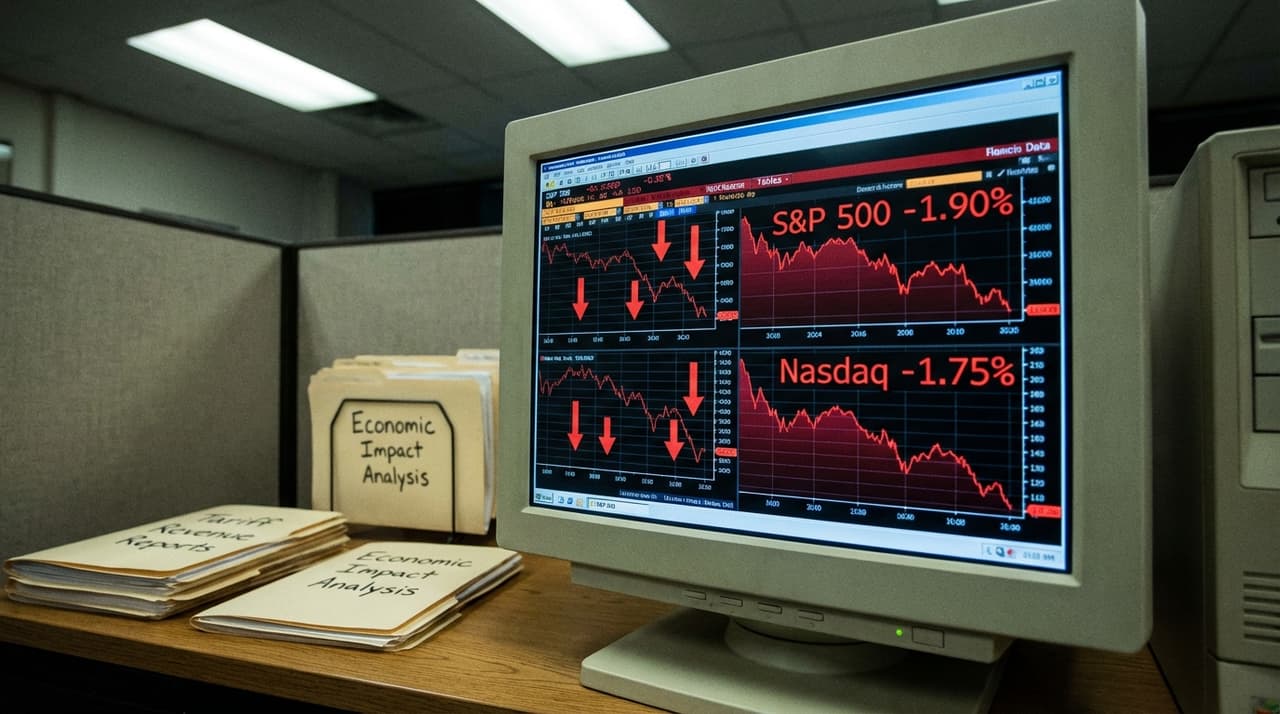
- Tariff rates soared to a 27% average effective rate by April 2025, the highest in over a century, triggering a global market crash with the S&P 500 dropping 4.88% and Nasdaq 5.97%.
- Tariff revenue hit $287 billion in 2025, up 192% year-over-year, funding initiatives like military spending and deficit offsets, but raising costs for households and businesses.
- Economic fallout includes slowed job growth, increased poverty, and corporate bankruptcies, despite sustained GDP growth and Trump's claims of bringing America back.
In a dramatic escalation of trade policy, former President Donald Trump's push for aggressive tariffs has reshaped the U.S. economic landscape, with rates spiking from 2.5% to a 27% average effective rate by April 2025—the highest in over a century. This surge, part of his ongoing promotion of 2025-2026 tariff policies, prompted a global market crash in April, sending the S&P 500 down 4.88% and the Nasdaq tumbling 5.97%, according to market data. Trump paused "reciprocal" tariffs above 10% for 90 days on April 9, 2025, except for China at 145%, amid the volatility, but by January 2026, he threatened 10-25% tariffs on eight European countries over Greenland negotiations, signaling continued use of tariffs as negotiation tools.
Behind the headlines, the financial impact is stark. Tariff revenue skyrocketed to $287 billion in 2025, a 192% year-over-year increase, with officials touting it as a funding source for military initiatives, Ukraine aid, and deficit offsets through mechanisms like the OBBBA. However, this windfall comes at a cost: companies bear 51% of the burden, households 37%, and CPI inflation rose post-April 2025, despite Trump's December 2025 claim it had stopped. Jobs grew by only 584,000 in 2025, compared to 2 million in prior years, and manufacturing employment declined monthly, while corporate bankruptcies hit 2010 highs. U.S. farm exports fell due to retaliation, though bailouts mitigated some damage, and poverty rose by 650,000-875,000 Americans, or 0.2-0.3% of the population, according to economic analyses.
Efforts to restructure trade relations have hit a snag, with China's retaliation persisting at 145% and parallel threats to the EU bloc complicating negotiations. Without a deal, the U.S. could face deeper economic strain, as low-income groups bear a regressive burden through reduced purchasing power, pushing an estimated 375,000 more children into poverty per OPM measures. Stakeholders include burdened businesses and farmers, sparking debates on affordability, with over half of Americans blaming Trump tariffs for higher living costs, according to people familiar with consumer sentiment.
In the political arena, Trump campaigned in 2024 on promises of 60% tariffs on China, 100% on Mexico, 20% universal, and 200% on outsourcers like John Deere (DE), framing tariffs as tools for border security, childcare subsidies, and war prevention. 2026 signals include potential 200% tariffs on pharmaceuticals and ongoing threats with Japan, Korea, India, and China, while Trump's criticism of the Federal Reserve has raised fears of Powell's removal. The CBO projects a $2.5 trillion deficit reduction by 2035 if tariffs become permanent, but SCOTUS challenges could require refunds, adding uncertainty.
Looking ahead, the short-term outlook risks recession and market volatility, with negotiations potentially de-escalating through deals. Long-term, more tariff-funded programs are proposed, but poverty and inflation persistence are likely, and economists predict slower GDP growth if policies moderate. This tariff narrative ties into bilateral deals amid China stalemate, with 2026 policy briefs flagging recurring threats as the new norm. For now, the economic strain contrasts sharply with Trump's claims of revival, leaving investors and policymakers navigating a volatile landscape.