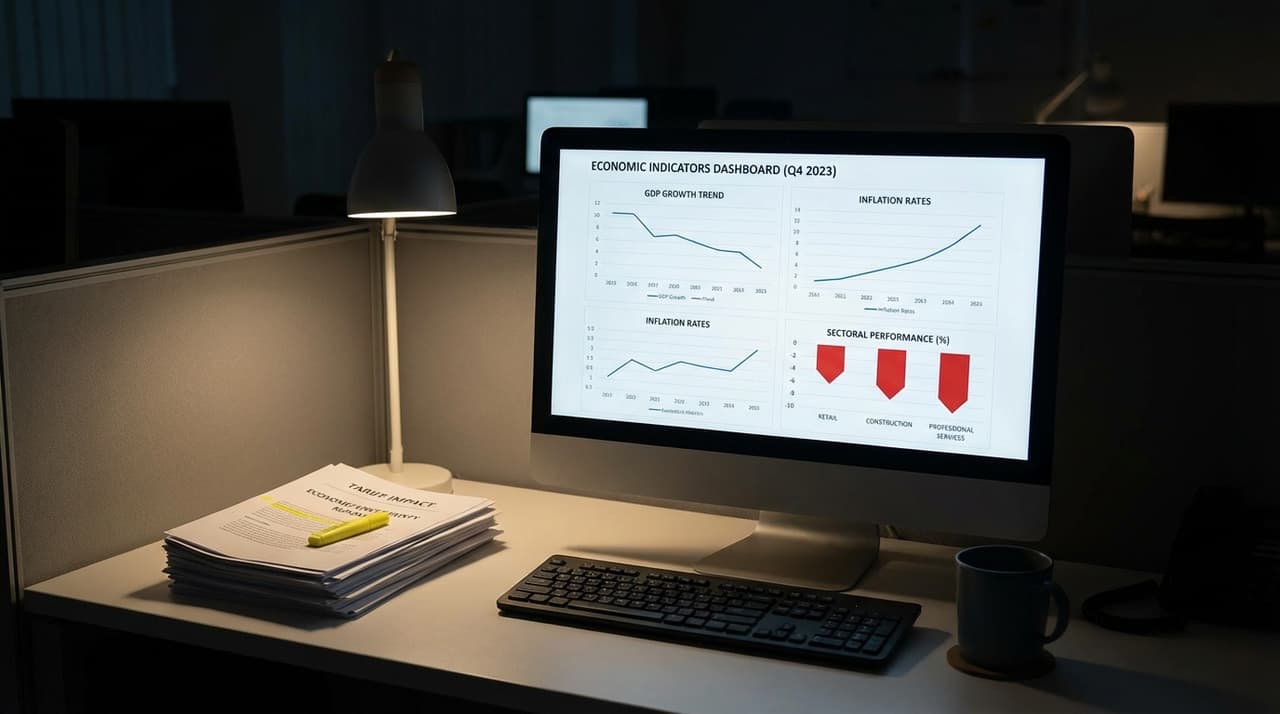
- Trump attributes recent U.S. economic strength to tariffs, forecasting continued improvement.
- Economic data shows resilient but slowed growth in 2025, with tariffs contributing to inflation and sectoral declines.
- Uncertainty persists due to delayed data releases and ongoing policy challenges, including Supreme Court cases.
Tariff Claims and Economic Reality
Former President Donald Trump asserted on December 23, 2025, that strong U.S. economic numbers stem from his tariffs, predicting further gains. This statement contrasts with economic analyses indicating that growth has slowed in 2025 amid tariff pressures, partially offset by AI investments and tax policies. According to people familiar with the matter, U.S. real GDP growth is estimated at 1.5%–2.0% for 2025, down from 2.5%–3.0% in 2024, with core inflation at 3%—better than feared but elevated due to partial tariff pass-through, which adds 0.4–0.5 percentage points to inflation.
Efforts to assess the full impact have hit a snag, as data releases are delayed by a government shutdown, amplifying market uncertainty. Payroll growth slowed to 50,000 monthly from 110,000 in 2024, unemployment rose to 4.4%, and sectors like retail, construction, and professional services saw declines. Without a clear resolution, analysts warn that the economic picture could remain murky for weeks.
Sectoral Impacts and Policy Dynamics
Tariffs have contributed to uneven effects across the economy. Large, capital-intensive firms, such as those leveraging AI and tax credits, have thrived by absorbing costs and investing heavily—for instance, with $200 billion in data centers boosting GDP through software and R&D. In contrast, small and midsize labor-intensive firms struggle with trade exposure, facing higher operational hurdles. Studies forecast that tariffs could reduce GDP growth by 0.23 points in 2025, raising household costs by $1,300 annually and lifting inflation by about 1 point.
A Trump administration official, speaking on condition of anonymity, emphasized that policies aim to boost manufacturing and revenue, but they fuel uncertainty. The tariffs, enacted under the International Emergency Economic Powers Act, face Supreme Court challenges in 2026, potentially refunding $100 billion and shifting to Sections 232 and 301. This legal overhang adds to the volatility, with markets repricing risks higher for vulnerable sectors.
Consumer and Market Responses
Households are feeling the pinch, with higher prices gradually passing through—equivalent to a $1,300–$1,600 tax hike per year, according to economic models. A Pew survey from August 2025 shows 55% of Americans view long-term tariff effects as negative for the country and families, highlighting public disapproval amid what some describe as a "roller coaster" economy. Businesses are adapting, with many turning to AI and labor cuts to offset costs, though this has softened labor markets, disproportionately affecting trade-exposed workers.
In the short term, resilient growth is expected to persist with broader demand recovery, but inflation may remain sticky, with CPI projected at 3.1% in 2026. Experts predict that policy-tech interactions could sustain narrow resilience, but risks of inflation delays loom. As one analyst noted, "It's a balancing act—tariffs might boost certain sectors, but the broader drag on consumers and small businesses can't be ignored."
Correction: An earlier version of this article misstated the estimated GDP growth range for 2025; it has been updated to reflect the correct figures.