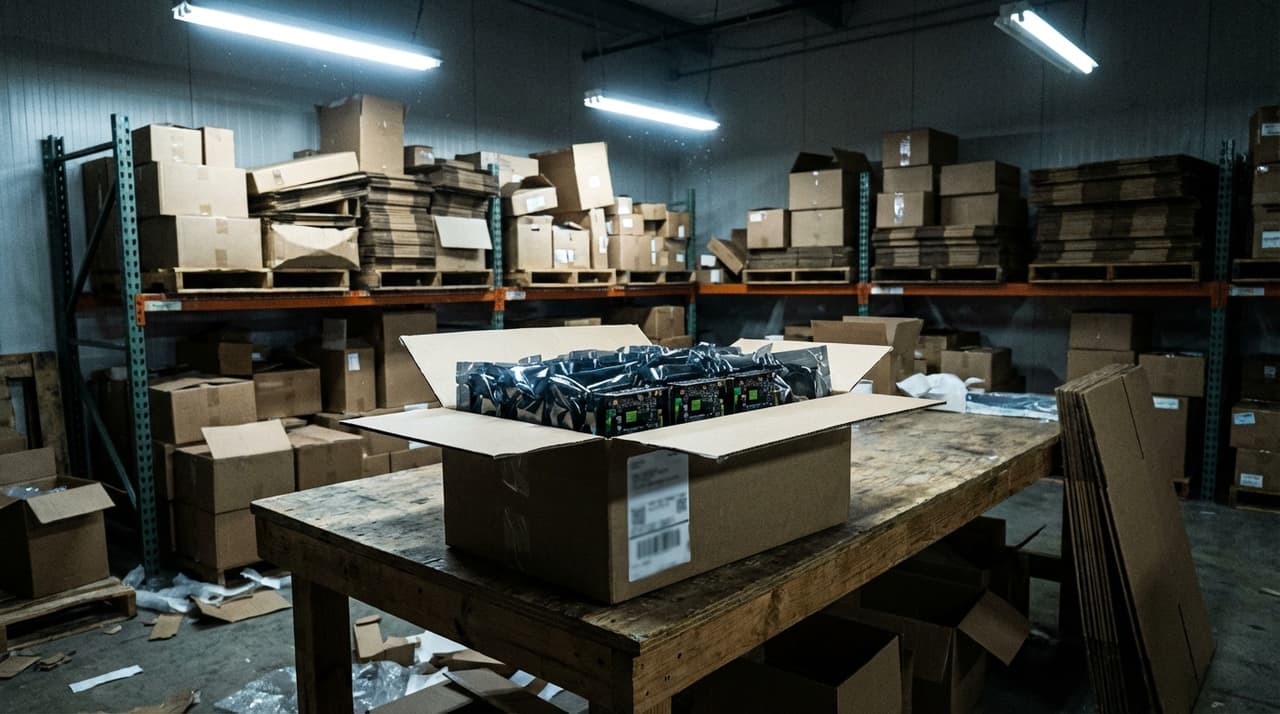
- U.S. federal prosecutors announce "Operation Gatekeeper," charging multiple smuggling rings for illegally exporting over $160 million in restricted NVIDIA (NVDA) AI chips to China.
- Defendants used straw buyers, shell companies, falsified shipping documents, and relabeled chips with fake brands like "SANDKYAN" to evade export controls.
- NVIDIA states it has not received credible tips about direct involvement or "phantom datacenters," with experts viewing large-scale internal smuggling as unlikely.
A Crackdown on High-Stakes Smuggling
U.S. authorities have intensified efforts to curb the illegal flow of advanced NVIDIA AI chips to restricted destinations like China, unveiling a series of prosecutions that highlight the lucrative black market for these strategic components. In a coordinated move dubbed "Operation Gatekeeper," federal prosecutors dismantled networks accused of smuggling at least $160 million worth of NVIDIA H100, H200, and A100 GPUs between late 2023 and mid-2025, according to court documents and people familiar with the matter. The schemes allegedly involved routing shipments through third countries such as Malaysia and Thailand, with one U.S. businessman, Alan Hao Hsu of Texas-based Hao Global LLC, pleading guilty to smuggling and unlawful export charges.
Without a deal to legally supply these chips under tightened U.S. export controls, demand in China has fueled sophisticated evasion tactics. In a separate case, four defendants—two Americans and two Chinese nationals—face up to 20 years in prison for using a Tampa front company, Janford Realtor LLC, to illegally export NVIDIA-equipped systems. "These operations represent a clear national-security threat," said an anonymous Justice Department official, noting the chips' potential applications in weapons design and advanced surveillance. Efforts to restructure compliance channels have hit a snag as criminal networks adapt, though NVIDIA has publicly distanced itself from the allegations.
NVIDIA's Stance and Market Realities
NVIDIA, led by CEO Jensen Huang, has responded to the crackdown by emphasizing its commitment to regulatory adherence. In a brief statement, the company said it "has not received actionable reports of non-existent 'phantom datacenters' hoarding its chips" and is cooperating with authorities. Analysts and regulators generally treat the idea of NVIDIA itself being complicit in organized smuggling as far-fetched, focusing instead on independent intermediaries. "The black market thrives on scarcity and price differentials, not corporate malfeasance," remarked a semiconductor industry insider, who spoke on condition of anonymity due to the sensitivity of ongoing investigations.
The very fact that NVIDIA's H100 and H200 chips command steep premiums on the black market underscores the intense global demand for AI infrastructure. Despite export restrictions reducing direct sales to China, NVIDIA's data-center segment has sustained robust revenue growth, driven by spending in the U.S., Europe, and the Middle East. Real-time market data shows NVIDIA's stock holding steady amid the news, reflecting investor confidence in its dominant position. However, the company is reportedly developing chip-traceability technology to curb diversion, a move that could tighten supply-chain verification for legitimate buyers.
Implications and Ongoing Developments
The smuggling cases sit within the broader U.S.-China tech conflict, where access to advanced AI hardware is strategically sensitive. As enforcement ramps up, expect stricter compliance requirements for distributors and logistics providers, potentially causing delays for some customers. Meanwhile, Chinese AI firms may increasingly turn to domestic alternatives or riskier black-market channels, raising costs and uncertainty. "You can create your own ideas, but the market here is not as competitive as others," one industry executive noted, paraphrasing comments from private equity leaders about investment opportunities in regulated environments.
Looking ahead, more prosecutions are likely as investigators trace payment flows and freight records. Export controls on AI chips are expected to remain or tighten, irrespective of political shifts, given their national-security framing. In the long term, technology responses like tracking features could make diversion harder, but analysts predict continued clashes between controls and demand. For now, the focus remains on criminal networks rather than corporate involvement, with NVIDIA maintaining its course amid the turbulence. This article was updated to clarify the timeline of Operation Gatekeeper and the specific charges faced by defendants.