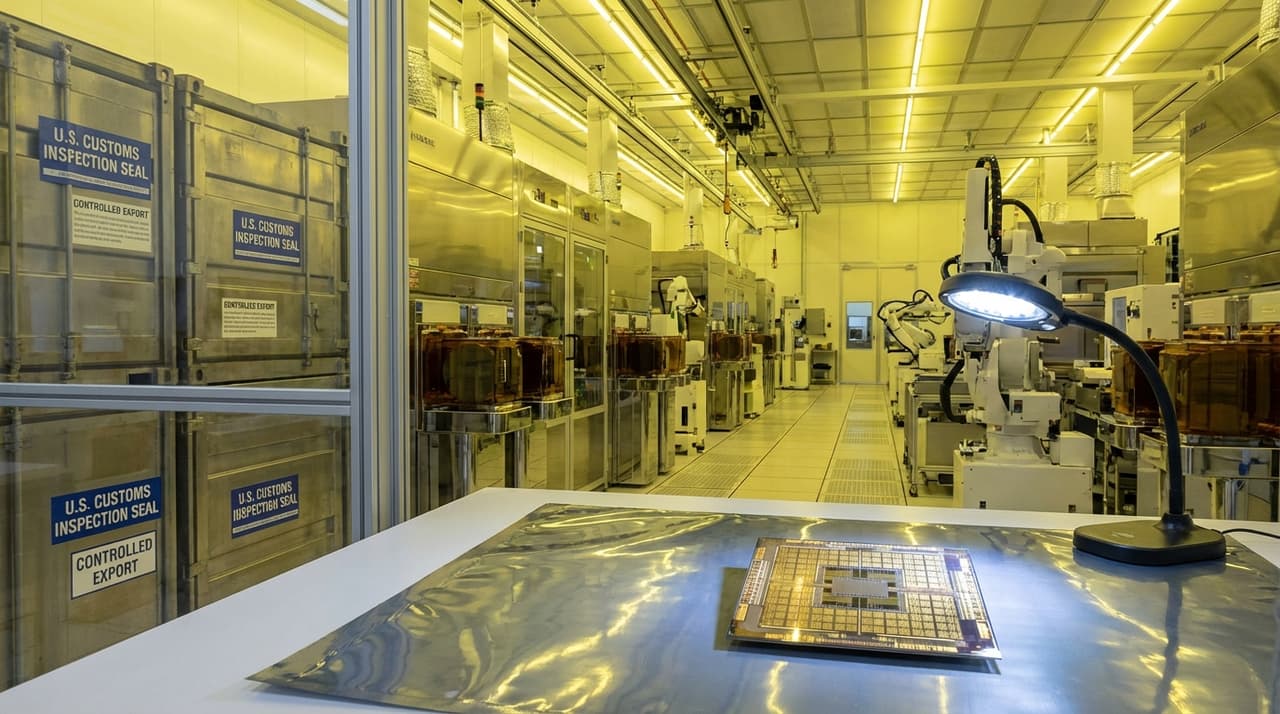
- Controlled H200 exports to China under strict U.S. oversight could generate federal revenue but risk eroding America's semiconductor edge.
- Chinese tech giants like Alibaba (BABA) and Tencent (TCEHY) may regain access to high-performance AI chips, easing reliance on inferior domestic alternatives.
- The policy shift from outright bans to "managed access" reflects ongoing U.S.-China tech tensions, with both sides balancing economic interests against security concerns.
In a significant reversal of prior restrictions, the U.S. government has approved exports of Nvidia (NVDA)'s H200 AI chips to select Chinese customers under stringent controls, including U.S. inspections, routing through U.S. territory, and a 25% import duty. This move, approved by the Trump administration in December 2025, follows a period of bans that barred these high-performance GPUs and comes after China's own September 2025 prohibition on its tech firms buying Nvidia chips.
According to people familiar with the matter, Chinese regulators are now reviewing demand from firms like Alibaba, ByteDance, and Tencent, while simultaneously pushing domestic alternatives. The H200, which offers roughly six times the speed of Nvidia's H20 chip with CUDA software support, provides Chinese AI developers with a crucial boost in compute power for training large models. "This reasserts U.S. control while capturing value, but Beijing may intensify its domestic accelerator programs," one industry expert noted, speaking on condition of anonymity.
Nvidia, with a market capitalization exceeding $3 trillion as of late 2025, has prioritized high-margin orders from U.S. hyperscalers, deprioritizing H200 production and limiting near-term supply to China. The company lost its entire Chinese market share during the export freeze but stands to regain revenue through these controlled sales. Efforts to reach Nvidia for comment were unsuccessful, but sources indicate the firm is focusing production on its newer Blackwell B100/B200 chips for U.S. and allied markets, with the Rubin architecture slated for 2026.
Without this deal, Chinese firms would have faced continued reliance on grey-market channels or inferior domestic hardware like Huawei's Ascend chips, potentially stalling AI advancements. The U.S. House panel has raised concerns that managed access could still risk America's technological advantage, especially as China pushes toward 2027 self-sufficiency goals in semiconductors. A congressional aide, who asked not to be named, said, "The inspections and tracking are designed to prevent military diversion, but the long-term impact on U.S. leadership remains uncertain."
In the short term, supply constraints from low H200 production may delay large Chinese orders, and regulators on both sides must finalize approvals. China is likely to cap imports tied to domestic procurement, mirroring prior H20 restrictions from August 2025. Parallel developments include China convening Alibaba, ByteDance, and Tencent for H200 demand assessments, echoing responses to earlier bans that have fueled growth for local players like Cambricon (688256.SS).
Correction: An earlier version misstated the timing of China's ban on Nvidia purchases; it was implemented in September 2025, not earlier in the year.