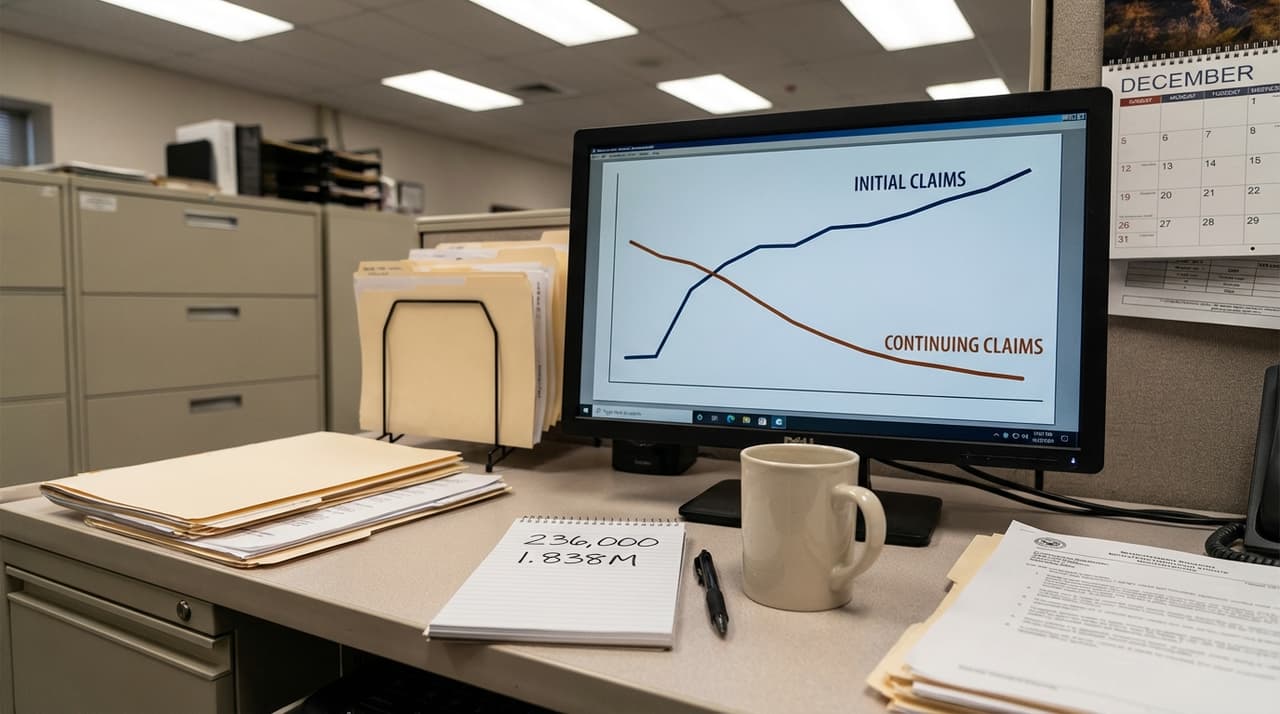
- Initial unemployment claims increased to 236,000 for the week ending December 6, above the consensus estimate of 220,000.
- Continuing claims fell to 1.838 million for the week ending November 29, down from 1.939 million the prior week.
- The data suggests a modest pickup in layoffs but some improvement in re-employment, reflecting a gradually normalizing labor market.
A Mixed Signal for the U.S. Labor Market
New data from the U.S. Department of Labor indicates that seasonally adjusted initial jobless claims rose to 236,000 in the week ended December 6, surpassing market expectations of 220,000. This marks a rebound from the prior week's unusually low figure of 191,000, which had been the lowest since September 2022. Meanwhile, continuing claims, which track the number of people remaining on unemployment benefits, declined to about 1.838 million for the week ended November 29, down from 1.939 million the week before. The numbers paint a nuanced picture: while new layoffs have edged higher, there's a slight easing in the stock of individuals relying on benefits.
According to people familiar with the matter, the latest figures are being closely watched by Federal Reserve officials as they assess the timing and pace of potential interest-rate cuts. A modestly softer but still resilient labor market could support arguments for earlier monetary easing, provided inflation continues to moderate. "What we're seeing is consistent with a cooling trend, not a collapse," one analyst noted, speaking on condition of anonymity. Efforts to reach the Labor Department for additional comment were not immediately successful.
The rise in initial claims to 236,000, though above estimates, remains historically low—well below the long-run average of about 361,000 since 1967. This reinforces the view that the labor market is gradually normalizing from post-pandemic tightness rather than heading into a sharp downturn. In recent months, claims had been drifting slightly higher, with continuing claims climbing toward levels not seen since 2021, indicating that finding new jobs was taking longer. The latest drop in continuing claims to 1.838 million partially tempers those concerns, suggesting some improvement in re-employment or exits from benefit rolls.
Market reaction to the release was muted, with Treasury yields ticking lower and equity indices holding steady, reflecting investor interpretation of the data as incrementally dovish for Fed policy. The broader implications tie into expectations for consumer spending and GDP growth, as a resilient yet cooling labor market could ease wage-growth pressures while sustaining household income. Looking ahead, models project initial claims may gradually rise to around 270,000 by the end of the quarter, signaling further softening but not alarm. As one economist put it, "This is the kind of data that fits a soft-landing narrative—slow and steady, without the drama of a recession."
Correction: An earlier version of this article misstated the prior week's initial claims figure; it was 191,000, not 190,000.