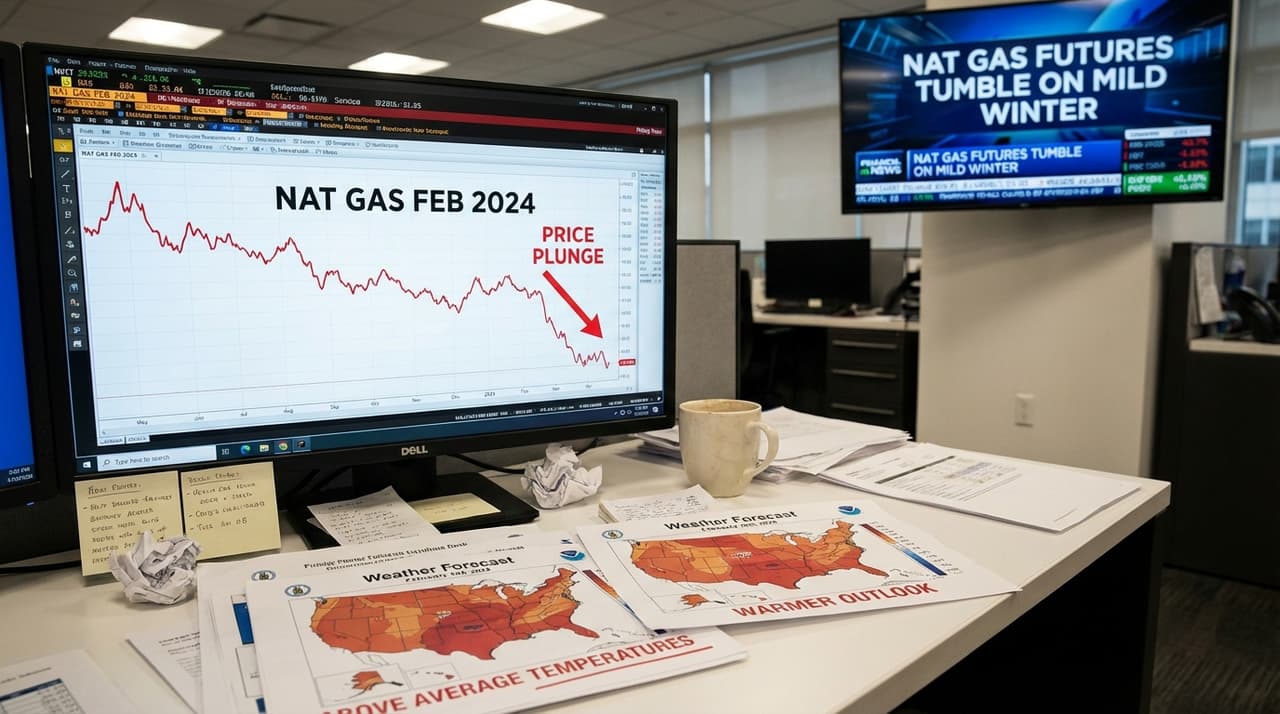
- Natural gas prices have plummeted more than 20% to a two-week low as forecasts shift to milder weather, reversing last week's dramatic surge driven by Arctic cold.
- The price collapse reflects reduced heating demand expectations, with the National Oceanic and Atmospheric Administration predicting warmer-than-usual conditions later in February.
- Market volatility highlights the weather-dependent nature of natural gas, benefiting stakeholders like Europe with lower LNG import costs as storage refill season begins.
Natural gas futures extended their sharp decline on Monday, with prices dropping over 20% to a two-week low as weather forecasts turned warmer, according to trading data. This marks a stark reversal from the previous week, when an Arctic cold blast sent prices soaring 117% over five days to $6.60 per million British thermal units at Henry Hub—the highest level in four years. In Asian trading, U.S. natural gas fell 17% to $3.62 per mmBtu, erasing much of the gains fueled by severe snowstorms and surging demand.
The price collapse stems from changing weather expectations that have caught traders off-guard. The National Oceanic and Atmospheric Administration forecasts warmer-than-usual conditions across parts of the United States later in February, reducing anticipated heating demand. This contrasts sharply with last week, when demand spiked to 128.7 billion cubic feet daily, exceeding the Friday production rate of 110 billion cubic feet. Efforts to balance the market have hit a snag, with one trader noting, 'The rapid shift in forecasts forced many to unwind positions quickly, amplifying the drop.'
Without sustained cold, the market faces pressure as supply disruptions ease. Last week's cold spell disrupted both supply and demand: gas deliveries to liquefied natural gas export plants fell by up to 48%, while heating demand surged, creating a sudden imbalance. This caught traders with short positions unprepared, forcing rapid coverage that accelerated the initial price spike. Now, the focus turns to storage levels, with EU storage at 41.13% and Germany's at 32.44%—significantly below the five-year average, according to recent reports.
The decline offers relief for Europe as it enters its gas storage refill season, with lower LNG import costs providing a buffer. In the U.S., long-term expectations remain relatively stable, but near-term volatility persists. The U.S. Energy Information Administration forecasts Henry Hub prices will average $3.38 per mmBtu for the first quarter of 2026, down from a previous forecast of $4.35/MMBtu. For 2026 overall, prices are expected to average just under $3.50 per mmBtu—a 2% decrease from 2025, according to people familiar with the projections.
Looking ahead, natural gas prices are projected to rise in 2027 as demand outpaces supply growth. The EIA forecasts a 33% increase to an average of $4.60 per mmBtu, driven by expanding LNG export capacity—with three new facilities ramping up operations—and increased consumption for electricity generation. Production is also increasing but at a slower pace, with U.S. dry natural gas output expected to grow 1% in 2026, led by the Permian region. Attempts to reach major producers for comment were unsuccessful, but industry sources suggest the market remains sensitive to short-term weather shifts amid these longer-term trends.