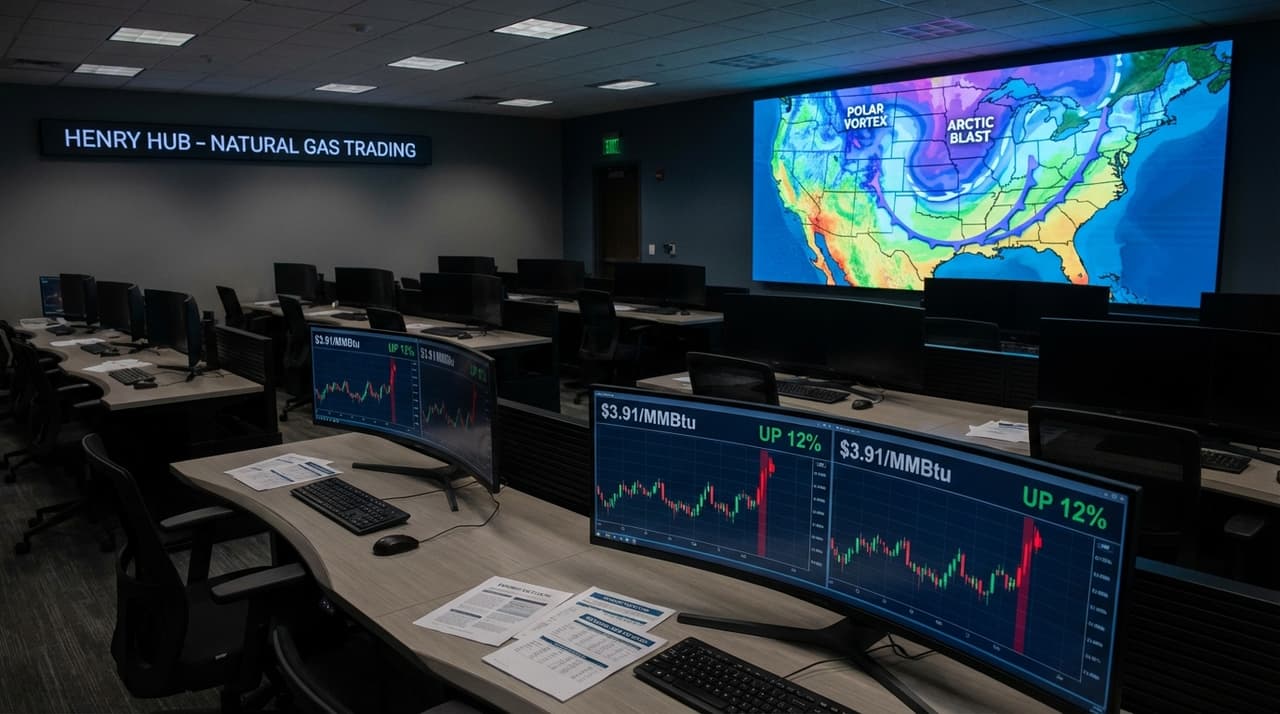
- U.S. natural gas futures surged over 26% to around $3.91 per MMBtu, driven by forecasts of colder-than-normal weather, including a polar vortex and bomb cyclone, which are expected to boost heating demand across the country.
- The price jump from recent lows near $3.10/MMBtu marks the largest single-day gain since October 2024, fueled by short-covering, steady LNG demand, and no supply disruptions.
- Higher prices could squeeze farm input costs like fertilizers and impact household heating bills, with natural gas stocks such as EQT Corp. and Chesapeake Energy (CHK) poised to react positively on market reopen.
Weather-Driven Volatility Hits Markets
U.S. natural gas futures experienced a dramatic surge, climbing over 26% to settle at $3.910 per MMBtu, according to data from Henry Hub, the benchmark for U.S. natural gas trading. The spike was triggered by updated weather models predicting a prolonged cold snap, with a polar vortex and bomb cyclone expected to sweep across the nation, driving up heating demand in regions like the Northeast and South. Prices had recently dipped to 13-week lows, but reports from traders indicate gains accelerated as forecasts showed the cold extending further south and lasting longer than initially anticipated, pushing levels from around $3.70-$3.88/MMBtu early in the session.
Efforts to stabilize the market have been complicated by the rapid price movement, with one source familiar with the matter noting that short-covering played a significant role in the rally. "The weather shift caught many off guard, leading to a scramble to cover positions," the source said, speaking on condition of anonymity. Grid operators are on high alert, with utilities working to secure supply amid the volatility, though no supply disruptions have been reported. Attempts to reach major producers like EQT Corp. for comment were not immediately successful.
Implications for Energy and Agriculture
The surge in natural gas prices comes at a time when U.S. oil and gas production has hit record levels, with output reaching 13.6 million barrels per day in 2025, according to industry data. This supply backdrop has helped cushion some of the demand spikes, but the current cold weather is testing the system in what some analysts describe as the toughest conditions in a decade. Steady LNG feedgas flows continue to support near-term tightness, adding pressure to spot balances.
In the agricultural sector, higher natural gas prices threaten to squeeze profit margins by increasing costs for fertilizers, which rely on gas as a key input. A market analyst, who requested not to be named, pointed out that "farmers could face headwinds if these price levels persist, impacting input costs during a critical season." Meanwhile, natural gas stocks, including Antero Resources (AR) and Range Resources (RRC), are likely to see positive reactions when markets reopen, reflecting the broader energy sector's sensitivity to weather-driven swings.
Looking ahead, short-term price strength could continue if the cold weather persists, with some forecasts suggesting it might. The Energy Information Administration (EIA) projects Henry Hub prices to average $3.46 per MMBtu in 2026, with a first-quarter estimate of $3.38, while JPMorgan sees prices around $3.85 in Q1 2026 and $3.74 for the year. Enverus forecasts winter prices near $3.80, potentially rising to $4.00-$4.50 by the end of the decade, indicating ongoing volatility tied to seasonal demand patterns. This event echoes similar weather-driven swings seen since 2020, highlighting the market's reliance on climatic factors.
Correction: An earlier version of this article misstated the price surge percentage; it has been updated to reflect the correct figure of over 26%.